

How Israel Moved the 'Yellow Line' Deep into a Devastated Neighborhood in Gaza
SadaNews - Satellite images captured and examined by Reuters, along with testimonies from residents, show that Israel destroyed dozens of buildings and displaced Palestinians in violation of the U.S.-backed ceasefire agreement in Gaza when it moved blocks marking the boundary established by the agreement with Hamas deep into a neighborhood of the city in December.
Satellite images show that Israel placed concrete blocks intended to demarcate the "yellow line" in areas throughout Gaza, located dozens or sometimes hundreds of meters inside the territories controlled by Hamas, and that its army also established at least six fortifications for its forces.
The images also illustrate how Israel unilaterally altered its control line in Gaza, encircling more land where Palestinians could reside, even as U.S. President Donald Trump pushes forward with a plan to end the war in Gaza that calls for the withdrawal of Israeli forces from more locations.
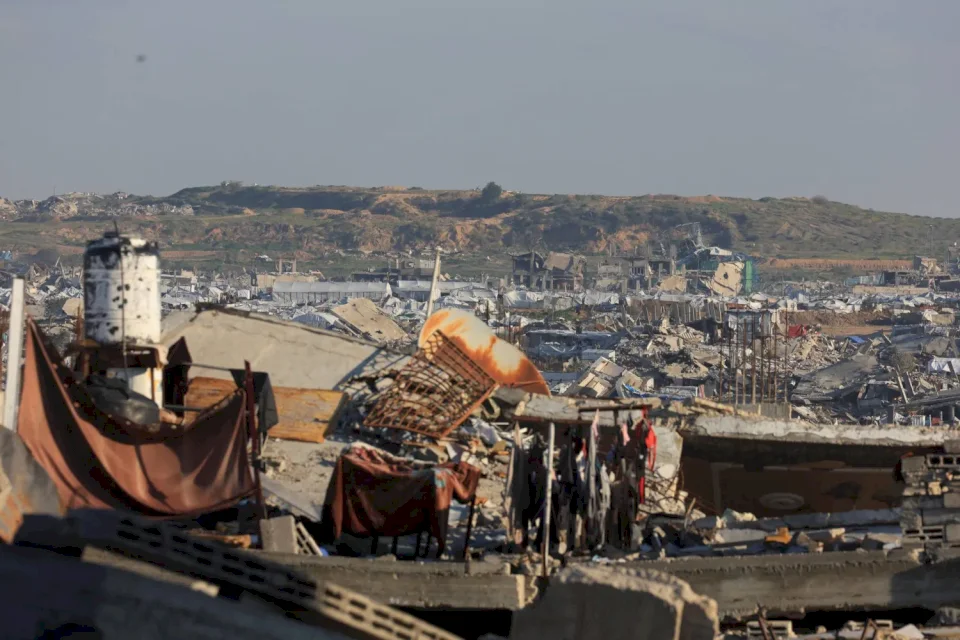
The expanding area of Israeli control is particularly evident in the Al-Tuffah neighborhood, once a historic area in Gaza City, which has now become a barren land scattered with destroyed buildings and metal debris as a result of Israeli bombardment over the past two years.
Thousands of Palestinians sought refuge in the Al-Tuffah neighborhood after the ceasefire took effect in October, which was supposed to witness the withdrawal of Israeli forces back to the yellow line designated on military maps, which extends nearly the entire length of the Gaza Strip and borders the eastern edge of the neighborhood.
However, satellite images of the Al-Tuffah neighborhood taken on December 2 and 13 show that Israel initially placed blocks on the Hamas-controlled side of the yellow line and then moved them about 200 meters inland.
Reuters' analysis of the images indicates that after moving the yellow-painted blocks, the Israeli army began leveling the area, destroying at least 40 buildings. Now, little remains of the existing buildings between the newly placed blocks and the yellow line.
It is unclear how Israel demolished the buildings, but it has previously used a combination of aerial bombardment, controlled explosions, and bulldozers.
The Israeli army stated that it is looking into Reuters' inquiries about why the blocks were moved and the buildings destroyed. It added that it continues its operations against Hamas since the ceasefire took effect, which includes targeting the movement's tunnel network in Gaza.
A military source said it was not possible to precisely define the yellow line as shown on maps due to obstructions from homes, buildings, or other structures. The source described the drawings of the yellow line published by the army and the Trump administration as "illustrative. "
Trump's plan to end the war in Gaza, consisting of 20 items, calls for an immediate cessation of hostilities, stating that "all military operations, including aerial and artillery bombardments, will be suspended, and the lines of conflict will remain frozen until the conditions for complete phased withdrawal are met.".
Forced to Leave
Manal Abu Al-Kass is one of many Palestinians who say they were forced to flee from the eastern part of the Al-Tuffah neighborhood after Israel moved the blocks.
Manal and her husband stated that two of their children were killed and buried in Al-Tuffah neighborhood alongside other relatives. She added that the family had been living happily in their home until "they placed this yellow stone and we had to leave against our will." She relocated with her husband and another son, both of whom had a leg amputated.
She mentioned that the Israeli army moved the blocks in mid-December, and they decided to flee in January, adding: "If it weren’t for the shells falling on our homes, we wouldn’t have left our house."
Far from the Al-Tuffah neighborhood, satellite images show that Israel placed blocks in areas controlled by Hamas throughout the Gaza Strip.
In Khan Younis, south of the sector, images show that in December, the army placed a block about 390 meters behind the line and another about 220 meters behind it.
The images indicate that during that period, many buildings were destroyed and two tent encampments designated to house the displaced were dismantled.
The images also show that the Israeli army established at least six large fortifications, all on the Israeli side within 700 meters of the control line. One of these, in Beit Hanoun in northern Gaza, is located about 264 meters from the line.
The army stated that it is looking into Reuters' questions regarding Khan Younis and about the fortifications. A military source said that these fortifications, mostly made of clay and earth, are temporary in nature and aim to protect the forces from incoming fire.
Trapped in a Narrow Strip
Hazem Qassem, a spokesperson for Hamas, stated: "The occupation continues to push the yellow line westward; this is a clear and significant violation of the wartime agreement concerning the Gaza Strip."
Qassem added: "This also means that all the people of the Gaza Strip will be trapped in a narrow strip west of Gaza, in an area that is 30% less than the area of the strip."
The U.S.-backed agreement calls for a complete ceasefire while allowing Israel to control more than half of the Gaza Strip, linking the withdrawal of troops from more land to the disarmament of Hamas. On Thursday, Trump announced a "Peace Council" following last week's announcement of the Palestinian technocrat committee to manage the sector in an attempt to move the agreement to its next stage.
Nearly all of Gaza's two million inhabitants have been forced to flee to a narrow coastal strip controlled by Hamas, where most live in tents or damaged buildings. Officials have expressed concerns about a de facto division of the strip, with reconstruction likely confined to areas under Israeli control.
Israel has repeatedly fired on people in the areas surrounding the yellow line since the ceasefire agreement was signed in October, often accusing armed individuals of attempting to cross the line or attack the forces.
In the Al-Tuffah neighborhood, videos captured on January 1, verified by Reuters, show Israel flying quadcopter drones or small drones over buildings about 500 meters inside the yellow line while patrolling the area. The army had no comment on its use of quadcopter drones.
Paramedics in Gaza reported that over 460 Palestinians, including many children, were killed by Israel since the October agreement took effect, while armed individuals killed three Israeli soldiers. Both sides have exchanged accusations of violating the ceasefire.
Israel waged its war on Gaza following a cross-border attack led by Hamas on October 7, 2023, which, according to Israeli statistics, resulted in the deaths of 1,200 people. Health authorities in Gaza state that the Israeli war resulted in the deaths of 71,000 Palestinians.
 Follow the latest Sada News via Google News
High-level sources reveal to SadaNews: Washington seeks to hold a Gaza Reconstruction Conf...

Iraqji Reveals Details of the Attack on the Iranian Supreme Leader's Headquarters

صراع على إرث خامنئي وسط غياب مجتبى.. والمتشددون يتهمون قادة إيران بـ«الانقلاب»

The European Union Reiterates Its Call for Israel to Refrain from Expanding Settlements in...

"Mamdani Berlin".. The German Left Bets on a Politician of Turkish Descent to Lead the Cap...

Hebrew Channel: Kushner Pushing to Enhance Communication Between the United States and the...

SadaNews Report: Israeli Elections with a Settlement Flavor!
