

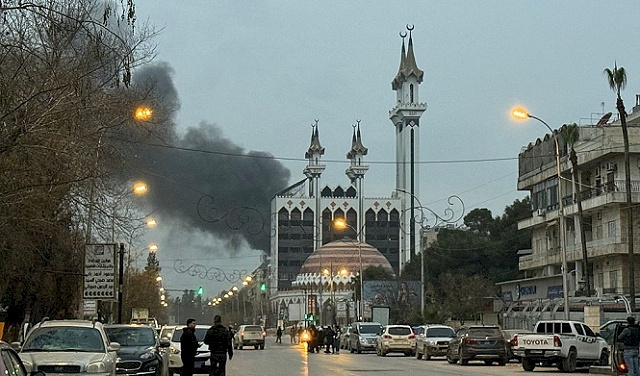
Syria: Curfew Imposed in a Neighborhood in Aleppo Ahead of Bombing Sites of "SDF" Amid Their Refusal to Withdraw
SadaNews - On Friday, the Syrian army announced that it would resume bombing sites in a neighborhood in Aleppo that it claimed were being used for military purposes, following the refusal of the Syrian Democratic Forces (SDF) to withdraw from the city, despite the authorities announcing a ceasefire there.
Deadly clashes erupted on Tuesday in the Sheikh Maqsoud and Ashrafiyeh neighborhoods in Aleppo between government forces and the SDF, resulting in 21 fatalities, with both sides exchanging accusations of instigating the violence. These developments come against the backdrop of stalled negotiations between the two parties since the signing of an agreement in March that aimed to integrate Kurdish autonomous administration institutions within the structure of the Syrian state.
The Syrian Ministry of Defense announced early Friday a ceasefire in the two neighborhoods, calling on SDF fighters to evacuate them in preparation for their relocation to the Kurdish autonomous areas in northeastern Syria.
However, the fighters refused and asserted that they would continue to "defend" their areas. The SDF stated that "the call made by the temporary Damascus government forces to our people and our security forces is a call to surrender, yet our people in these neighborhoods are determined to remain in their neighborhoods and defend them."
Hours later, the official SANA agency published maps prepared by the army of sites in the Sheikh Maqsoud neighborhood that they intend to "target," urging residents to "evacuate immediately," and accusing the SDF of using them as "a military site to bombard neighborhoods and residents of Aleppo. "
The army announced a curfew in the neighborhood starting from 6:30 PM according to SANA, which was the time the deadline to open a corridor for civilians to exit Sheikh Maqsoud ended.
Near the Sheikh Maqsoud neighborhood, several residents were seen exiting under the rain. The ongoing fighting has forced at least 30,000 families to flee so far, according to the United Nations.
At the same time, Syrian state television reported, citing a military source, that SDF had targeted "several civilian and security sites in Aleppo" using "Iranian-made drones."
For its part, the security forces affiliated with the SDF in Aleppo stated that the Sheikh Maqsoud neighborhood is facing "intense and heavy bombardment from factions and militias associated with the Damascus government."
"Gratitude"
The city experienced a brief calm on Friday morning after the announcement of the ceasefire, which was welcomed by the United States.
Elham Ahmed, an official in the Kurdish autonomous administration, confirmed in a statement on Friday that the administration is committed to the agreement with the Syrian authorities, accusing the "government side" of trying to terminate it by attacking areas with a Kurdish majority in Aleppo.
She noted the existence of "intermittent and slow communication" with the government, asserting that the reason was that the "temporary government side has chosen the path of war."
She also indicated that the United States is "playing the role of mediator" between the autonomous administration and the government, adding that "their efforts are appreciated and we hope they will exert pressure to reach understandings."
A diplomatic source reported on Friday that U.S. envoy Thomas Barak is on his way to Damascus.
According to Ninar Hoosh from the International Crisis Group, "the battles in Aleppo have become a test for the already weak framework of integration between Damascus and the Syrian Democratic Forces."
He noted that the battles in Aleppo reflect "the shift to military pressure and moving away from technical negotiation towards more coercive forms of influence."
For months, both sides have exchanged accusations of undermining efforts to implement the March agreement, which was supposed to conclude its provisions by the end of 2025, but differing perspectives have prevented progress, despite pressures led by Washington, which primarily supports both sides.
Regional Competition
The battles in Aleppo have raised concerns that the conflict could take on a regional dimension, prompting Ankara to reaffirm its readiness to support Damascus if requested, while Israel condemned the attacks on the "Kurdish minority."
Both Turkey and Israel have become involved in these battles.
Turkey welcomed the Syrian military operation against the SDF in Aleppo on Friday. Turkish Defense Minister Yasar Guler stated, "We welcome this operation that targets all terrorist groups. I would like to emphasize that we see that Syria's security is our security, and we support Syria's fight against terrorist organizations."
French President Emmanuel Macron, for his part, called on his Syrian counterpart to "exercise restraint," according to a statement from the French foreign ministry.
The statement added that "France continues its efforts to facilitate dialogue between the transitional Syrian authorities and the Syrian Democratic Forces in coordination with the United States and reiterates its commitment to the full implementation of the March 10 agreement."
The Syrian Democratic Forces (SDF) control vast areas in northern and eastern Syria, which include the main oil and gas fields. They have served as the spearhead in fighting the terrorist organization "ISIS" and managed to defeat it from its last strongholds in the country in 2019 with support from the U.S.-led international coalition.
Following the ousting of Bashar al-Assad's regime, the Kurdish autonomous administration showed flexibility toward the new authority and raised the Syrian flag in its areas. However, its insistence on a decentralized governance system and the recognition of their rights in the constitution has not received a receptive ear in Damascus.
 Follow the latest Sada News via Google News
Morocco Hosts Formative Exercise for International Stabilization Force in Gaza

Sheikh Holds Meeting with Security Leaders to Follow Up on Current Developments

Hebrew Channels: The Likelihood of Israel's Participation in the Attack on Iran is Increas...

Netherlands Sets September Deadline for Ban on Settlement Products

12 Martyrs in Gaza Strip since Dawn Today

A Series of Important Decisions Taken.. The Cabinet Discusses Developments in the Deterior...

Organizations of the Temple Prepare for the Largest Raid on Al-Aqsa on What is Called the...
