

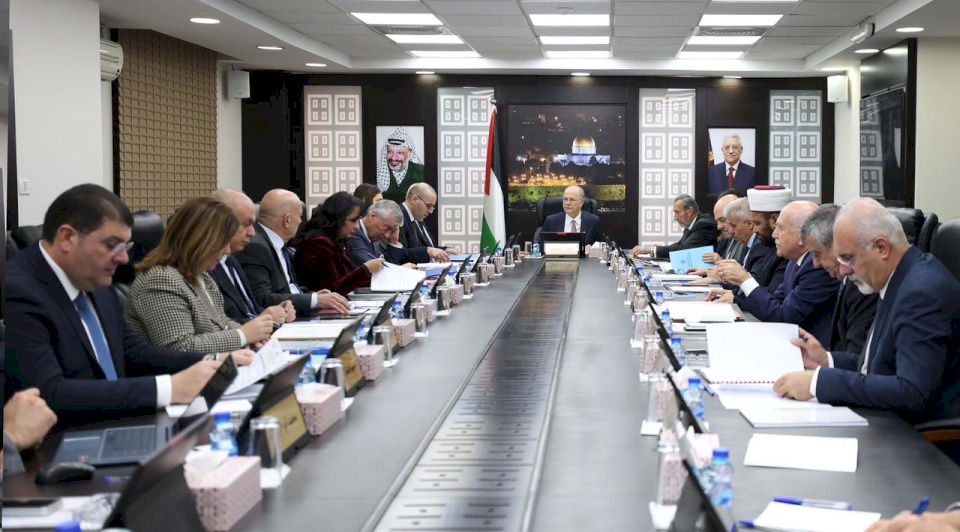
Mustafa directs various government institutions to utilize all their relief capabilities in the Gaza Strip
SadaNews - Prime Minister Dr. Muhammad Mustafa has directed various government institutions to mobilize all their relief capabilities for our people in the Gaza Strip, and to provide whatever contributions possible through the government operations room and international partners, despite the restrictions and obstacles imposed by the occupation on the entry of relief and economic recovery needs.
Furthermore, the Cabinet warned in its weekly session today, Tuesday, against the manipulation by influential parties within the Gaza Strip regarding the registry of private and public lands and attempts to transfer ownership illegally, under the threat of legal accountability. It reaffirmed that the Land Authority in the State of Palestine maintains copies of land records in the sector at its headquarters in Ramallah, which will, in turn, review any papers, documents, or processes related to ownership transfers in Gaza as soon as it is able to operate in the sector. Any transactions or processes related to ownership transfers will be deemed illegal, invalid, and lacking legal effect, thus necessitating legal accountability.
Accordingly, the Cabinet directed the Land Authority and various official Palestinian institutions, including embassies, to conduct further review and verification of any papers or ownership transfer transactions to safeguard citizens' rights.
The council also warned of the rising pace of illegal trade that exploits the suffering of people, especially as the Israeli occupation controls the entry of goods through a limited number of traders. It emphasized the necessity of obligating the occupation to adhere to signed international agreements, calling on the international community to exert real and effective pressure to lift the restrictions imposed on the entry of humanitarian aid and goods into the Gaza Strip, as the continuation of these restrictions exposes civilians, particularly women and children, to severe humanitarian risks and deepens the ongoing humanitarian catastrophe.
The council demanded that the international community not be satisfied with statements of condemnation and expedite the adoption of practical steps to implement international law and international legitimacy resolutions, and to put an end to settlement policies in light of the increasing demolition orders in the West Bank and Jerusalem, the crimes of settlers, and the Israeli occupation authorities' approval of establishing 19 new settlements in the occupied West Bank, raising the number of settlements approved in the last three years to 69, in a serious escalation that undermines peace prospects and directly targets the two-state solution.
The council also followed up on the Ministry of Agriculture's preparations in light of reports from the World Organization for Animal Health about the widespread emergence of a new mutated strain of foot-and-mouth disease in some neighboring countries and its serious effects on cattle and livestock. The ministry is working to obtain vaccines amidst rising global demand and limited availability, and it will regularly monitor the epidemiological situation and disseminate guidance information to livestock breeders.
In addition, the Cabinet approved the national energy efficiency plan, which includes numerous steps and procedures to increase the efficiency of energy use in homes, buildings, and institutions, using energy efficiency solutions such as control systems, smart meter installation, energy-saving lighting, insulation, and solar heaters. This plan aims to improve legislation to reduce electrical consumption by 7.9% by the year 2030, which will lead to an annual saving of $120 million upon its completion.
Moreover, the council reviewed the policy for classifying government data, contributing to data protection and strengthening the digital security of governmental institutions, as classifying this data is a fundamental requirement for enacting the Right to Information Law, the final draft of which is being prepared before submission to the Cabinet.
It also discussed, for the first reading, a draft law amending Law No. 37 of 2021 concerning communications and information technology and its amendments, which includes aligning legislation with the government's plans to complete the implementation of the digital transformation initiative.
Additionally, it discussed, for the first reading, the electronic commerce registry system in Palestine, which contributes to establishing and organizing the register, managing the procedures for registering electronic stores, and mechanisms for receiving complaints.
Furthermore, the Cabinet approved the assignment of the Minister of Transport and Communications to chair the permanent ministerial reform committee.
 Follow the latest Sada News via Google News
Washington Investigates Possible Russian Role in Iranian Attacks on Its Sites

Mossad Chief Visited Washington to Discuss Iran and Its Nuclear Program

Report: Washington Informed Israel It Is Preparing to Intensify Attacks on Iran and Use St...

Organization of Islamic Cooperation Condemns Nauru's Decision to Open an Embassy in Occupi...

Video:: Nablus: Settlers Evict Tubasi Family from Their Home in Jaloud and Take Over It

Netanyahu: I Intend to Form a Broad National Unity Government

Syrian Foreign Minister Meets with Yasser Abbas in Damascus
