

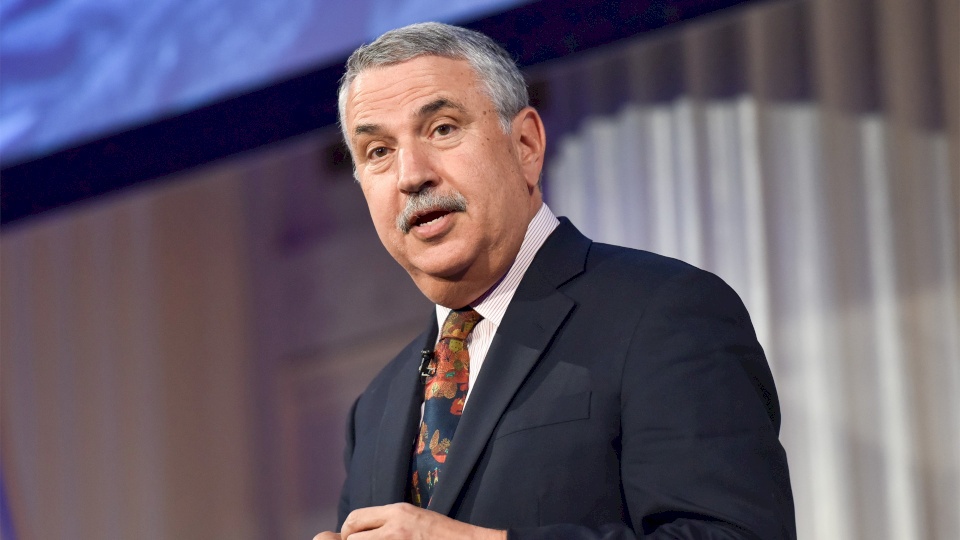
Thomas Friedman: Putin Manipulates American Envoys Like a Skilled Flutist
SadaNews - American journalist and prominent writer Thomas Friedman has sharply criticized the approach of President Donald Trump and his envoys to Russia, Steve Witkoff and Jared Kushner, regarding the handling of the Ukrainian war.
In an article in the New York Times, he asserted that the problem lies not in their intentions but in their ignorance of the nature of the conflict, as they treat it as if it were a major real estate deal, which makes them, in his view, "useful idiots" exploited by Russian President Vladimir Putin, referencing the term that Russian communists used to describe foreigners exploited to serve the strategies of their enemies.
Lost Influence
The American writer believes that Putin does not act like a real estate broker but rather as a territorial expansionist leader akin to Nazi German leader Adolf Hitler in Poland, and that his goal in invading Ukraine is not development or profit, but to achieve a historical illusion.
He states that this context makes the presence of negotiators with real estate backgrounds a burden on the United States rather than an advantage, as they fail to understand that war and peace are not a positive-sum game, but a zero-sum struggle between democratic values and fascist aggression.
Friedman adds that in such cases, America needs a statesman of the caliber of late Secretary of State Henry Kissinger or his contemporary James Baker, who understands the difference between real estate and issues of war and peace.
He recalls that previous American presidents, most notably Ronald Reagan, understood that any settlement with an "aggressive" power should start from protecting the values and strategic interests of the United States and its allies, not from a transactional mindset.
Thus, Trump's behavior, according to the article, represents one of the most shameful episodes in American foreign policy, as he acts as a neutral mediator seeking gains from both sides, instead of supporting Ukrainian democracy and confronting Russian aggression.
The writer notes that some isolationist voices within the Republican Party, such as the faction led by J.D. Vance, accuse proponents of supporting Ukraine of wanting endless wars. However, he clarifies that since the beginning of the war, he anticipated that it would end with a "dirty" settlement that does not give Ukraine everything it aspires to.
However, the writer distinguishes between a "dirty deal" that protects the interests of Ukraine and the West, and another "disgusting" one that gives Putin the ability to reignite the war whenever he wishes.
He sees that the reason behind the weakness of American influence is the lack of a clear policy-making process and President Trump's fluctuating stance.
The article explains that influence in diplomacy is not measured only by money but also by the military power that can be brought to bear, and the economic isolation that can be inflicted on the opponent. Most importantly, it involves turning the opponent's populace against their leadership.
Trump Weakens America
The article criticizes Trump for what it deems "disabling" the United States' ability to exercise its influence, as he halted military funding for Ukraine and prevented the provision of advanced weapons such as Tomahawk missiles, promoting a "false" narrative that views Ukraine as the aggressor.
Furthermore, Trump sent a message of "humiliation" to Ukrainian President Volodymyr Zelensky by stating that he holds no "negotiation papers" without Washington's backing.
The writer believes that a "normal" American president would have worked for the benefit of his country, exerting pressure on Putin by strengthening Ukraine's negotiating position and undermining Russia's stance by targeting its public opinion.
He questions: What if Trump had acted like a dignified American president based on American interests and values?
He answers the question by stating that Trump would not have told the "brave" Ukrainians that they have no cards; instead, he would have provided them with the cards to maximize their influence while loudly telling the Russian people that their future is uncertain because Putin "stole all their cards."
On another note, the article describes Putin as a "delusional fool," emphasizing that he will be remembered in history for his war against Ukraine, which has made Russia an energy colony of China and a marginal small state.
The writer supports his claims by pointing to Russia's position in the technological revolution, where it ranks 28th globally, behind Luxembourg in the Stanford Institute’s global ranking of AI vitality. He attributes this to the Russian president's waste of his country's human resources in a "futile" war with no prospects.
 Follow the latest Sada News via Google News
12 Martyrs in Gaza Strip since Dawn Today

A Series of Important Decisions Taken.. The Cabinet Discusses Developments in the Deterior...

Organizations of the Temple Prepare for the Largest Raid on Al-Aqsa on What is Called the...

Smotrich: Israel Has No Interest in Joining the War Against Iran

Occupation Issues Military Order to Seize 5 Dunams of Land in Jaba'

Axios: Proposal for a 10-day Ceasefire Between Washington and Tehran and Two Options for M...

In a Rapid Pace.. The Occupation Builds a Huge Earth Barrier Inside Gaza
