

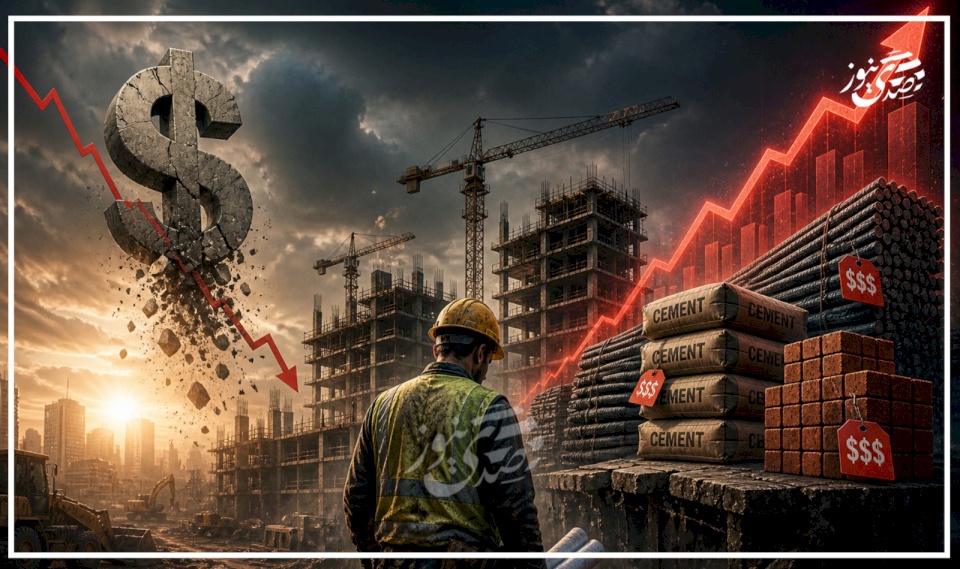
The Decline of the Dollar and Rising Material Costs Pressure the Construction Sector
Special to SadaNews: The emergency budget announced by the government for the current year 2026, based on cash flows, shows that total expenditures (excluding net lending and public debt servicing) will reach 17.7 billion shekels, which is approximately 1.21 billion shekels lower than the national reform program amounting to about 19.12 billion shekels, reflecting measures to control expenditures and implement austerity steps.
The emergency budget assumes institutional continuity and the provision of a minimum level of essential services amid severe financial constraints. The allocations in the draft budget law represent the minimum necessary for the existence of international institutions, and commitments and spending from the allocations are contingent on the availability of financial liquidity, and are not necessarily a governmental obligation towards financial responsibility centers.
Compensation for employees in this budget is estimated at about 9.4 billion shekels, constituting 51% of total current expenditures. Preemptive measures have been taken to contain the growth of the salary bill and the number of employees during the year 2026. Meanwhile, the salary bill and similar salaries represent 66% of current expenditures, 78% of net revenues, and 71% of the budget for responsibility centers, reflecting the rigid structure of current spending.
According to the budget, total government support allocated for fuel, electricity, and water support, whether for camps or tariff differences, exceeds 1.3 billion shekels. The budget includes a 44% reduction in travel expenses compared to last year.
In 2024, actual revenues amounted to about 14.57 billion shekels, while expenditures reached about 19.36 billion shekels, resulting in a deficit nearing 5 billion shekels. In 2025, revenues were approximately 15.28 billion shekels and total expenditures were about 18.83 billion shekels, with a deficit of about 3.55 billion shekels.
However, these numbers remained captive to the seizure of clearance funds, which constitute about 67% of total revenues, while local revenues accounted for only 33% of revenues.
Current expenditures constituted 95% of total spending during 2025, leaving only 5% for developmental expenditures.
Data from the budget reveal that external support for the budget rose from 1.3 billion shekels in 2023 to 3 billion shekels in 2024, then to 3.2 billion shekels in 2025, reflecting an exceptional leap in 2024 followed by a more moderate growth rate. The increase was primarily focused on financing the current budget, while funding for the developmental budget remained almost stable, indicating that most of the support was directed towards covering operational expenses.
The 2026 budget anticipates that the deficit before grants will reach about 3.78 billion shekels, accounting for 6% of the GDP, while the deficit after grants will amount to about 1.30 billion shekels, or 2% of GDP. If the seized clearance funds are not transferred, the net cash deficit could reach 11.86 billion shekels, equivalent to 18.9% of GDP.
Public finance expert Moyad Afana told "SadaNews" that the context for preparing the 2026 budget as a realistic emergency budget based on available cash flows came in response to the emergency situation in Palestine due to the Israeli economic stranglehold, which has locked up all clearance revenues since May 2025, depriving the general budget of 68% of its estimated revenues, in addition to the overall decline of the Palestinian economy due to the Israeli extermination war on the Gaza Strip, the suffocating economic siege in the West Bank, and various measures including the zeroing out of clearance revenues, preventing workers from returning to their jobs inside the Green Line, and cutting up the West Bank with hundreds of gates and checkpoints and more.
Afana confirms that it was not possible to adopt a classical budget under these circumstances, thus necessitating a move towards an emergency budget based on available cash flows that enhances the resilience of the Palestinian citizen and focuses on ensuring institutional continuity and securing the minimum of essential services amid severe financial constraints.
Afana believes that the 2026 budget has brought forth several positive and necessary issues, including strict reduction and rationalization of operational expenditures, including travel tasks, halting developmental expenditures from the general treasury, and prioritizing the continuity of services in the education, health, security, and social protection sectors. Among the positive issues is also the increase of the emergency budget to respond to emergencies, especially in areas subjected to occupation measures and settler violence, in addition to the continuation of government support for marginalized groups, and maintaining support for fuel, electricity, and water.
However, Afana points out that the general budget for 2026 faces fundamental challenges in revenue availability, especially regarding the continuation of salary payments and covering basic operational expenses, particularly for sectors like health, as they rely heavily on local revenues and limited external support. Therefore, a comprehensive national strategy must be devised based on intensive international pressure to release clearance revenues, securing urgent Arab and international support for the budget through the emergency fund announced by France and Saudi Arabia in September of last year, in addition to enhancing national products to provide additional local revenues, rationalizing public spending, and enhancing tax collection without imposing additional burdens on citizens.
 Follow the latest Sada News via Google News
Soaring Oil Prices Burn the Pockets of the Palestinian Citizen "The Poor"

Millions of Dollars in Losses.. "SadaNews" Reveals Shocking Figures for Traders from Pales...

The Problem of Shekel Overcrowding Worsens.. Fuel Station Owners Threatened with Closure o...

The Palestinian Economy at a Crossroads: 4 Files Awaiting Resolution

Currency Exchange Rates Against the Shekel (July 3)

Israeli Discussions Explore Ways to Tackle Rising Crime Against Banks and Their Employees

Bringing in New Foreign Workers to Israel Instead of Palestinians
