

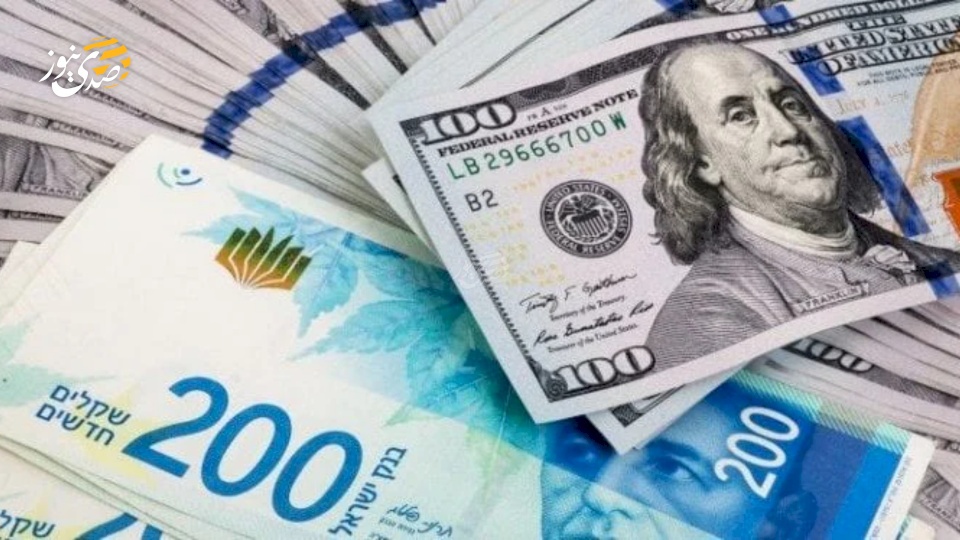
Hebrew Report: War with Iran Puts the Dollar Before Four Possible Scenarios
SadaNews - Professor Leo Leiderman, head of the IREES research institute at the "Peres" academic center, believes that a single event could push the dollar to a level approaching two shekels per dollar, which is the fall of the regime in Iran.
According to Sada's economic translation, Leiderman stated that this scenario would lead to massive capital inflows into Israel, a sharp decrease in risk premium, alongside regional economic prosperity and unprecedented large-scale investments.
These estimates are surprising, as they imply a significant additional increase in the value of the shekel, which is already considered strong at the current stage, with the dollar currently trading at around 3.13 shekels, close to its historical highs, as translated by Sada's economics.
For his part, Matan Shtrit, chief economist at "Phoenix", pointed out that a simplified model presented by the Bank of Israel months ago, which shows a relationship between the rise of the S&P 500 index and the strength of the shekel, indicates that the Israeli currency should currently be trading at a higher level of around 2.95 shekels to the dollar.
In an interview with "Globes", Leiderman emphasized, according to Sada's economics translation, that there are no "sacred limits" to the exchange rate, explaining that previous estimates that suggested a floor for the dollar's decline at 3.3 or 3.2 shekels are no longer valid. He added that a radical change in the regional reality, such as the fall of the Iranian regime, could push the shekel below the level of 3 shekels in a short time, and possibly to the range of two shekels.
He pointed out that such a development could lead to a flourishing of financial markets, a rise in the stock market, a decrease in bond yields, and a reduction in the risk premium associated with the Israeli economy.
Leiderman also noted another scenario that could lead to similar results, which involves Saudi Arabia joining the "Abraham Accords", considering that such a step would reflect a significant reduction in geopolitical risks in Israel and the region generally, potentially enhancing both financial and real investments significantly.
Ronen Menahem, chief economist at "Mizrahi Tefahot Bank", agrees that the shekel may continue to rise, but he sees the scenario of it reaching two shekels against the dollar as extreme. According to Sada's economics translation, he stated that part of the regime change scenario in Iran is "already priced in" to the exchange rate and the stock market, as mentioned in Sada's economics translation.
However, Menahem acknowledges that the fall of the Iranian regime would reduce the level of uncertainty surrounding Iran and its proxies, emphasizing that a decline in security threats favors the shekel. He also pointed out that this scenario could give a strong impetus to regional peace processes and the expansion of the Abraham Accords, enhancing the shekel's standing against the dollar.
No Attack on Iran
The second scenario, according to the translation, involves no attacks being carried out and a return of the parties to the negotiating table regarding the nuclear agreement. According to Sada's economics translation, Menahem describes this scenario as moderate, as there could be a limited reduction in the level of Iranian threats, without causing a substantive change in the dollar's exchange rate against the shekel.
For his part, Itai Lipkovich, CEO and founder of "Horizon", views the scenario of procrastination as the most negative, as it would allow Iran to continue developing its missile capabilities and rebuilding previously damaged capabilities, keeping markets pricing in the possibility of a future conflict.
He added, according to Sada's economics translation, that this situation could last for a year, noting that the deployment of U.S. forces in the region does not necessarily mean their use, especially with the upcoming U.S. elections, which might lead Washington to settle for a limited "symbolic" strike, in which case the dollar would not drop below the level of three shekels.
Short-Term War Against Iran
The third scenario involves a quick and short war. Menahem believes that such a limited confrontation could lead markets to conclude a reduction in risk levels and a lower probability of another war, which may reflect positively on the shekel, albeit relatively limited.
As for Lipkovich, he considers this scenario positive, explaining that despite the likelihood of the dollar rising and markets declining in the short term, stability could return within two to three weeks. According to Sada's economics translation, he stated that damaging Iranian capabilities, even without overthrowing the regime, could reduce the risk premium and attract foreign investors, enhancing the value of the shekel and the stock market.
Long War with Iran
The fourth and most negative scenario involves a long and complicated war against Iran and its proxies. According to Menahem, this scenario could damage GDP, sustain the activities of the Houthis, and perhaps make the United States reconsider its level of engagement in the region, which could lead to a decline in the value of the shekel against the dollar.
Leiderman believes, according to Sada's economics translation, that any outcome that does not end with the fall of the Iranian regime will keep the situation close to the existing one, warning that the threat of Iran possessing nuclear capabilities continues. He added: "The most important question is what will happen the day after," citing the experience of Venezuela, where attempts to change the regime did not lead to a return of investments due to the previous regime's continued influence within state institutions.
 Follow the latest Sada News via Google News
Soaring Oil Prices Burn the Pockets of the Palestinian Citizen "The Poor"

Millions of Dollars in Losses.. "SadaNews" Reveals Shocking Figures for Traders from Pales...

The Problem of Shekel Overcrowding Worsens.. Fuel Station Owners Threatened with Closure o...

The Palestinian Economy at a Crossroads: 4 Files Awaiting Resolution

Inflation Expectations in Israel Stabilize at 1.5%

Ministry of Economy Announces the Opening of Import Application Submissions for Commodity...

Relative Stability of the Dollar Near 3.04 Shekels and Predictions of Returning Inflationa...
