

What France Would It Be If Marine Le Pen Reached the Élysée?
SadaNews - With the announcement of the leader of the far-right "National Rally" party, Marine Le Pen, to run in the French presidential elections scheduled for spring 2027, the race to the Élysée Palace has entered a new phase that may be the most sensitive in the history of the Fifth Republic. This decision not only opens the door to electoral competition but also sets a political and judicial precedent represented by a convicted candidate for embezzlement of public funds running a presidential campaign after the appeals court restored her eligibility to run.
In 2025, the Paris court convicted Le Pen of embezzling funds allocated by the European Parliament, sentencing her to four years in prison, one of which she would serve under house arrest with an electronic bracelet to monitor her location, in addition to a financial penalty and a five-year disqualification from running for public office. However, the appeals court reduced the disqualification to fifteen months, which it deemed fulfilled, emphasizing the need to preserve "the freedom of the voter to choose" and safeguard the democratic will, which returned Jean-Marie Le Pen's daughter back to the presidential race without clearing her tarnished legal record.
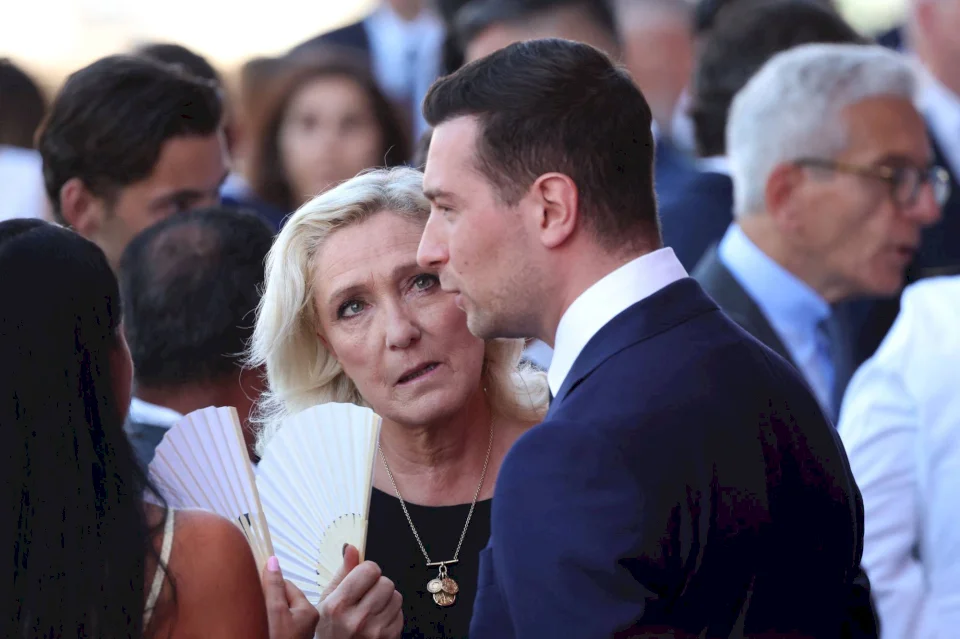
*Le Pen, Bardella, and Institutions
Polls indicate that any presidential candidate from the "National Rally" currently enjoys about 40 percent of voting intentions in the first round, making Le Pen the favorite to reach the second round, and possibly win the presidency if her opponents fail to unite behind a single candidate.
However, the significance of the judicial decision extends beyond the legal aspect; it encompasses the nature of the political discourse adopted by Le Pen, who hastened to declare her innocence and affirm her intention to appeal the ruling, presenting herself as a victim of the political and judicial system. Observers note that this rhetoric echoes the populist style established by former U.S. President Donald Trump. This approach involves questioning institutions when they issue undesirable rulings, portraying legal actions as political targeting, and transforming condemnation into evidence of "persecution" of a candidate who presents herself as representing the will of the people.
Analysts believe that this shift could alter the nature of the upcoming electoral campaign, as it is likely to focus more on attacking institutions and the judiciary than on political programs, which foreshadows further polarization in a French society suffering from increasing political and social divisions.
If Le Pen reaches the Élysée, she is expected to delegate the implementation of her strict domestic policies to Jordan Bardella, her young party president (30 years old), by appointing him as head of government.
Meanwhile, the centrist camp led by President Emmanuel Macron continues to experience a phase of weakness and fragmentation after ten years in power. The end of Macron's second term coincided with successive crises, from the Russian-Ukrainian war to transatlantic tensions, through economic slowdown and rising public discontent. So far, centrist forces have been unable to produce a figure capable of seriously competing with Le Pen, representing the greatest strength for the far-right leader.
*A President of Radical Change?
On the foreign policy front, Le Pen's presidency could represent a fundamental shift in France's orientations. While Macron has made enhancing the European Union and pushing for greater European independence in defense a cornerstone of his policy since his first term, and added support for Ukraine in his second term, Le Pen adopts a more skeptical view of the European Union and seeks a radical change in its current structure. She calls for reducing the powers of EU institutions, notably the European Commission, and replacing the existing model with a loose alliance of sovereign states enjoying greater independence in decision-making. She also supports ending the Schengen Agreement and reinstating strict controls on national borders to limit immigration. Additionally, she seeks to significantly reduce France's financial contribution to the EU budget.
Le Pen calls for a reassessment of France's relationship with NATO, supporting Paris's withdrawal from the alliance's unified military command while maintaining its political membership. She believes this option enhances France's independence in military decision-making and grants Paris greater freedom to shape its defense policies, raising concerns among European allies about weakening France's role within NATO amid ongoing security challenges facing the continent.
At the same time, she opposes tightening sanctions on Russia and supports reducing military aid to Ukraine.
This potential shift’s impact is not limited to France; it extends to Europe as a whole, at a time when the continent faces unprecedented security challenges due to the war in Ukraine, the return of Donald Trump to the White House, and ongoing tensions in the Middle East. Thus, many European leaders view the upcoming French elections as a pivotal moment that could reshape power dynamics within the EU and NATO.
*What About Other Candidates?
The leader of the radical left ("La France Insoumise") Jean-Luc Mélenchon continues to prepare for his fourth presidential election, while others from the traditional right and center are expected to announce their candidacies in the coming months. However, the deep division within these factions gives the "National Rally" a clear advantage, especially amid growing public discontent with traditional parties that have failed to implement real reforms and lift the economy from its troubles.
In fact, no one expects Mélenchon to win the presidency, as his extreme rhetoric—which is no less populist than that of the "National Rally," albeit in the opposite direction—cannot reach right-wingers, centrists, or even traditional leftists like socialists.
While the candidacy landscape is unclear, what is certain is that the election campaign will be dominated by issues of the economy, rising living costs, immigration, security, and possibly climate change, alongside the debate over defense spending in light of current geopolitical challenges. Moreover, the judicial issues will remain a central focus, especially as Le Pen’s case itself has become part of the political battle.
Although France's electoral history has shown more than once the ability of traditional parties to form a "Republican front" to prevent the far-right from reaching the Élysée in the second round, the current circumstances appear different. The popularity of traditional parties has noticeably declined, while Le Pen has succeeded in expanding her electoral base and presenting herself as an alternative to the ruling political elite.
Thus, the 2027 elections do not seem merely a competition for the presidency of France but also a referendum on the future of the French Republic and its position within Europe and the world, at a moment where internal crises intersect with major geopolitical transformations, making the election outcome an event whose repercussions extend beyond French borders to the entire European continent, especially regarding the future of the EU and France's role within NATO...
Opponents of Marine Le Pen claim that "if she enters the Élysée, Marianne will weep," while her supporters assert that Marianne, the symbol of France since 1792, will regain her stature as a symbol of the Republic and its values.
 Follow the latest Sada News via Google News
The Death Toll from the Earthquakes in Venezuela Exceeds 5,000

What France Would It Be If Marine Le Pen Reached the Élysée?

Ukraine Expands Its Offensive and Strikes Moscow with 370 Drones

Aoun in Washington Amid Progress in Lebanon-Israel Talks

Trump Calls on Lynsey Graham's Sister to Run for Senate

Burnham Elected Leader of the British Labour Party in Preparation for Taking Over as Prime...

Germany's Foreign Minister Proposes Sending an EU Mission to Replace UN Forces in Lebanon
