

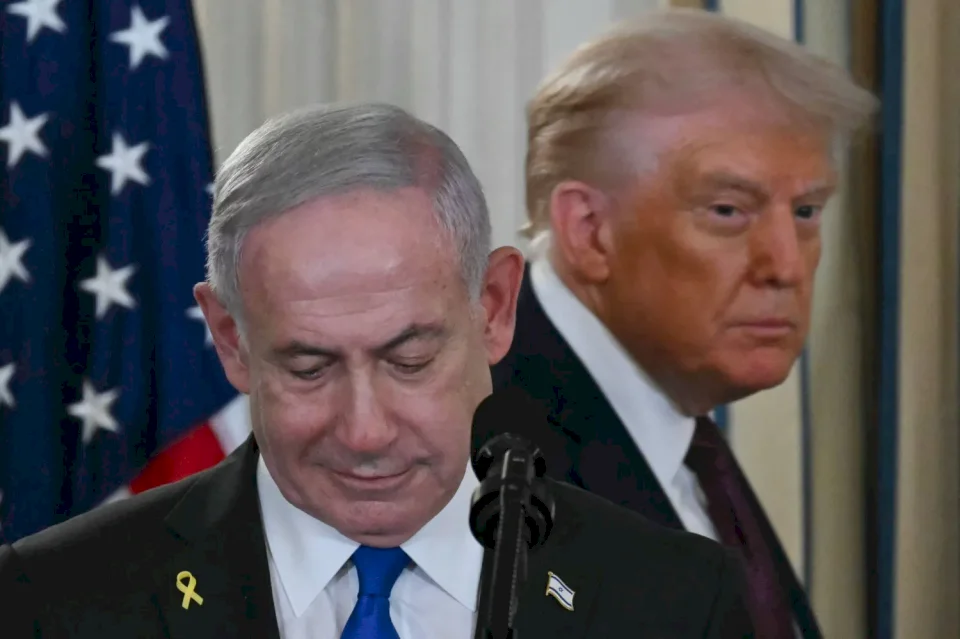
Postponement of Netanyahu's Visit to Washington Due to Announced American Anger Against Him
SadaNews - Political sources in Tel Aviv confirmed that the statement from Israeli Prime Minister Benjamin Netanyahu's office, which claimed that Netanyahu decided to postpone his visit to the United States, originally scheduled for next week, due to the postponement of the funeral for Republican Senator Lindsey Graham, who passed away earlier this week, is not truthful. The postponement has become a mutual desire of both the Israeli and American sides. Both parties do not want President Donald Trump to meet Netanyahu at the White House.
These sources stated that Netanyahu knows that the atmosphere in the United States is hostile towards him. He knows why. Americans are monitoring every move he and his colleagues in the government make, tracking every public statement, as well as those made in closed-door meetings. Israel is also observing, and there are those keen on listening to what is said about it and its leaders in closed discussions. For this reason, he fears being publicly embarrassed in the White House, as occurred with Ukrainian President Volodymyr Zelensky at the beginning of last year. Such embarrassment could ruin Netanyahu's standing and harm his upcoming election campaign.
In contrast, Americans feel that Netanyahu is causing significant damage to Trump's policies and programs, obstructing them overtly, indicating a "gratitude denial," and even backstabbing. Vice President JD Vance clearly expressed this during a podcast interview with journalist Joe Rogan that lasted three hours last night, stating that Israel is managing a massive campaign, spending large amounts of money in the U.S. to make the war with Iran eternal and abort negotiations, thereby personally inciting opposition against him.
The American Vice President stated that "there is a massive Israeli campaign" to sabotage negotiations with Iran and prolong the war with Iran "indefinitely." He emphasized that Israeli officials are running a "broad secret campaign" to influence American public opinion and undermine negotiations with Iran. He added that these actions aim to prolong the war "not for any specific purpose but indefinitely." When asked how he knows this, the American Vice President stated that he has compelling evidence that elements within the Israeli government "loathe" the emerging nuclear agreement and are working to undermine it.
He referenced an article published in Time magazine, which indicated that influential American figures received payments from a senior former official who worked on a campaign funded by Israel to attack the agreement. Vance remarked, "When I open Time magazine and see that a foreign influence campaign is funded with the clear goal of sabotaging the agreement that I advocate, and when I am attacked by several recipients of those funds in completely erroneous ways, my response is: they can go to hell." He stressed that his role is to represent the American people first and foremost and to implement the negotiation policies set by President Trump.
Political sources confirm that Trump has been stalling on meeting Netanyahu since the U.S.-Iran agreement on June 16 of last year, as he was displeased with the Israeli reaction and campaign that followed it. Although Netanyahu personally spoke about the positives of the deal, the majority of politicians in his government considered it a "submission by the Americans." This was reflected in Israeli public opinion, with polls indicating a sharp drop in Trump's popularity in Israel (from 74% to 32%), and that 62% of Israelis believe that Trump does not care about Israel's interests. Americans view this trend as gratitude denial and a stab in the back. They believe the Israeli campaign aims to evade commitments made to President Trump on several other files.
In their phone conversations, Trump urged Netanyahu to act as a strong leader who people follow, rather than as someone who follows the people. He called on him to begin the withdrawal (redeployment) from areas occupied by Israel in southern Syria and Lebanon and to succeed in the peace plan for Gaza, starting immediately to implement the agreement and begin reconstruction. He clarified that he does not want Israel to join this war at this stage.
From Netanyahu's reactions, Trump felt that Netanyahu was not interested in responding to any of his requests. The primary reason for this is the Israeli elections; he fears that he will lose his right-wing electoral base. However, in topics like this, Trump holds an opposing view. He believes that Netanyahu can win the elections if he proves that he is a strong leader who leads people rather than follows them. He can gain votes from the liberal right-wing sector that wants to see political investment in the war.
From Netanyahu's perspective, there is a need to calm Trump's anger for now, allowing his adviser Ron Dermer to work on easing tensions, and to revert to the original plan that the American president would stand by him in the electoral battle. Netanyahu fears that the president will turn against him and support one of his opponents, especially after Naftali Bennett spent five days in America last week. Information is circulating about indirect American communications with Netanyahu's strongest rival, Gadi Eisenkot.
 Follow the latest Sada News via Google News
America intends to send dozens of additional refueling aircraft to Israel in anticipation...

Postponement of Netanyahu's Visit to Washington Due to Announced American Anger Against Hi...

"Mamdani Berlin".. The German Left Bets on a Politician of Turkish Descent to Lead the Cap...

Martyrs in the Occupation Bombardment of the Al-Nuseirat Camp in Central Gaza Strip

Iranian Revolutionary Guard: Strikes Will Continue Until Calm Returns to the South of the...

Iran: U.S. Bombing Resulted in 38 Deaths and More Than 400 Injured Since June 22

Mustafa briefs Arab ambassadors in Baku on developments in the Palestinian issue and stren...
