

"Electronic Nose" Detects Food Spoilage and Allergens Using Artificial Intelligence
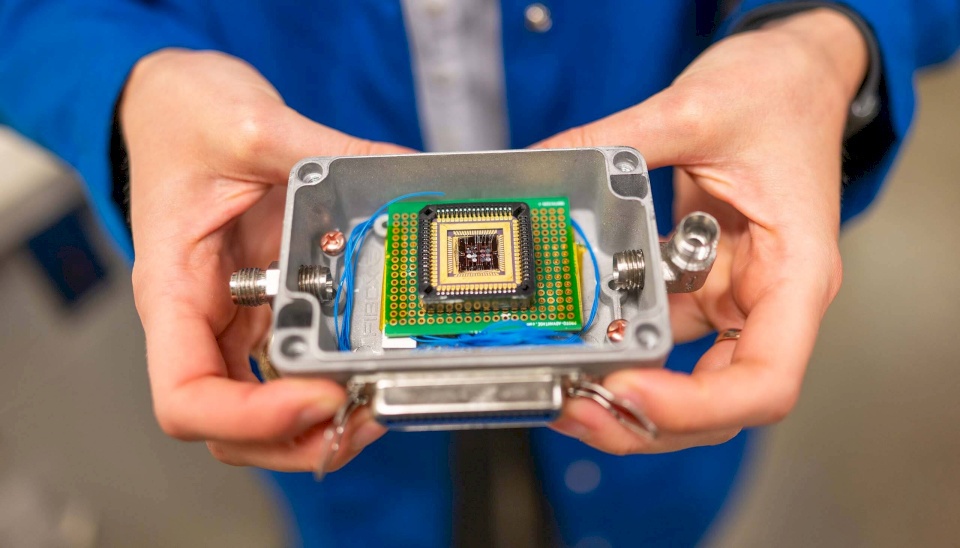
SadaNews - Researchers at the University of California, Berkeley, have developed a sensor chip that functions as an "electronic nose" capable of identifying different types of food, monitoring spoilage in some, and detecting small amounts of certain food allergens. The technology combines 16 gas sensors with a machine learning model that learns the chemical signatures of various odors. The study, published in the journal "Science Advances," demonstrated the system's ability to classify 16 food items with an overall accuracy of 92.6 percent. The device does not attempt to identify every chemical compound individually; instead, it relies on a set of sensors that respond in different ways to gases emitted from food.
How does the chip work?
The chip contains 16 gas-sensitive materials, each reacting with a different mixture of molecules. The chemical reactions that occur on the sensor's surface are converted into electrical signals, which the machine learning model then aggregates and searches for patterns associated with each type of food.
Carla Basil, the lead researcher of the study, likened this array to a set of "digital taste buds," where each sensor provides a slightly different response, and the combined responses are used to create a distinct odor signature.
The model was trained to recognize strawberries, blueberries, bananas, walnuts, hazelnuts, cashews, and peanuts. Researchers also tested its ability to differentiate between raw chicken, milk, and eggs in their fresh state, as well as after being left at room temperature for 24 and 48 hours.
Allergen Detection
In addition to monitoring food spoilage, the team explored the chip's potential use in detecting nuts that could pose a risk to individuals with food allergies. Experiments showed that the system could detect 0.05 grams of isolated walnut, approximately equivalent to one hundredth of an average shelled walnut. However, this result was achieved under specific experimental conditions. The researchers have not yet tested the device's ability to detect walnuts when they are part of a composite food, such as a salad or cake, where their scent may mix with other ingredients. The same limitation applies to spoiled food. The study tested samples in isolation, not within a refrigerator filled with multiple foods and overlapping gases and odors.
Carbon Nanotubes Instead of Heating
The concept of the electronic nose is not new; devices relying on arrays of gas sensors have been under development for decades. However, manufacturing a large number of different sensing materials on a single chip has remained a challenge, especially when each material requires independent fabrication steps.
The Berkeley team used transistors based on carbon nanotubes as the conductive material. These tubes can form layers only a few nanometers thick and provide a large surface area that makes them highly sensitive to chemical reactions.
The device operates at room temperature, unlike other sensors that require heating. This has allowed the researchers to use various sensitive materials, including polymers that may degrade when exposed to high heat.
The team also employed a simple deposition method that enables placing different materials on the chip in a single step, which researchers view as crucial for the potential mass production of these sensors.
From the Laboratory to Smart Refrigerators
Basil believes that smart refrigerators could be among the most prominent applications for this technology, as the sensors monitor the odors emitted by foods and alert users when a product is nearing spoilage.
After concluding the experiments discussed in the study, the researcher developed a portable version that can be operated via an app on an iPhone. However, this portable model was not part of the published results.
The device still requires testing in more complex environments that include multiple foods and odors in the same space, as well as improving sensitivity and reliability before considering its use in home appliances or food safety monitoring systems.
The study presents a model that combines precise sensors and machine learning to identify odors in a measurable way, but it does not imply that the technology is ready for commercial use or is an immediate substitute for established food safety testing.
 Follow the latest Sada News via Google News
World Cup: Morocco achieves the first Arab victory while Turkey loses for the second time,...

"Google" Launches "Android 17" with App Bubbles and Stronger Data Protection

"Electronic Nose" Detects Food Spoilage and Allergens Using Artificial Intelligence

6 Foods That Enhance Your Health as You Age

Why Don't We Feel Full Sometimes Despite Eating?

It's Not Walking... A Study Reveals the Most Effective Exercise for Protecting Women's Hea...

Chewing Gum After These Foods Lowers Blood Pressure
