

Newsweek: Trump's Options on Iran and the Scenario of a 'Third Gulf War'
SadaNews - The United States continues its military buildup in the Gulf region in anticipation of targeting Iran, at a time when negotiations between the two sides regarding the Iranian nuclear program are ongoing. President Donald Trump has repeatedly hinted at direct military action if the diplomatic path does not lead to the desired results.
In its predictions regarding Trump's options on Iran and the scenarios it calls "Third Gulf War," Newsweek stated that any attack decided by President Trump on Iran would exceed the scale of the military operation that targeted Iranian nuclear facilities last summer.
The magazine pointed out that President Trump has several options, which may include new rounds of targeted military strikes, or assassinations of senior Iranian leaders, or a long-term military campaign that could resemble a Third Gulf War.
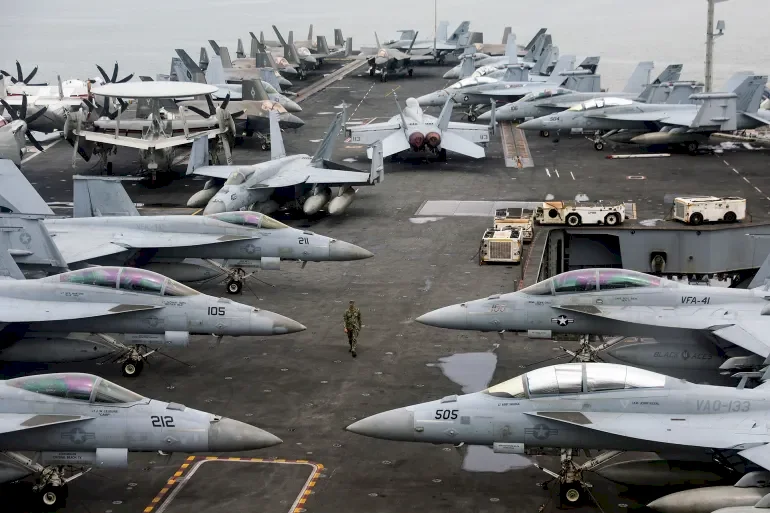
US Forces in the Region
The magazine noted that President Trump has repeatedly expressed his preference for a diplomatic solution and his desire for a nuclear agreement that surpasses the 2015 agreement which limited Iran's nuclear program in exchange for easing sanctions.
Newsweek observed that the gap remains between Washington and Tehran's positions, quoting White House spokesperson Caroline Levitt as saying that the two sides are still "very far apart" on key issues.
Former Deputy Assistant Secretary of Defense during Trump’s first term, Mick Mulroy, stated that the White House wants to reach a more restrictive agreement than the 2015 deal, which is likely to include constraints on Iran's ballistic missile program.
According to this official, if Iran rejects these conditions, Washington will take decisive military action against Iranian nuclear facilities and sites for producing and launching ballistic missiles, and will respond to any escalation from Iran.
Targeting Military and Strategic Sites
Newsweek highlighted that Iran possesses the largest arsenal of missiles and drones in the region, stating that this poses a significant threat in the event of a conflict, as it has been observed that Iran significantly expanded its missile arsenal in response to the Israeli attack last June.
According to the magazine, the maximum range of Iran's missiles reaches at least 2000 kilometers, placing the entire Middle East and parts of Southeast Europe within their range.
Most of Trump's statements have focused on reaching an agreement with Iran regarding its nuclear program, but he has sometimes stated, along with other senior American officials, that Iran's missile capabilities, among other areas, will also be subject to constraints under a new deal.
Israeli Prime Minister Benjamin Netanyahu, who visited Trump at the White House last week, focused on the issue of ballistic missiles.
In contrast, Iranian officials refuse any discussions about including ballistic missiles in a preliminary agreement, affirming their country’s right to enrich uranium at low levels.
Despite seeking a diplomatic solution, Iranian officials warn that any American strike will lead to a comprehensive war, with Supreme Leader Ali Khamenei threatening to sink American warships directly.
Richard Goldberg, former director of countering Iranian weapons of mass destruction at the National Security Council during Trump’s first administration, does not rule out that missile capabilities could be among Trump’s primary targets should he decide to resort to military action against Iran.
Targeting Iranian Leaders
Trump delivered the first direct blow to Iran in January 2020, when he ordered the operation that resulted in the death of the head of the Iranian Revolutionary Guard's Quds Force, General Qassem Soleimani, at Baghdad International Airport in Iraq.
Following the "Flood of Al-Aqsa" operation on October 7, 2023, Israel targeted Hamas leadership in Tehran and Iranian leaders in Syria, to which Iran responded with waves of missile strikes.
In June 2025, Israel carried out military strikes on Iran over 12 days, to which Tehran responded with a wave of missile strikes, and before any direct American intervention in bombing Iranian nuclear facilities, Trump publicly hinted at the possibility of assassinating Ali Khamenei, indicating that he knew his whereabouts.
Recently, President Trump has shown willingness to target the Iranian leadership similar to the scenario in Venezuela, where its president, Nicolás Maduro, was arrested after a US military pressure campaign that involved the aircraft carrier "USS Gerald R. Ford," which will join the "USS Abraham Lincoln" in the Gulf.
The escalation of American military pressure on Iran began following the operation in Venezuela, during which Iran was witnessing protests and violent clashes, and President Trump blamed Iranian security forces for the deaths of thousands of people. Analysts at that time told Newsweek that the White House might eventually seek to apply the "Venezuela model."
With increasing speculation about who would lead the country in the event of Khamenei's death, including possibilities that figures from Iranian political and military leadership could take charge, US Secretary of State Marco Rubio himself acknowledged late last month that "no one knows who will take power."
However, Kenneth Pollack, a former official at the National Security Council at the White House, believes that the option of regime change in Iran is "entirely unlikely" at this stage, and that nuclear and military targets are the more probable options for Trump at this time.
Pollack added in a statement to Newsweek that missile manufacturing facilities and previously untouched nuclear sites from last June, in addition to the headquarters of the Revolutionary Guard and Basij forces considering their role in maintaining the regime's clout, will be targeted.
The magazine pointed out that potential targets include what is termed the "ghost fleet" of oil tankers that continue to export Iranian oil despite US sanctions, which, in the magazine’s view, requires a broader campaign covering several maritime fronts.
Long-Term War
On the other hand, the magazine states that there are not many signs that America is planning any form of large-scale invasion, such as what occurred during the invasion of Iraq in 2003, which is sometimes referred to as the Second Gulf War.
The magazine mentioned that that war was preceded by a significant American buildup of troops and equipment in neighboring countries like Kuwait to support the entry of about half a million American soldiers into Iraq during the initial phase of the war.
Although no such buildup is happening around Iran today, the presence of aircraft carriers, fighter jets, and other equipment is likely sufficient to support air operations for an extended period.
Unlike previous American military interventions in the region since the First Gulf War, known as Operation Desert Storm, the current American administration may be inclined, in Pollack’s opinion, towards "easy, cheap, and rapid foreign adventures."
Pollack added that from this perspective, American military intervention would aim to disrupt Iranian air defenses before bombarding them and causing severe damage to the Iranian regime.
However, this does not necessarily mean, according to Pollack, that American escalation will be limited to a single round; rather, the primary message that Trump will convey to Tehran is that pressure on it will continue until its negotiating stance improves and it is ready to strike the deal he wants.
Source: Newsweek
 Follow the latest Sada News via Google News
Washington Investigates Possible Russian Role in Iranian Attacks on Its Sites

Mossad Chief Visited Washington to Discuss Iran and Its Nuclear Program

Report: Washington Informed Israel It Is Preparing to Intensify Attacks on Iran and Use St...

Organization of Islamic Cooperation Condemns Nauru's Decision to Open an Embassy in Occupi...

Video:: Nablus: Settlers Evict Tubasi Family from Their Home in Jaloud and Take Over It

Netanyahu: I Intend to Form a Broad National Unity Government

Syrian Foreign Minister Meets with Yasser Abbas in Damascus
