

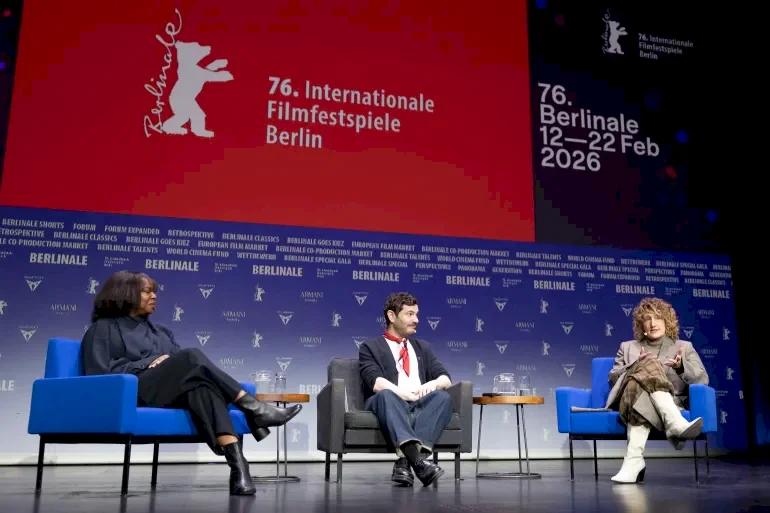
Berlin Festival 2026: Films Reflecting Family Concerns and the World’s Anxieties
SadaNews - The 76th edition of the Berlin International Film Festival will be held from February 12 to 22, 2026, amidst major transformations and international divisions at both the political and cultural levels, which is reflected in the official competition selections that include 22 films representing about 28 countries this year.
The festival's selections serve as a mirror that raises questions concerning filmmakers around the world in a historically anxious moment.
The 76th Berlinale features special honors, notably the honorary Golden Bear awarded to Malaysian actress Michelle Yeoh in recognition of her cross-cultural global career.
The festival also awards the "Berlinale Camera" to composer Max Richter, celebrating his contributions to enhancing the role of music within the contemporary cinematic experience, which confirms the festival’s openness to honoring arts behind the camera as well.
Artistic director Tricia Tuttle states in a press release on the festival’s website that she is betting on the selection of films chosen this year, saying, "We found so much to fall in love with in this year’s competition lineup, and we are very confident in the appeal of these 22 films to the extent that we say unitedly: if you don’t find anything to love here, you don’t love cinema!".
The list focuses on films whose themes relate to family, memory, and individual isolation, featuring unconventional cinematic forms, including animated films and documentary works within the official competition itself.
This edition sees Arab representation in the official competition through the film "In a Whisper" by Tunisian director Leyla Bouzid, underscoring the ongoing presence of Arab cinema in one of the major platforms for art cinema globally.
Bouzid, known for films that lean towards psychological sensitivity and analyze fragile human relationships, presents a work that focuses on the internal spaces of characters in a contemporary social context, with a quiet visual style that aligns with the Berlinale's tradition of celebrating cinema that favors depth over noisy events.
The Tunisian participation is part of a broader landscape that includes voices from outside traditional centers of the film industry, which is an objective of the festival as a platform for geographical and cultural diversity.
Global Concerns
The competition list shows a notable interest in family stories as a gateway to understanding political and social transformations. Among these works is "At the Sea" by Hungarian director Kornél Mundruczó, one of the prominent cinematic voices in contemporary Europe, known for films that mix body, politics, and open space.
The film follows a woman returning to her family's home after a treatment period for addiction, where she is forced to confront past traumas and the loss of her identity after her professional career ends. The work stars Amy Adams along with several well-known actors and is presented globally for the first time within the main competition.
Mundruczó employs the sea in the film as a metaphor for separation and the search for meaning, in a drama where personal relationships intersect with broader existential questions.
Mundruczó is known as an actor and director for the films "Jupiter holdja" (2017) and "Pieces of a Woman" (2020).
Meanwhile, the film "Home Stories" by German director Eva Trobisch delves into confined domestic spaces to read family tensions as reflections of broader transformations in contemporary German society.
It revolves around "Lea," who works on a reality talent show production team, questioning her identity and what the family hotel she lives in represents, in a search for self within a fluctuating family and social framework.
Also highlighted is the film "Yellow Letters" by German director Ilker Çatak, known for his focus on identity, integration, and migration in contemporary Germany.
The work engages with family memory and its extension into political history, where personal relationships turn into a mirror of the larger society and its crises.
It is a politically family-centric film, narrating the lives of the artistic couple Derya and Aziz after a state intervention incident in their play, which sparks tensions threatening their marriage and professional lives.
The idea of isolation in modern cities occupies a central place in multiple films within the competition. Austrian director Markus Schleinzer presents the film "Rose," characterized by a reliance on silence and suggestion, delivering a drama that explores internal separation and emotional fragmentation, using a cinematic language that aligns with the festival's aesthetic tendencies, albeit marked by psychological harshness.
German director Angela Schanelec, a prominent figure in European experimental cinema, returns to the competition with the film "My Wife Cries," relying on slow pacing and narrative fragmentation, where emotional disintegration transforms into a self-standing cinematic structure.
Schanelec, whose name is linked to the "Berlin School," continues here her project of dismantling the traditional narrative, placing viewers in front of a contemplative experience that does not provide easy answers.
The film addresses a simple incident, where a crane operator receives a call from his wife to pick her up from the hospital, and he struggles to understand what it means to find her alone on a bench in the garden crying, while an ordinary day turns into a meditation on relationships and emotional impact.
Documentary and Animation
A notable feature this year is the continued presence of the documentary film within the official competition through "Everybody Digs Bill Evans," which chronicles the life of the famous American musician Bill Evans, known for his jazz music.
The work tracks the artistic journey of the musician, using his biography as a gateway to contemplate the relationship between art and individual freedom, confirming that documentary within Berlinale is not a marginal genre but part of the broader cinematic discourse.
In a step reflecting an increasing openness to unconventional forms, the competition also includes a Japanese-French animated film titled "A New Dawn," which addresses themes of emergence and transformation in an experimental visual language, reflecting the festival's readiness to embrace animation within a fully cinematic language, and not just for children or side sections.
African cinema is present in the competition through the film "Soumsoum, the Night of the Stars" by Chadian director Mahamat-Saleh Haroun, one of the leading cinematic voices on the continent.
Haroun is known for working on themes of loss, memory, and life on the margins, presenting the festival with a poetic work that balances the local with the universal human, in a narrative that appears simple on the surface but is laden with political and cultural connotations.
The film tells the story of "Kielo," a girl with supernatural powers that she does not understand until a pivotal encounter reshapes her destiny and leads her toward understanding herself in an emotional context.
Meanwhile, Latin cinema is represented by the film "Moscas" by Mexican director Fernando Eimbcke, presenting a social drama with a sarcastic tone, approaching neo-realism in its treatment of the lives of marginalized classes, confirming Latin America’s presence as a source of enduring vitality in global cinema.
The official competition film list in "Berlinale 2026" reveals a festival that represents a space for cinema that thinks about the world rather than merely displaying it.
Between family cinema, memory, isolation, and formal experimentation, the competition films converge on a single question about how cinema can capture the fragility of contemporary humans in a world where transformations accelerate?
Source: Reuters
 Follow the latest Sada News via Google News
After Deschamps' Departure... Zinedine Zidane Tops the Candidates to Lead France

Mbappe Surpasses Messi and Becomes the All-Time Top Scorer in the World Cup

England Defeats France and Achieves Largest World Cup Achievement Since 1966

Messi Refused to Play for Spain and Missed 3 World Cups

Publishers Sue Google for Allegedly Using Books to Train Artificial Intelligence

Google Expands Capabilities of Google Search Console to Support Social Media Accounts

The Mediterranean Table... An Ancient Diet Revealing Its New Secrets for Health and Longev...
