

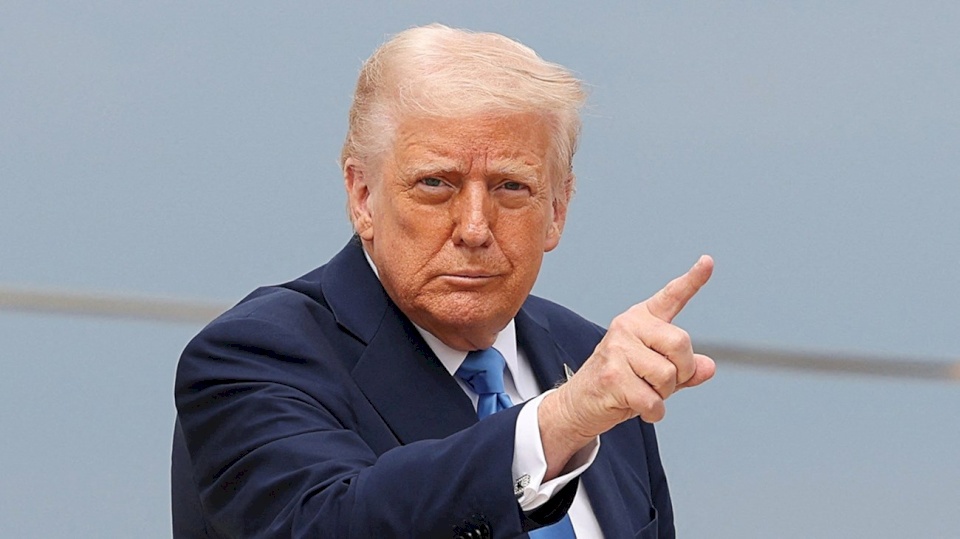
Trump Confident That Greenland Tariffs Will Not Disturb Trade Agreement with Europe
SadaNews - President Donald Trump expressed confidence that the European Union will continue to invest in the United States, even if it moves forward with imposing new tariffs related to his efforts to take control of Greenland, a step that has provoked anger among leaders in the European continent.
European Commission President Ursula von der Leyen said yesterday that Trump's threats are a "mistake" and violate the agreement made last year with the bloc. European officials have already begun preparing plans to respond, which could lead to a reciprocal escalation that would undermine the agreement. However, the U.S. president downplayed the likelihood of Europe following through with these threats.
Donald Trump Casts Doubt
During a press conference at the White House yesterday, Trump, in response to a question about whether moving forward with tariffs related to Greenland might cause the EU to retract its investment commitments, said: "I doubt that."
He added: "They desperately need this deal with us. They really need it, and they fought hard to get it. So I doubt that."
Trump announced a 10% tariff on imports from eight European countries starting February 1, increasing to 25% in June, unless an agreement is reached regarding the "purchase of Greenland," the semi-autonomous Danish territory, a NATO ally, and a member of the European Union.
When asked how far he was willing to go to gain control of the island, Trump told reporters: "You will know."
This rare appearance by the president in the White House briefing room came just before he left Washington on Tuesday night heading to the World Economic Forum in Davos, where he is scheduled to face European leaders angry over his attempt to acquire a territory belonging to Denmark, a NATO member.
Von der Leyen said: "The EU and the United States reached a trade agreement last July. In politics, as in business, a deal is a deal. When friends shake hands, there must be meaning to that."
Dispute with Europe
The transatlantic dispute over the U.S. president's ambitions overshadowed the annual gathering of global financial and political elites, casting a shadow over Washington's relations with several key allies.
Trump generally expects that the "many scheduled meetings regarding Greenland" this week in Davos will yield positive outcomes, stating: "Things will actually go well."
He also downplayed criticism from European leaders, including French President Emmanuel Macron and British Prime Minister Keir Starmer, asserting that he expects a warmer reception upon meeting them.
Trump said: "They always treat me well. They get a little sharper when I'm away, but when I'm present, they treat me very kindly."
In recent days, Trump has intensified his pressure campaign, threatening to impose tariffs on imports from Denmark, Norway, Sweden, France, Germany, the United Kingdom, the Netherlands, and Finland if these countries continue to oppose his efforts. The idea of Trump's acquisition of the island dates back to his first presidential term.
These tariffs threaten to increase market turmoil, which has already seen a drop in stocks and the U.S. dollar following Trump's threats, while gold reached an all-time high.
Trump also said that using military force to seize the island remains an option, a move Danish Prime Minister Mette Frederiksen said earlier this month would mean the end of NATO.
Scenario of Invading Denmark
Although the scenario of a potential invasion remains unlikely, Greenland's Prime Minister said yesterday that authorities there need to begin preparations, adding that military conflict "cannot be ruled out."
Earlier yesterday, Trump announced that he would meet with several parties in Davos to discuss the Greenland issue, while rejecting estimates suggesting that Europe would strongly oppose his plans.
Trump insists that the United States must control the island to protect its national interests, warning that failure to do so would make it susceptible to Russian and Chinese influence. He also stated that Denmark and other NATO partners have neglected to bolster its security.
Trump ignored questions yesterday regarding whether his policies jeopardize the transatlantic alliance, which has formed the bedrock of the global order since World War II.
He said: "I believe we will reach an arrangement that will greatly satisfy NATO, and please us as well. But we need it for security reasons. We need it for national security, and even for world security. It is critically important."
Trump also linked his demand for the island to not receiving the Nobel Peace Prize, claiming that Norway controls the selection process, although the prize decisions are made by an independent committee not the government. He reiterated this accusation yesterday saying: "Don't let anyone tell you that Norway doesn't control things."
Threats of Tariffs
In a series of interviews he conducted yesterday in Davos, U.S. Treasury Secretary Scott P. Mintz repeatedly urged the United States' trading partners not to respond to Trump's threats of imposing tariffs, calling on them to listen to what the president will be proposing during his visit.
Mintz said during a press conference: "I am confident that leaders will not escalate, and that things will end up in a very good place."
Like Trump, Mintz dismissed the likelihood that Europe would strongly retaliate against the United States. When specifically asked about the risk of Europe resorting to selling U.S. Treasury bonds, which could create a massive shock in the markets, he described these speculations as "a false narrative."
European countries hold U.S. bonds and stocks worth trillions of dollars, some owned by public sector funds. Selling these assets could raise borrowing costs and push stocks down, given the United States' reliance on foreign capital. However, most market strategists see the likelihood of policymakers resorting to this option as low.
Macron also proposed activating EU tools to combat coercion to pressure the United States, but German Chancellor Friedrich Merz sought to temper this approach.
 Follow the latest Sada News via Google News
The World Bank Warns: "The Worst-Case Scenario" for Global Growth is Approaching

Trump Prepares to Impose New Tariffs on Dozens of Economies

Gold Surpasses $4,100 as Selling Pressure Eases

Oil Rises for the Fourth Day as Supply Risks Escalate

An Additional $8 Billion.. A New Account from the Pentagon on the Cost of the War with Ira...

London Stock Exchange Enters the Era of 24/7 Trading

Shamaran Petroleum: Suspension of Oil Production in Duhok Fields in the Kurdistan Region o...
