

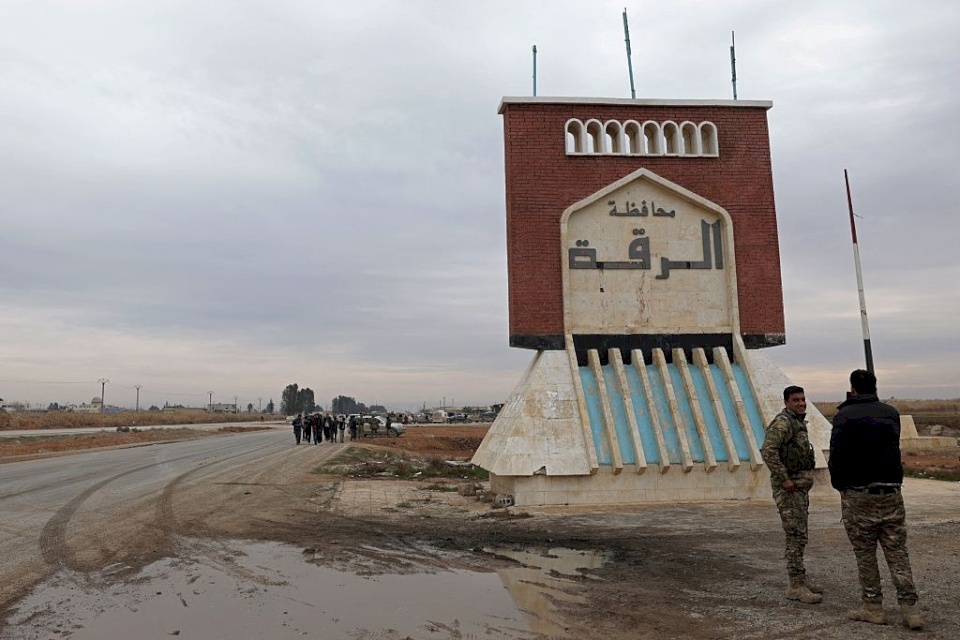
The Syrian Army Expands Its Control as Operations Continue in Raqqa, Al-Hasakah, and Deir Ezzor
SadaNews - Syrian government forces tightened their control today, Sunday, over strategic cities and facilities in the north and east of the country, following successive withdrawals by the Syrian Democratic Forces (SDF) after days of confrontations between the two sides.
The government control included vital sites, most notably the Euphrates Dam in western Raqqa Governorate, one of the largest hydropower facilities in the country, as well as the Al-Omar oil field in the eastern Deir Ezzor countryside, the largest oil fields in Syria.
These developments came after negotiations between Damascus and the SDF leadership aimed at integrating civil and military institutions in northeastern Syria into the state framework stalled, following an agreement signed between the two sides on March 10, 2025.
The government forces began a military operation days ago that launched from the city of Aleppo, Syria's second-largest city, managing to drive SDF fighters out of two neighborhoods they controlled before advancing eastward towards the strategic city of Tabqa in Raqqa Governorate.
Shara Meets Barak Amid Fighting on Both Sides of the Euphrates
Syrian President Ahmad Shara met on Sunday with U.S. envoy Tom Barak in the capital, Damascus. The Syrian presidency reported in a brief statement via Telegram that Shara was holding a meeting with Barak "at the People's Palace in Damascus".
In the early hours of Sunday, the SDF unexpectedly withdrew from all its controlled areas in the eastern Deir Ezzor countryside, a region with an Arab majority that includes the most prominent oil and gas fields, according to the Syrian Observatory for Human Rights.
Observatory director Rami Abdul Rahman stated that the SDF withdrew from its control areas in the eastern Deir Ezzor countryside, including the Al-Omar and Tanak fields, noting that the withdrawal occurred amidst the advance of fighters from local tribes in coordination with the authorities, including former members of the SDF.
Those areas, which include dozens of Arab tribes, are now under the control of the Syrian authorities, according to the Observatory.
The Al-Omar field is the largest oil field in Syria and had been under SDF control since the expulsion of the "ISIS" organization from it in 2017. It also served for years as a main base for the U.S.-led international coalition, which provided direct support to the SDF during the battles against the organization until it was defeated in its last strongholds in 2019.
Local sources reported that residents of the city of Shaddadi in Al-Hasakah Governorate, located east of the Euphrates River, expelled SDF members from the city, while official sources indicated that "SDF members in Shaddadi are burning their headquarters amid a state of confusion and chaos in the area".
In a post on the "X" platform, Syrian Minister of Energy Mohammad Bashir praised what he described as the "uprising of the people of the Arabian Peninsula," considering that the return of the region's resources to state authority "means opening a wide door for reconstruction and revitalizing the agriculture, energy, and trade sectors".
The SDF's withdrawal from eastern Deir Ezzor followed hours after its withdrawal from the city of Tabqa, and the announcement of the Syrian army's control over it and the adjacent Euphrates Dam, the largest dam in the country, which contains eight electrical generating units, each with a capacity of 110 megawatts.
A field security source in Tabqa reported that army and security forces began extensive combing operations within the neighborhoods of the city, coinciding with the deployment of armored vehicles and tanks in its vicinity, and conducting military patrols within the streets.
Local sources mentioned that the majority of the population remained at home while shops and commercial institutions closed their doors. One resident of the city, Ahmed Al-Hussein, stated, "People are scared," adding, "We have suffered a lot and hope that things will improve in the coming days."
At the northern entrance of the city of Tabqa, several residents destroyed a statue of a female fighter from the Kurdish forces that had been erected years ago in her honor after she was killed in battles to expel the "ISIS" organization from Raqqa.
In a related context, Syrian authorities accused the SDF of blowing up two main bridges on the Euphrates River within the city of Raqqa, which, according to the governorate's media directorate, led to "the complete interruption of water supplies to the city of Raqqa".
In contrast, the Kurdish self-administration stated in a statement on Sunday that government forces launched "an attack on our forces on multiple fronts," despite what it described as "efforts made to find peaceful solutions," indicating that its withdrawal from some areas was a "good-faith" gesture.
The SDF's withdrawal from Deir Ezzor followed a meeting held on Saturday in Erbil, which included the U.S. special envoy to Syria, Tom Barak, SDF commander Mazloum Abdi, and the President of the Kurdistan Region of Iraq, Nechirvan Barzani.
In this context, the head of the Kurdistan Democratic Party, Masoud Barzani, announced that the joint meeting discussed ways to reduce escalation, expressing hope for "an end to fighting and tensions as soon as possible" and for the parties to return to previous agreements, considering that the decree issued by Syrian President Ahmad Shara regarding the rights of the Kurdish component is a "positive step in the right direction".
U.S. Central Command (CENTCOM) commander Admiral Brad Cooper called on Syrian government forces to stop "any offensive actions" in the area between the cities of Aleppo and Tabqa.
In this context, PKK leader Abdullah Öcalan described the ongoing fighting in Syria as a "attempt to undermine the peace process" that began in Turkey with the party's fighters, according to what he conveyed to a visiting delegation on Saturday. Meanwhile, Turkey, a supporter of Damascus, praised the Syrian authorities' efforts to confront "terrorist organizations".
Amid rising tensions, Syrian President Shara issued an unprecedented decree on Friday, granting the Kurdish component key rights, including Syrian citizenship and recognizing the Nowruz holiday as a national holiday.
The self-administration welcomed the decree and regarded it as a "first step," but emphasized that the "fundamental solution" lies in the establishment of a "democratic decentralized constitution," a proposal that Damascus rejects.
 Follow the latest Sada News via Google News
American Anger at Israel Due to Refueling Planes at Ben Gurion Airport

Trump Retracts 20% Tariff on Ships Crossing the Strait of Hormuz

Mustafa Meets the EU Special Representative for the Middle East Peace Process and the Acti...

Netanyahu Threatens Iranian Leaders: You Will Receive a Different Response If You Attack U...

1.3 Billion Shekels to Expand Settlements in the West Bank.. A Secret Decision Concealed b...

10 Martyrs Including the Director of Jabalia Police Due to Israeli Airstrikes on Gaza

Omani Foreign Minister: Long-term Arrangements to Ensure Freedom of Navigation in Hormuz
