

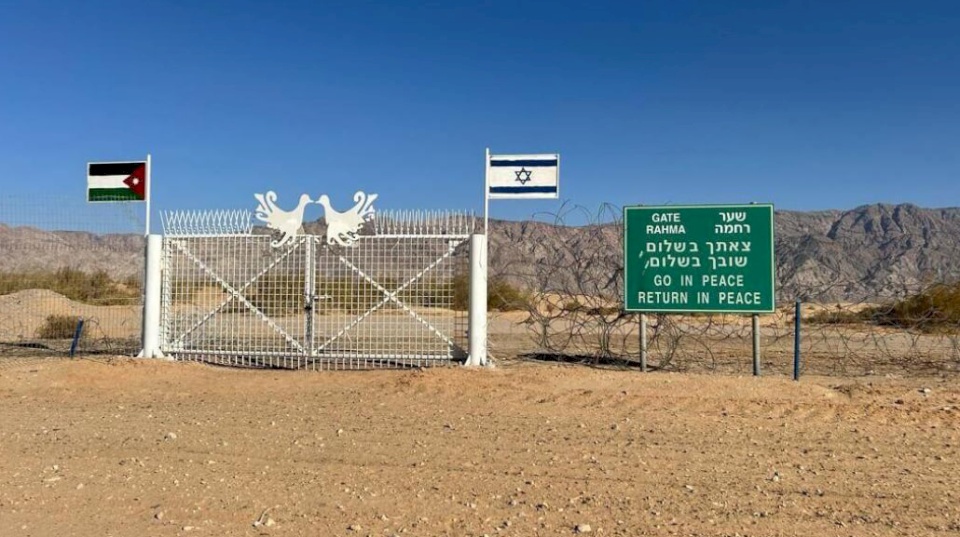
Report: Israeli Alert at the Jordanian Border Due to Iranian Threats
SadaNews translation: The border with Jordan is experiencing unprecedented alertness within the Israeli occupation army, amidst new security assessments indicating the possibility of Iraqi groups supported by Iran, along with the Houthis in Yemen, exploiting the Jordanian route to carry out operations against Israel. This shift in Israeli security perspective follows the Hamas attack on October 7, which prompted the Israeli military establishment to reevaluate the weaknesses in its defense system, as reported by Yedioth Ahronoth, translated by SadaNews.
Reopening Military Sites Abandoned Since the Peace Treaty
According to Israeli sources, the occupation army has begun redeploying its forces along the eastern border and reopening military sites that had been abandoned since the peace treaty with Jordan in 1994. Additionally, five brigades were formed from old reserve soldiers who were called to volunteer for guard and monitoring duties.
The occupation army maintained 46 advanced military sites along the Jordan Valley during and after the War of Attrition to prevent infiltration and smuggling. However, these sites were gradually evacuated after the peace treaty, based on an Israeli conviction that the border was stable and that Jordan was effectively controlling it.
Radical Shift After October 7
Yedioth Ahronoth reported, translated by SadaNews, that Hamas's sudden attack prompted former Chief of Staff Herzi Halevi to form what is known as the "Red Team" to study the possibilities of conducting surprise attacks from unexpected fronts. The team's findings concluded that the eastern border is one of the most vulnerable fronts, necessitating the reconstruction of a complete defense system in the area.
Old Fortifications Back in Service
During a field visit to one of the reopened sites, fortifications dating back to the War of Attrition were seen: walls built from river pebbles within metal networks, narrow tunnels leading to living and resting rooms, concrete ceilings, and fortified communication channels. One of the commanders says that the site was filled with garbage weeks ago, but today it is equipped with monitoring and firing systems, managed by mixed teams of soldiers and officers.
In contrast to the light resting sites scattered along the Gaza border, which collapsed easily under the attack of Al-Qassam fighters on October 7, the new sites on the Jordanian border appear more fortified and prepared, as translated by SadaNews.
Opposing Jordanian Sites... and Israeli Fears of Exploitation
On the opposite bank of the Jordan River, Jordanian guard points are clearly visible, as the Jordanian army has established forward positions close to the water line. Israeli estimates suggest that these sites may be susceptible to exploitation by smugglers or armed groups, despite ongoing Jordanian efforts to control the border.
The Jordan Valley lies below the military sites, covered by dense vegetation indicating it is a natural obstacle; however, the Israeli army confirms its ease of crossing on foot. Beyond the valley rise the hills known in Arabic as "the Ghor," which extends east into Jordanian territory and west into the occupied territories.
The Israeli occupation army has regained control over the hills overlooking the valley, due to their wide view of the water line and the ability to target any crossing attempts with light arms. However, the rugged terrain provides natural cover for would-be infiltrators, prompting the army to establish dozens of forward sites to cover the entire area.
Continued Alertness on the Eastern Border
These movements come amidst growing Israeli fears that the Jordanian border may be exploited by Iraqi groups or the Houthis, as part of what Tel Aviv describes as the "rising Iranian threat" on its eastern borders.
While Israel continues to bolster its military presence in the region, the Jordanian-Palestinian occupied border remains one of the most sensitive fronts, given the rising regional tensions and the changed security calculations following the October 7 attack, as translated by SadaNews from the Hebrew report.
David Battalions... The New Rapid Deployment Force
According to Yedioth Ahronoth, as part of rebuilding the defense system, Israel is working on establishing the "David Battalions," which are expected to become the main combat force of the "Gilad" division deployed along the eastern border. Reserve soldiers joining these battalions are being equipped with light weapons that they keep at home, enabling them to quickly join their units when called up.
This organizational model is known as "Bezek Battalions," and aims to ensure rapid mobility without the need for heavy equipment or logistics that might impede immediate access to deployment areas and contact lines.
According to Israeli reports, the Chief of Staff of the Israeli occupation army, Eyal Zamir, decided to expedite the timeline for establishing the Gilad division and ordered its actual activation last June, just days before the operation began in Iran. The decision came out of fear that Tehran would respond via Jordanian territory using Iraqi militias or the Houthis.
The division, led by Brigadier Orin Simcha, moved quickly and improvisationally after receiving reinforcements from the central command, and according to the Israeli narrative, managed to carry out its required tasks: a multi-layered defense system and a new barrier spanning 500 kilometers.
Simultaneously, the Ministry of the Israeli occupation army began on Monday constructing the new barrier in the Jordan Valley and its surrounding valleys. The first two segments of the barrier will be implemented in areas identified as key points for arms smuggling, particularly around Tiberias, with the remainder of the sections to be completed later.
The total estimated cost of the project is 5.5 billion shekels, with the barrier extending for 500 kilometers from the southern Golan Heights to northern Eilat.
 Follow the latest Sada News via Google News
12 Martyrs in Gaza Strip since Dawn Today

A Series of Important Decisions Taken.. The Cabinet Discusses Developments in the Deterior...

Organizations of the Temple Prepare for the Largest Raid on Al-Aqsa on What is Called the...

Smotrich: Israel Has No Interest in Joining the War Against Iran

Occupation Issues Military Order to Seize 5 Dunams of Land in Jaba'

Axios: Proposal for a 10-day Ceasefire Between Washington and Tehran and Two Options for M...

In a Rapid Pace.. The Occupation Builds a Huge Earth Barrier Inside Gaza
