

Report: "The Crimson Thread".. A New Separation Wall Threatening Tubas and the Northern Valleys
SadaNews - A report prepared by the National Office for the Defense of Land and the Resistance of Settlement states that the Tubas Governorate and the Northern Valleys are in direct danger due to colonial plans, which have accelerated recently.
The office added in its weekly report, which tracks the period from November 27 to December 5 of the current month, that despite U.S. President Donald Trump's commitment to leaders of several Arab and Islamic countries to prevent Israel from annexing the West Bank or parts of it, ongoing developments in Tubas Governorate and the Northern Valleys confirm that they are in direct danger now more than ever.
It noted that the occupation authorities recently issued nine new military orders, as is known, to seize large areas of land in the governorate, including private property and others classified as state land, with the aim of constructing a new military road linking "Ain Shibli" to the village of "Taysir," stretching over 40 kilometers, running from the lands of Tammun, through the al-Buqei'a plain east of the village of Atoof, from the area of Einon in Tubas, reaching the area of Yirza east of Tubas, and up to the lands located east of the village of Taysir.
He explained that the commander of the Central Command in the occupation army, Avi Blot, launched an open war on the governorate at dawn on the 26th of last month, called "the five stones" in reference to five areas concentrated in the operation, including: the city of Tubas, the town of Tammun, the town of Aqaba, the town of Taysir, and the Far’a refugee camp and its surroundings, under flimsy security pretexts.
The report noted that it is clear from the course of this war on the governorate, which lasted for two weeks, that the security needs raised by the occupation army are used as a cover for political and field expansionary steps aimed at tightening the noose on Palestinians and destroying the elements of Palestinian agriculture. The authorities impose restrictions on farmers as pressure tools aiming to weaken the Palestinian agricultural sector and, on the other hand, to prepare the land for confiscation, ultimately leading to the displacement of citizens from the entire area.
It explained that the ongoing military operations in Tubas Governorate and the Northern Valleys are unrelated to the security justifications promoted by the occupation authorities; among its goals, there is nothing that reflects any real security concerns, rather they come within the context of a broader project related to military training and field preparations for future political and settlement steps, foremost among which is the annexation of the Northern Valleys.
According to the report: This military operation has been accompanied by a campaign of raids and incursions into citizens' homes, turning some of them into military barracks.
According to the Israeli newspaper "Yediot Ahronot," three brigades from the occupation army participated in the operation: "Menashe," "Shomron," and "Commando," having begun by closing the main roads in the governorate to reinforce control over the area, imposing a comprehensive curfew on the city of Tubas and the surrounding towns, and closing all entrances with earthen mounds and military checkpoints, transforming Tubas Governorate into an "open military zone" instead of being a civil society.
According to the Israeli newspaper "Haaretz," the occupation army has begun to implement a new segment of an apartheid separation wall deep in the Northern Valleys, a step that citizens and rights activists describe as the most dangerous in years, as it transforms dozens of communities into besieged areas, severing their connection with large expanses of agricultural and pastoral lands.
According to the same newspaper, the current segment extends for 22 kilometers, and is 50 meters wide, located more than 12 kilometers west of the Jordanian border, with ongoing works including the leveling of residential, agricultural, tent, and storage facilities, as well as sections of water networks, within what is known as the military project "The Crimson Thread."
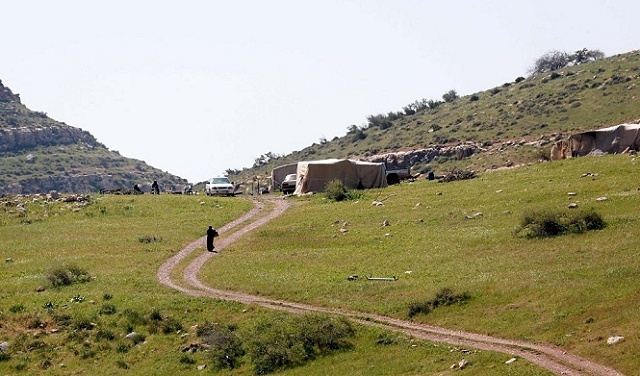
The occupation authorities have informed several families in the Ain Shibli and Khirbat Atoof areas of demolition orders within a week, in preparation for the construction of the new wall pathway, with residents fearing that their villages will become isolated islands, particularly Khirbat Yirza, which is home to about 70 individuals relying on livestock farming in an area estimated at 400 dunums that will be completely surrounded.
Military documents indicate that the wall will be used as a patrol road accompanied by earthen mounds and deep channels, while a security fence is being constructed in several sections.
In this context, Dror Atkas, an expert in settlement affairs from the "Kerem Nabot" association specialized in monitoring Israeli actions to control Palestinian land, estimates that the current phase of the "Crimson Thread" project will result in the separation of farmers and landowners in Tarqumiyah, Tubas, Taysir, and Aqaba towns from vast areas of their lands, reaching about 45,000 dunums, which will lie between Alon Road and the new wall.
The targeted area located between the northern valleys and the Hamra checkpoint contains seven existing settlements, in addition to 16 pastoral outposts in the form of farms.
In addition, a news report published by the Hebrew site "Walla" last week revealed that Israeli officials from the "Shomron" regional council, chaired by the far-right Likud member "Yossi Dagan," and the municipality of the "Rosh Ha'ayin" settlement launched a joint initiative to establish a new colonial city in the West Bank, under the name "Eastern Rosh Ha'ayin" on government lands in the northern highlands of the West Bank, accommodating more than 130,000 settlers.
Officials believe that the project represents an extension of the "Million in Samaria" vision, aiming to increase the number of settlers to one million and enhance the colonial presence by 2050.
Supporters of the project affirm that the goal of establishing the city is not only demographic but strategically and security-wise as a priority, also promoting it as a "vital security belt" for central Israel to protect areas like "Rosh Ha'ayin" from future threats.
The announcement of the proposed city came during a visit by Dagan and Sagi to the "Lerner" farm located between the settlements of "Bidoel," "Leshem," "Brokhin," and "Eli Zahav," on the lands of Qalqilya and Salfit governorates.
The Israeli news site "Walla" reported that teams from the "Shomron" council and the "Rosh Ha'ayin" municipality have been working over the past two months on a plan that includes connecting the eastern neighborhoods of "Rosh Ha'ayin" with the "Leshem" settlement to form a connected residential and agricultural bloc, and the initiators of the project called on the government to officially approve the plan.
On another note, the Israeli newspaper "Haaretz" published an intriguing investigation last week titled "For Judah: The Israeli army turns into a cog in the settlers' machine," shedding light on a project on the internet: "WhatsApp," "Telegram," and "Instagram," and "YouTube," where the occupation army invites soldiers and the public to visit colonial hotspots and archaeological sites in the West Bank, including areas (A) and (B).
The project operates through organized groups managed by the occupation army, with the content provided by officers, soldiers, guides, civilian archaeologists, and political figures from the settlements, originating from a soldier who served in the "Judah" brigade, who continues to lead it even during his reserve duty with full support from his senior commanders.
 Follow the latest Sada News via Google News
Morocco Hosts Formative Exercise for International Stabilization Force in Gaza

Sheikh Holds Meeting with Security Leaders to Follow Up on Current Developments

Hebrew Channels: The Likelihood of Israel's Participation in the Attack on Iran is Increas...

Netherlands Sets September Deadline for Ban on Settlement Products

12 Martyrs in Gaza Strip since Dawn Today

A Series of Important Decisions Taken.. The Cabinet Discusses Developments in the Deterior...

Organizations of the Temple Prepare for the Largest Raid on Al-Aqsa on What is Called the...
