

Mustafa Discusses with the International Finance Corporation Expanding Support for the Private Sector and Renewable Energy Projects
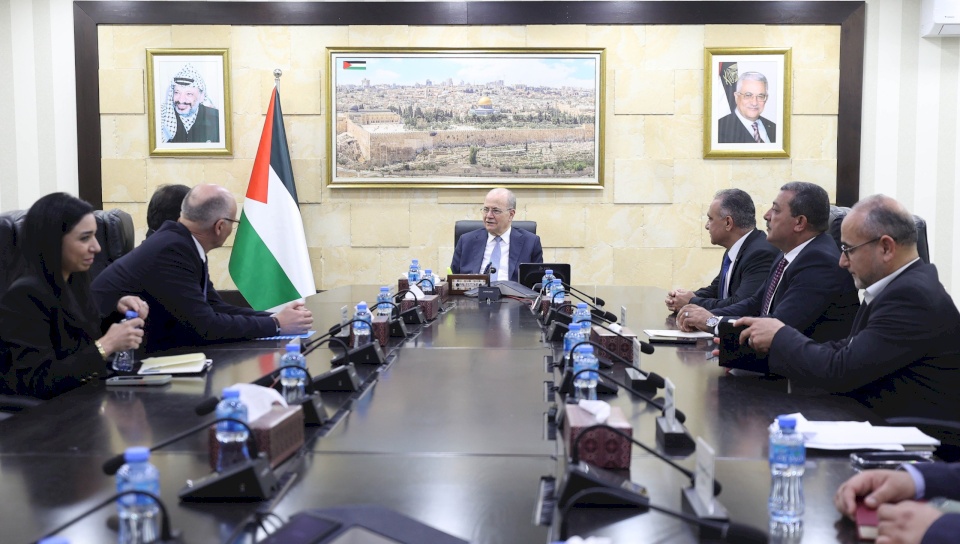
SadaNews - Today, Thursday, Prime Minister Dr. Muhammad Mustafa discussed in his office in Ramallah with Aftab Ahmed, the regional director for the Middle East at the International Finance Corporation (IFC), mechanisms for enhancing the institution's programs and activities in Palestine, in the presence of the World Bank Director in Palestine, Stephen Amblard, the institution’s director in Palestine, Rafeef Darwish, the head of the Palestinian Energy Authority, Ayman Ismail, and the Deputy Minister of Local Governance, Raed Muqbel.
The meeting addressed several vital sectors that the IFC focuses on in its programs and projects within Palestine, which it leads in collaboration with the Palestinian private sector. Among these are renewable energy projects, solid waste management, digital transformation, and the health sector, in addition to energy efficiency programs and green buildings, as they are considered core sectors for achieving sustainable economic development and enhancing the Palestinian economy's ability to face challenges.
Mustafa emphasized that the government is working to create a suitable environment for investment and encourage developmental and productive projects, particularly in the sectors of health, energy, and digital transformation, contributing to improving services and enhancing economic and environmental sustainability. He affirmed that the government will continue to provide all necessary facilities for developers and companies interested in implementing developmental projects, as long as there is seriousness and readiness to invest and develop.
The Prime Minister praised the role of the IFC in supporting the Palestinian private sector by providing funding and technical expertise, and contributing to the development of strategic projects with economic, developmental, and environmental dimensions.
He also commended the "exceptional" support provided by the World Bank to Palestine, explaining that the volume of aid has approached nearly 300 million dollars annually since the formation of the nineteenth government, which he regarded as an unprecedented development in the size and nature of the World Bank’s work in Palestine, whether through financing developmental projects or supporting vital sectors and essential services.
The meeting discussed the efforts being made to accelerate and develop the solid waste-to-energy project, particularly the "Zahret Al-Finjan" project, which is considered one of the leading strategic projects in Palestine; due to its importance in improving solid waste management and transforming it into a source for producing alternative energy, contributing to reducing environmental impact and enhancing reliance on renewable energy sources.
For his part, the IFC regional director affirmed the institution's interest in supporting vital projects in Palestine, especially in the sectors of health, energy, and digital transformation, praising the quality of the institution's project portfolio in Palestine compared to several other countries in the region, and confirmed the institution's commitment to continue expanding its investments and support for developmental projects and the Palestinian private sector, contributing to enhancing economic growth and improving the level of services and infrastructure.
 Follow the latest Sada News via Google News
Soaring Oil Prices Burn the Pockets of the Palestinian Citizen "The Poor"

Millions of Dollars in Losses.. "SadaNews" Reveals Shocking Figures for Traders from Pales...

The Problem of Shekel Overcrowding Worsens.. Fuel Station Owners Threatened with Closure o...

The Palestinian Economy at a Crossroads: 4 Files Awaiting Resolution

Predictions for the Bank of Israel to Reduce Interest Rates by a Quarter Point

Palestinian Statistics: Decline in the Industrial Production Index in Palestine During May...

Currency Exchange Rates Against the Shekel on Sunday (July 5)
