

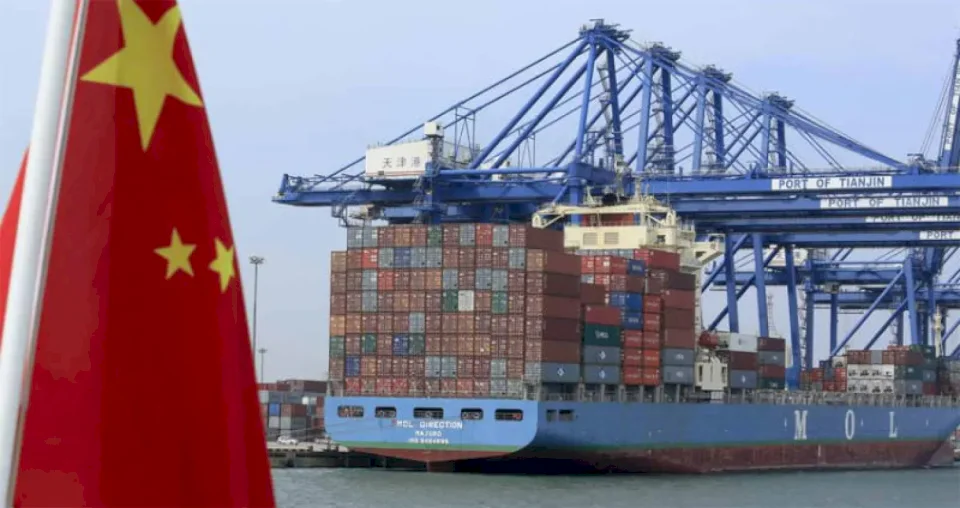
China's Exports Surge Beyond Expectations Supported by Artificial Intelligence
SadaNews - China's exports and imports grew at a faster pace in May, exceeding expectations, as strong demand for artificial intelligence-related equipment compensated for disruptions caused by the conflict in Iran.
Exports jumped by more than 19% compared to the same period last year, marking the highest growth rate in three months, according to a statement from the General Administration of Customs released on Tuesday. This compares to an average forecast of 15% from economists surveyed by Bloomberg.
Imports also surged by more than 27% in May, resulting in a trade surplus of $105.4 billion, the largest since January.
Hao Zhou, chief economist at Guotai Junan International Holdings, said that the robust growth in exports "indicates continued support from demand for AI-related equipment, and possibly also reflects acceleration of some foreign orders amid geopolitical uncertainty." He added that "the strong performance of exports provides significant support in the face of weak domestic demand."
AI Infrastructure Drives Asian Trade
The global expansion in building AI infrastructure has become one of the key drivers of Asian trade this year, despite the global energy crisis triggered by the conflict in the Middle East. This has resulted in significant gains for companies like South Korean giant Samsung Electronics, as well as lesser-known Chinese equipment firms like Zhongji Innolight, which specializes in producing optical modules essential for data centers.
Exports of computers and their components rose by 66% in May compared to last year, recording the fastest growth rate since 2010, up from a 47% increase in the previous month. Integrated circuit exports soared by 111%, the highest since 2013.
Chinese exports to the United States rose by around 36%, marking the fastest pace since 2021, continuing to recover after a long series of double-digit declines during the trade war initiated by Donald Trump. Export growth accelerated to most major regions, except for the European Union and Latin America.
Meanwhile, Chinese imports are increasing as companies ramp up purchases of chips and foreign equipment. South Korea's semiconductor exports to China jumped by over 200% in May compared to the previous year.
Divergence in Chinese Trade and Industrial Output Performance
The AI boom is driving an unbalanced expansion in trade, industrial output, and industrial profits in China. In April, semiconductors and computers accounted for half of the growth in Chinese exports, while traditional products like clothing showed little to no growth.
This divergence complicates the task for economic policymakers in China, as large parts of the economy still suffer from weak consumer demand while some factories linked to the AI sector thrive.
Moreover, the strength of exports may make Chinese authorities more comfortable with a rising yuan. Unlike labor-intensive products, high-tech exports are less affected by the appreciation of the local currency.
Rise in Chinese Export Prices
With the sharp rise in oil, chip, and metal prices, Chinese export prices soared in April at the fastest pace in three years, reversing years of near-constant decline. However, these increases did not transfer to most other Chinese goods, indicating that the intensity of domestic competition still limits manufacturers' ability to raise prices for buyers.
Despite being the world's largest oil importer, China is buying significantly less crude oil from abroad, with imports declining by 5% in the first five months of 2026 compared to the same period last year.
"China achieved strong export growth despite global economic uncertainty and the rise of the renminbi this year," according to Chiu Wei Chang, chief economist at Pinpoint Asset Management, using the official name for the Chinese currency. He added that "the strong growth in exports reflects the competitiveness of Chinese companies in international markets."
 Follow the latest Sada News via Google News
After raising $7.7 billion for Israel since the Gaza war.. "Luxembourg closes the window o...

The Approach of Oil Prices to $100 Puts the "Fed" and Its Peers to the Test

The Broadest Reform of Saudi Education Governance in Decades May Pave the Way for Bigger I...

Gold prices reach nearly $4,053 per ounce

Global Equity Funds Continue Gains for the Ninth Week

Gold Retreats as Dollar Approaches Its Highest Levels

النفط فوق 100 دولار متجها لتحقيق رابع مكسب أسبوعي على التوالي
