

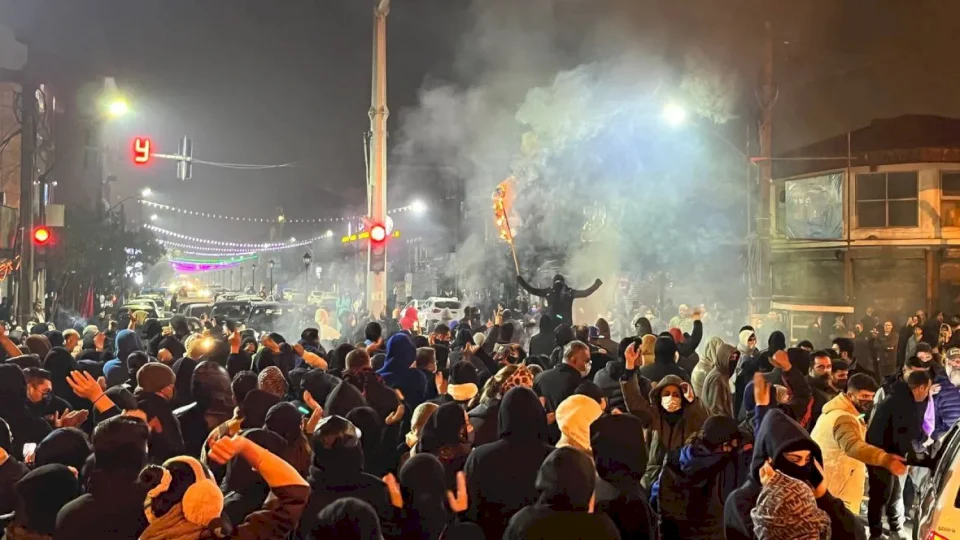
Tehran Announces Official Toll from Protests and Warns Washington of Comprehensive Conflict
SadaNews - The Iranian authorities revealed for the first time the official toll of victims from the recent protests, announcing that the death toll has reached 3,117 people, while Foreign Minister Abbas Araghchi warned of the risks of the confrontation with the United States sliding into a comprehensive conflict.
This warning comes amidst escalating internal repercussions from the crackdown campaign, ongoing arrests, internet disruptions, and conflicting narratives about the death toll, against a backdrop of growing international pressure and demands for investigation and accountability.
Araghchi issued a direct warning to Washington, emphasizing that Iran "will respond with all its capabilities if it faces a new attack," pointing out that "any future confrontation will be long and extensive, and will exceed the limited war calculations talked about by Israel."
He stated in an opinion piece published in the Wall Street Journal that "the violent phase of the internal disturbances lasted less than seventy-two hours," blaming the violence on what he termed "armed groups and saboteurs," noting that the state "has regained control."
The minister noted that his country, contrary to what he called restraint during the 12-day war with Israel in June, will not hesitate to use its full military capabilities if a new confrontation is imposed on it, adding that this is not a threat, but a description of reality as he sees it.
He clarified that "any forthcoming conflict will not be limited to Iran's borders, but will extend to encompass the entire region, affecting the global economy, energy security, and maritime navigation," considering that ignoring these realities "represents a dangerous gamble" by his country’s adversaries.
At the same time, Araghchi sought to keep the window for dialogue open, stressing that diplomacy remains a viable option if Washington engages with Tehran respectfully, referring to the duality of rhetoric between threats and de-escalation.
Araghchi's statements come in the context of mutual escalation with the United States, after U.S. President Donald Trump ramped up his rhetoric once again, hinting at the possibility of military intervention and demanding a change of leadership in Iran, remarks that triggered angry responses among Iranian officials.
The repercussions of the security campaign that ended a wave of protests that began in late December due to the economic crisis continue, before transforming in January into a broad political movement that openly challenged the regime, leading to a significant number of casualties and injuries.
The Iranian television announced the first official toll of the recent protests, stating that it has reached 3,117 dead.
This comes after Reuters reported from an Iranian official in the region that 5,000 have died in the protests, including about 500 security personnel. No denial or confirmation was issued by the authorities at that time.
According to the Iranian Human Rights Activists Organization (HRANA), based in the United States, the confirmed number of dead reached 4,519 by Tuesday evening, while over 9,000 cases of death remain under investigation, in what has been described as the highest toll in decades.
HRANA indicates that among the dead are 4,251 protesters and 197 security personnel, and reports about the arrest of approximately 26,500 individuals, relying on a network of activists inside Iran, in the absence of any official statistics and ongoing restrictions on access to information.
For his part, Mahmoud Amiri Moghaddam, Director of the Iran Human Rights Organization based in Oslo, stated that the number of dead may exceed the highest media estimates that suggest 20,000 dead, describing what occurred as one of the largest massacres against protesters in modern times.
These figures are accompanied by increasing concerns about the fate of the detainees; HRANA indicates that about 26,000 people have been arrested, amid warnings about the possibility of executing some of them.
In this context, an analytical statement was issued by doctors and medical specialists outside Iran, which HRANA relied upon, discussing evidence of targeting injured protesters while receiving medical treatment or leaving them without care.
The statement clarified that a review of photos and videos showed the presence of catheters, breathing tubes, and medical monitoring equipment on bodies found outside treatment facilities, suggesting that injured individuals may have died or been killed after the onset of treatment, violating the principle of medical neutrality.
The statement also referenced scenes of injured individuals shot by bullets, left without medical sorting, as well as unexplained surgical scars, along with signs of severe physical violence, mutilation, and mass transport of corpses.
The authors of the statement confirmed that these conclusions, although based on public visual evidence, are consistent with patterns of systematic violations and aim to support any future independent investigations.
Simultaneously, NetBlocks reported that internet interruptions in Iran exceeded three hundred hours, pointing to the use of what is known as the "white internet" to influence public opinion outside the country, while communications remain restricted since January 12.
"Unrealistic"
In contrast, Iranian authorities intensified their presentation of the official narrative of events, as the head of the judiciary Gholam Hossein Mohseni Ejei questioned the victim toll, describing it as "unrealistic," and pledging to announce an accurate toll later.
Ejei stated that "those involved in the killings and sabotage did not merely disrupt public order, but committed acts affecting state security," announcing a lack of tolerance and calling for tightening the legal framework.
He also announced directing legal authorities to prepare urgent legislative proposals if there are legislative loopholes, considering that "what occurred is an extension of what he described as the 12-day war, and that the enemy resorted to rumors after its failure."
This narrative was supported by several officials, including the chairman of the National Security Committee in Parliament Ibrahim Azizi, who called for the enactment of more effective laws to support the police, praising what he described as an intelligent distinction between protesters and saboteurs.
For his part, police chief Ahmad Reza Radan announced the continuation of strict measures against the leaders of the disturbances, affirming the ongoing security operations in various provinces.
The state television broadcast extensive reports on the damages, including field tours for journalists and foreign diplomats, showcasing burned buses, damaged buildings, and mosques that had been vandalized. The television reported that 25 foreign ambassadors participated in the tour in coordination with the Ministry of Foreign Affairs.
The state television also conveyed statements from a forensic official discussing the nature of injuries he described as intentional, emphasizing that some wounds indicate an intention to kill, noting that about a quarter of ambulances in Tehran were rendered out of service due to the disturbances. In this context, a cemetery washing official discussed shocking scenes of corpses.
The Security Campaign
Arrests continue following the wave of protests in Iran, according to local media and human rights organizations, and Iranian state media continue to report on the arrest of individuals accused of participating in a "terrorist operation" allegedly incited by Israel and the United States, Iran's arch-enemies.
In related developments, the Ministry of Intelligence announced the arrest and killing of elements it identified as belonging to armed groups in Baluchistan, seizing weapons and explosives, while reports indicated ongoing arrests in several provinces including Fars and Kerman.
In the Kurdistan region, an Iranian Kurdish opposition group in Iraq alleged that Iran targeted one of its bases with drones and missiles, resulting in the death of one fighter, a development that Tehran has not officially acknowledged.
On the other hand, the judiciary's lawyers' union announced filing a lawsuit against U.S. President Donald Trump and the Pahlavi Foundation, accusing them of "supporting terrorism and inciting violence."
Meanwhile, Iranian media published photos of former President Hassan Rouhani and former Foreign Minister Mohammad Javad Zarif at mourning ceremonies, denying reports of their arrest or contact with opponents abroad.
Journalists' Observations
Journalist Elham Mohammadi, who was arrested during the Mahsa Amini protests, stated in a post on the platform "X" that Tehran "reeks of death."
Mohammadi reported that access to the internet has become extremely intermittent, lasting only half an hour to an hour daily, in an attempt to inform the outside world that journalists "are still alive."
She added that she had never witnessed snowfall in Tehran without it being met with any smiles, indicating the depth of public shock. She explained that her newspaper "Ham Mihan" was suspended after three and a half years of publication, asserting that her team had tried in recent days to document as many names of the dead and injured across various regions, from testimonies of doctors and nurses who witnessed the catastrophe with their own eyes and did their utmost.
She added that the country "is in a state of collective mourning, widespread shock, and suppressed grief affecting everyone."
Also, her colleague Mohsen Salehi Khah, in the suspended newspaper "Ham Mihan," wrote a different narrative characterized by a sharp questioning tone regarding the state’s responsibilities.
Salehi Khah cited on the "X" platform that after 13 days of internet interruption, he went to the newspaper's office only to bid farewell to his colleagues, using a fleeting connection to the network to publish his stance. He relied on the official narrative that describes protesters as "terrorists" and attributes the deaths of thousands to "Mossad agents," raising two possibilities: either there is a serious security and intelligence failure that necessitates the isolation and trial of the responsible leadership, or there is prior knowledge of what is happening and allowing events to escalate to justify widespread repression.
He added that the result, according to the same official narrative, represents the second largest security catastrophe in Iran's history, compared to the 12-day war which resulted in fewer casualties. He published a picture of a Kalashnikov bullet casing that he claimed was found lying in the street.
For its part, the "Narges Mohammadi" Foundation, a Nobel Peace Prize winner in 2024, urged the international community to pressure Iran to halt the killings, demanding the abolishment of death sentences, restoration of the internet, and the formation of an independent international investigative committee, warning of ongoing violations.
The U.S. State Department emphasized that the protests in Iran are the result of "years of repression and mismanagement," and not a consequence of foreign government interference, rejecting Tehran's attempts to blame the outside for what is happening.
The official Persian page of the Ministry stated that accusing other countries of involvement in the protests represents a "laughable attempt to rewrite reality," considering that denying internal causes and blaming external parties only serves political propaganda and does not convince public opinion.
In parallel, the U.S. State Department called on Iranian authorities to respect citizens' basic rights, cease using violence against protesters, and release those detained in connection with peaceful protests, asserting that the escalation of repression, including the threat of executions, deepens Iran's isolation and exacerbates the crisis instead of containing it.
 Follow the latest Sada News via Google News
Jordanian Army Intercepts 4 Iranian Missiles and 4 Drones

Death of a Moroccan Man During His Arrest in Italy Sparks Calls for Investigation

Due to Trump's Sanctions.. Canada Cancels Joint Ceremony with the US for Bridge Opening

Trump: We will make great progress with Beirut.. Aoun: It is time for Lebanon to be stable

The Lebanese Army Deploys in the South and Comes Under Gunfire; Israel Clarifies

Bezhkian: Directives from the Leader to End the State of No War, No Peace

Meeting Between Aoun and Trump Expected Alongside 'Experimental Areas'
