

Mustafa: We are working on institutional governance for the health sector
SadaNews - Prime Minister Mohamed Mustafa confirmed the government's effort to provide the best services to citizens through sound institutional governance, leading to financial sustainability.
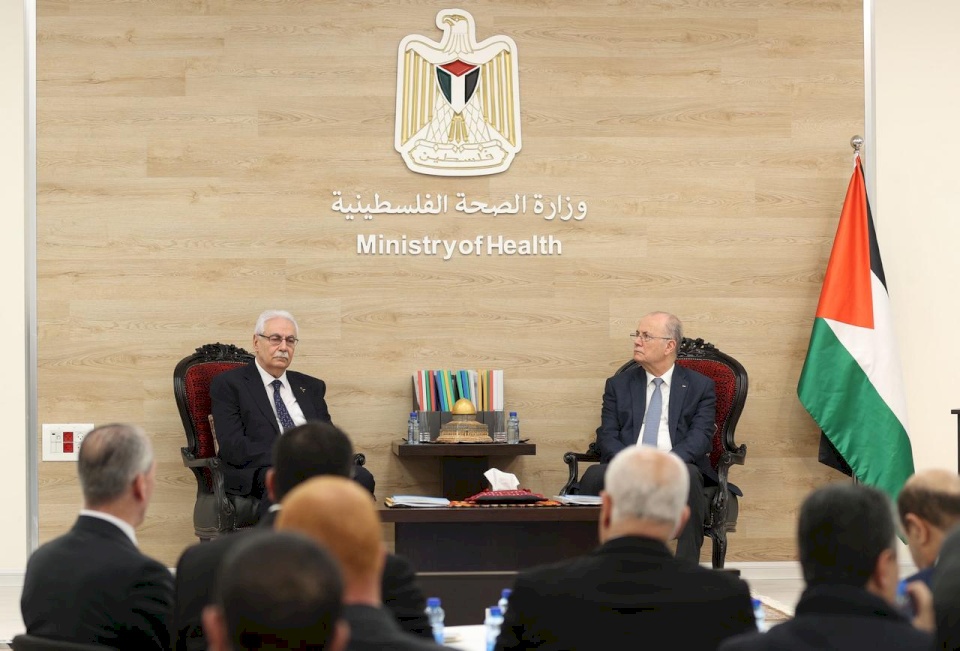
This was stated during his speech at the launch workshop for the health governance, quality, and patient safety strategies for the Ministry of Health, held today Wednesday at the ministry's headquarters in Ramallah, in the presence of Health Minister Majid Abu Ramadan, along with several ministers, officials, international partners, and health ministry staff.
The Prime Minister added: "While we strive to provide health services to citizens with better quality, we are working on institutional governance, which is a national duty, to achieve financial sustainability amidst limited resources and the challenges and difficult conditions we face."
Mustafa emphasized that "optimal management of available resources is extremely important, our financial capabilities are limited, and the health sector's budget within the Palestinian budget is relatively large, which indicates our interest in this sector and desire to provide this essential service to citizens with better quality."
He praised the efforts of the Ministry of Health, which has made significant progress in a range of measures related to digital transformation and medical referrals, estimated annually at around one billion shekels, which constitutes a third of the Ministry of Health's budget, aiming to rationalize expenses by localizing health services, enhancing the level of services provided, increasing capacities, and relying on the local sector from another perspective.
For his part, the Health Minister stated: "The launch of the governance and quality strategies comes in the context of a comprehensive functional review of the Ministry of Health, which reaffirmed the two pivotal roles of the ministry enshrined in the Palestinian Public Health Law of 2004: providing health services as a primary provider and regulating the health sector as a regulatory and leading body. These strategies and the action plans derived from them are among the most important outcomes of the functional review process, enhancing the institutionalization of the health system and raising its readiness and effectiveness at various levels."
Abu Ramadan added: "These strategies address pivotal issues that are at the core of developing the health system, most notably improving the quality of health services, enhancing patient safety practices, localizing health services, reducing the need for referrals abroad, and strengthening partnerships and coordination between the public and private sectors, as well as developing cooperation with international organizations, donor entities, and civil society to support the priorities of the health system and promote digital transformation to enable data-driven decision-making, and building human resource capacities, which are fundamental in providing high-quality health services."
He continued: "It is impossible to talk about governance and quality without addressing the catastrophic health scene in the Gaza Strip, where our health teams face one of the harshest humanitarian and medical crises in modern times. Despite the extensive destruction of the health infrastructure and shortages of supplies, the government continues, under the directives of the Prime Minister and with the efforts and work of ministry staff, to do everything it can to ensure the entry of medicines, consumables, and surgical supplies, and to enhance the operational capacity of the few centers that are still functioning."
 Follow the latest Sada News via Google News
Mossad Chief Visited Washington to Discuss Iran and Its Nuclear Program

Report: Washington Informed Israel It Is Preparing to Intensify Attacks on Iran and Use St...

Organization of Islamic Cooperation Condemns Nauru's Decision to Open an Embassy in Occupi...

Video:: Nablus: Settlers Evict Tubasi Family from Their Home in Jaloud and Take Over It

Netanyahu: I Intend to Form a Broad National Unity Government

Syrian Foreign Minister Meets with Yasser Abbas in Damascus

Al-Hayya: Our Priority is to Completely End the War and Restore National Unity
