
"National Beverages" and "Al-Tayf for Dairy and Food Products" Sponsor Workshop for Consumer Protection Association
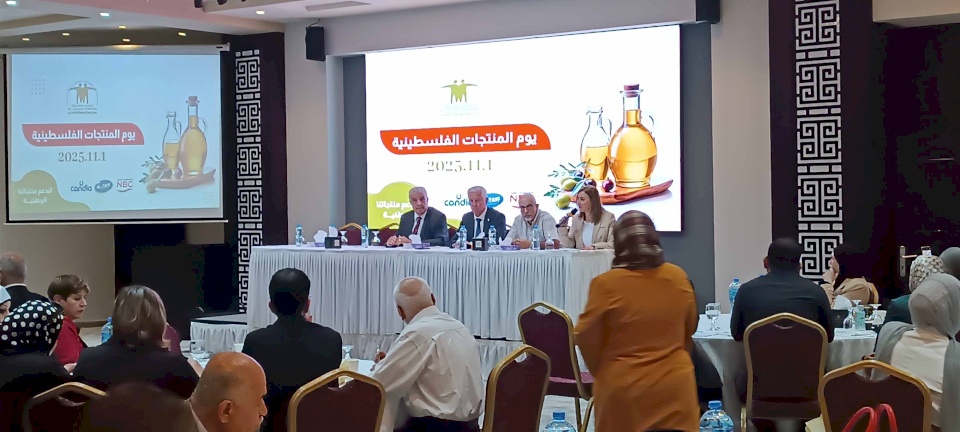
SadaNews – National Beverages Company and Al-Tayf for Dairy and Food Products (Kandia) have sponsored a workshop organized by the Palestinian Consumer Protection Association on the occasion of Palestinian Products Day, which is celebrated on November 1 each year, at the Carmel Hotel in Ramallah.
The event was attended by Minister of Industry Arafat Asfour, Chairman of the Board of the General Union of Palestinian Industries Abdul Hakim Faqih, and Chairman of the Palestinian Consumer Protection Association Salah Haniya, along with representatives from the public and private sectors, civil society organizations, women's associations, and several Palestinian universities.
A group of Palestinian companies also participated in an exhibition showcasing their products, including: Qatafa Investment and Marketing Company, Vegetable Oil Factories Company, UniPal/Reema, National Beverages, Kandia, Zadna for Food Manufacturing, Al-Rajeh Chemical Detergents Factory, Nice, and Palestinian Friendship for Chemicals.
This year's event aimed to enhance the position of high-quality Palestinian products and increase their market share by discussing strategic axes addressing the replacement of imports and its impact on supporting local products, the objective and external challenges facing the Palestinian industry, with a focus on marketing and professional promotion of local products.
For his part, Minister of Industry Arafat Asfour stated that the Palestinian industry has made significant strides since 1994 to date, with more than 40% of local industry being Palestinian-made, up from less than 10% 30 years ago.
He pointed out that the Palestinian market was previously flooded with imported products, unlike the current situation, which could not have been achieved without government regulations allowing many establishments to operate and establish hundreds of factories equivalent to the latest technologies and factories existing globally, alongside the establishments themselves which have made significant progress and invested in workforce and modern technology.
Asfour emphasized the need to encourage citizens to support local products, now that they have a significant presence in the markets, for example: dairy and cheese comprise 80% or more, and medicines 60%, while the expected percentage of animal feed in the market is 60%.
Meanwhile, the Chairman of the Food Industries Union Abdul Hakim Faqih noted that we have become accustomed to importing goods from abroad without resorting to agriculture and industry with Palestinian hands that contribute to resisting the occupation.
He explained that about 60% of the products in the Palestinian market are locally produced, with support for local products continuing amid the ongoing boycott campaign, hoping it remains steady and does not stop at a certain stage.
He touched on the challenges facing the labor market, the most significant being the occupation and its role in restricting the movement of producers and industrial facility owners through checkpoints and cutting off areas.
For his part, Mr. Imad Hindi, General Manager of National Beverages Company and Al-Tayf for Dairy and Food Products, clarified that sponsoring the workshop comes "as a confirmation of the private sector's commitment to support the national economy and to reinforce the Palestinian consumer's conviction in the quality of local products and their competitiveness," adding that Palestinian industry "has the competencies and expertise that enable it to achieve growth and sustainability."
He added that the two companies actively contribute to supplying the Palestinian market with high-quality products that meet the needs of the Palestinian consumer with international specifications, while continuously adhering to the highest standards of quality and safety at various stages of production," affirming that National Beverages Company and Al-Tayf "place the Palestinian consumer at the core of their priorities and work on developing their products and supplying the Palestinian market with new products that meet the aspirations of the Palestinian consumer and compete with imported products."
Chairman of the Palestinian Consumer Protection Association Salah Haniya stated that the Palestinian economy witnessed, after two years of genocidal war, the erosion of a third of the production base in Palestine due to its contraction in the West Bank, and the near-total collapse of the economic system in Gaza, with unprecedented unemployment rates reaching half of the workforce, and a suffocating financial blockade affecting various vital sectors, along with high levels of food insecurity.
He added: We stand today on solid ground witnessing an activity of chemical products at a rate of 93%, especially in the cleaning products sector, and growth in the food and beverage sector at a rate of 62%, particularly in the dairy sector, grain milling, vegetable oils, meat preservation, and animal feeds. This comes alongside an increased focus on quality standards and adherence to them, such that consuming Palestinian products is no longer merely because they are Palestinian, but because they are high-quality, diverse, and meet the marketing needs of the consumer.
Haniya called on the official bodies to be strict on consumer protection issues from harmful and non-compliant products, uncovering their market sources, activating the recommendations of the Import Replacement and Anti-Dumping Committee, enforcing Palestinian standards on imported products, especially from the Israeli market, and granting exemptions and reductions for Palestinian products, provided they reflect a drop in consumer prices, alongside partnership with the private sector to open new markets and focus on activating industrial areas.
 Follow the latest Sada News via Google News
Collaborative Efforts of Jerusalem Water Authority and Municipalities of Birzeit, Ajjul, A...

Housing Bank Donates to the Palestinian Red Crescent Hospital in Halhul

Mutual Honor Between Bethlehem Governorate and Jerusalem Electricity Company and Confirmat...

Ooredoo Palestine Allows Activation of VoLTE Service with Local Roaming Packages in Jerusa...

Quds Bank, the Diamond Sponsor of the Student Company Competition 2026 Organized by the In...

"Education" and Ingez Palestine Conclude the 18th Edition of the Student Company Program a...

The National Bank Supports the Launch of the First Specialized Program in Economic and Ban...
