

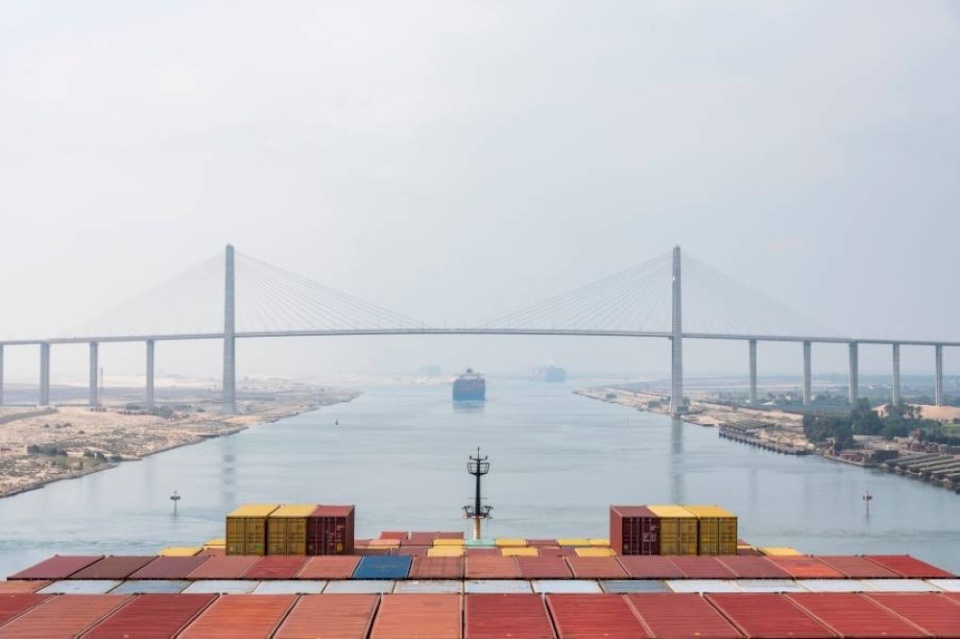
Suez Canal Raises Additional Fees on Ships to Boost Revenue
Sada News - The Suez Canal Authority has raised the additional fees imposed on most categories of ships transiting the canal, effective from mid-July, to enhance navigation revenue as the crossing traffic continues to improve amid changes in the global shipping market.
The canal holds significant importance, representing a transit point for approximately 15% of global merchandise trade, with this percentage approaching double regarding container traffic, according to Bloomberg.
Navigational publications issued by the authority, which "Asharq" has reviewed, indicate the increase in additional fees, confirming that these fees are temporary and subject to adjustment or cancellation based on market changes.
The Suez Canal has continued its gradual recovery in shipping traffic, achieving positive growth for the third consecutive quarter at a rate of 23.6%, supported by the regularity of transit operations and the sustained provision of maritime services despite regional tensions.
Closure of Hormuz Supports Suez Canal
The increases include crude oil tankers and petroleum derivatives, raising the additional fees to 37% of the regular transit fees from 25% previously, while fees for empty tankers of both types increased to 27% from 15% earlier.
The conflict between the United States and Iran has caused a near closure of the Strait of Hormuz, a vital corridor for energy trade and shipping in the region, prompting some shipping lines to redirect their routes through the Red Sea, which has partially activated shipping traffic in the Suez Canal.
Gas Tanker Fees
In the gas sector, additional fees on liquefied petroleum gas (LPG) carriers and chemical and other liquid carriers have been raised to 32% of regular transit fees from 20% previously. The increase also includes additional fees on liquefied natural gas (LNG) carriers to 19% from 7% earlier.
The Suez Canal is a vital source of foreign currency for the Egyptian economy, and authorities are betting on it as a key platform to attract foreign investments and boost exports to African and Arab markets.
The decisions also included dry bulk carriers, with additional fees raised to 22% of regular transit fees compared to 10% previously. As for general cargo, multipurpose ships, heavy lift carriers, roll-on/roll-off vessels, car carriers, special floating units, and other ships, the authority increased additional fees to 26% instead of 14%.
For car carriers, the authority decided to apply the new 26% fees on northbound transiting ships, while introducing additional fees of 12% on southbound ships.
For the first time, the Suez Canal Authority imposed an additional fee of 12% on container ships from the total transit fees, which includes the basic transit fees and surface container handling fees, effective from mid-July.
 Follow the latest Sada News via Google News
Gold prices reach nearly $4,053 per ounce

Global Equity Funds Continue Gains for the Ninth Week

Gold Retreats as Dollar Approaches Its Highest Levels

النفط فوق 100 دولار متجها لتحقيق رابع مكسب أسبوعي على التوالي

U.S. House of Representatives Approves Budget Plan to Fund War on Iran

Gold Retains Gains Despite Rising Concerns Over U.S. Interest Rate Hikes

Oil Prices Surge Amid Growing Supply Disruption Risk from the Region
