

From Gaza to Washington: When Journalists Become Targets in Times of Polarization and War
SadaNews - The danger facing journalists is no longer just related to standing near the frontlines or infiltrating battlefields. The world, which once viewed journalism as a witness to events, has begun to treat it as a party that must be silenced, undermined, or even eliminated.
In recent years, the threats following reporters were often linked to closed regimes, armed groups, or areas of open conflict, but the scene has changed dramatically.
Today, the pursuit can come from a drone hovering above a combat front, a judicial file waiting for a journalist at their home, or even a political environment that views media as an enemy that must be contained.
This transformation has become more evident with the escalation of wars in the Middle East and the ongoing Russian-Ukrainian war, alongside intensified political polarization within the United States and Europe, where journalism itself has become part of the battle.
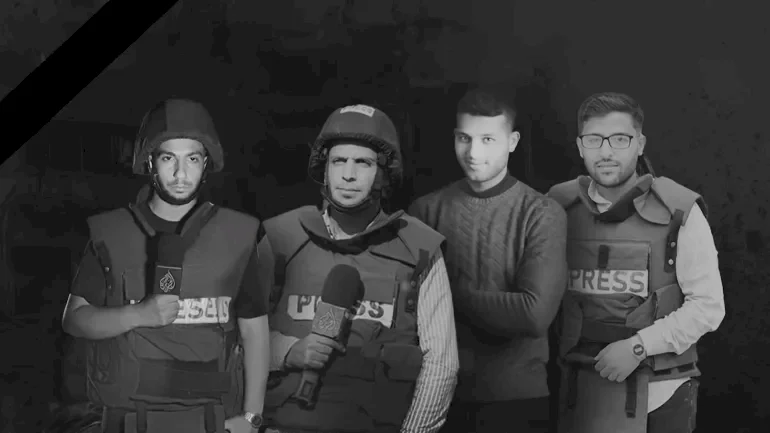
In Gaza, the risks surrounding journalists are no longer just expected professional probabilities but have turned into a daily reality, as reporters navigate bombing zones knowing that a press badge no longer provides protection; it may even make them more susceptible to targeting.
With the expansion of Israeli military operations over the past two years, Gaza has become the most dangerous place in the world for journalists. The Committee to Protect Journalists indicates that over a hundred journalists and media workers were killed in just one year, marking an unprecedented toll in the recent history of the profession.
Within the sector, there are no longer safe areas in the traditional sense. A journalist going out to cover an airstrike or to document the aftermath of bombardment is doing so amid complete uncertainty, where control lines change constantly, and danger zones expand without clear signs.
Thus, journalists now rely on procedures that resemble military tactics, constantly changing routes, sharing their geographical locations with family and newsrooms, avoiding solitary movements, and monitoring security updates minute by minute.
But the danger does not stop at Gaza; in southern Lebanon, covering border clashes has turned into a task fraught with deadly possibilities, especially with the increased targeting of areas near the border. Some journalists now report their movements to United Nations forces before any field assignment, in an attempt to minimize the chances of being bombed.
In Ukraine, drones have imposed a new reality on journalistic work. Trips to the eastern and southern fronts now involve precise calculations, including drone monitoring devices and rapid sheltering plans, while streets covered by protective nets have become part of the daily war scene.
Despite this, journalists continue to head to the front lines, as the complete picture of the war cannot be conveyed from behind screens or official statements.
However, the paradox is that dangers traditionally associated with conflict zones are beginning to manifest in different forms within countries that classify themselves as established democracies.
In the United States, the debate about the media is no longer limited to political criticisms or reciprocal media campaigns; the relationship between power and journalism has entered a more tense phase where politics intertwines with security and the judiciary.
One prominent example appeared with the case of independent journalist Georgia Fort, who was arrested after covering a protest inside a church in Minnesota. The arrest sparked widespread anger among press freedom advocacy organizations, but the deeper impact of the case was not the detainment but what followed.
The case left a large part of her source network out of communication after her lawyers advised her not to contact other defendants in the same case, including community and rights leaders she relied on for her coverage.
In this way, censorship does not always take the form of an official decision to ban publication but can manifest through creating an environment that renders a journalist unable to access the information or core sources necessary for their work.
The sensitivity of this type of case escalates when it involves independent journalism, which primarily relies on direct relationships with local communities and unofficial sources.
Independent journalists often lack the legal or financial cover that major institutions provide. Furthermore, targeting them could effectively disrupt their entire media project.
As trust in traditional media institutions declines, a wave of platforms and independent journalists presenting themselves as closer to local communities or marginalized issues has surged in recent years.
However, this rise has also made them more vulnerable to direct friction with authorities or political and security institutions, especially when their coverage addresses issues related to discrimination, immigration, protests, or civil rights. Simultaneously, large media institutions face another dilemma concerning the cost of journalistic coverage itself.
Working in conflict zones now requires massive budgets that encompass protective equipment, insurance, security training, risk assessment, and ongoing communications. Moreover, newsrooms have become compelled to deal with the possibilities of kidnapping, targeting, or complete communication breakdowns during field missions.
This reality raises pressing questions within media institutions: To what extent can coverage of wars and conflicts continue amidst rising human and material costs?
But perhaps the more complicated question relates to the nature of the role that journalism is supposed to play in this tumultuous global climate.
Amid the rise of populism and political polarization, the very concept of journalistic neutrality has become a topic of discussion within newsrooms and media colleges.
Is a journalist's role confined to conveying different viewpoints, even if they involve anti-democratic or violence-inciting rhetoric? Or should defending democratic values and freedom of expression become part of journalism’s function itself?
This debate is no longer theoretical; in many countries, media institutions are accused of bias no matter how much they try to adhere to traditional standards of objectivity, while other journalists feel that neutrality on certain issues may convert into a form of complicity or silence.
Conversely, governments and political groups have taken advantage of this increasing division to undermine trust in media by portraying journalists as political adversaries or propaganda tools.
With the rise of misinformation campaigns and the spread of digital deception, journalism today faces a dual challenge: protecting journalists themselves and safeguarding public trust in the profession.
A journalist who goes to a combat front or faces a lawsuit due to their coverage is not only defending their personal right to work but is also advocating for a broader idea concerning the public’s right to know what is happening.
Thus, the most dangerous challenge facing journalism today may not only be bullets or arrests but also the global climate that makes targeting journalists a more commonplace and less shocking occurrence. In such a world, the truth itself becomes more costly and more fragile as well.
Source: Al Jazeera
 Follow the latest Sada News via Google News
Mohammed bin Salman and Trump Discuss Cooperation Relations and Regional Developments Over...

Death Toll from Venezuela Earthquakes Exceeds Four Thousand

North Korea: Senior Military Official Removed from Ruling Party Over Corruption Allegation...

Six Injured in Russian Attack on Ukrainian Capital Kyiv

US Treasury Department Issues New Sanctions Related to Iran

Eight People Charged with Planning Attack on the White House to Assassinate Trump, Vance,...

American Official: We Will Oversee Israel's Withdrawal from "Experimental Areas" in Lebano...
