

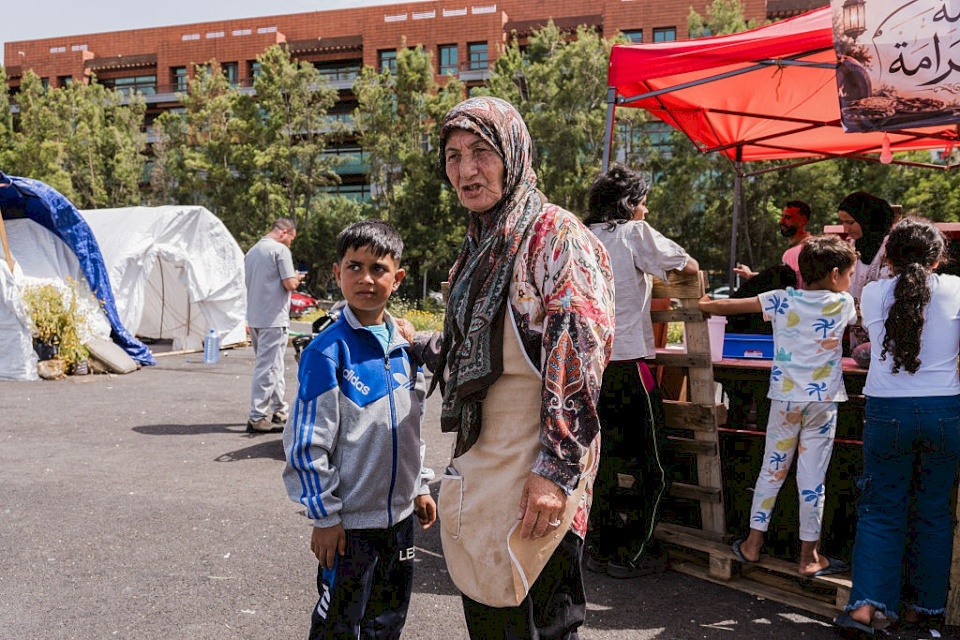
"For the Sake of God": A Seventy-Year-Old Displaced Woman Provides Baked Goods for Free to Displaced Individuals in Lebanon
SadaNews - Amid the backdrop of war and displacement, Lebanese woman Um Muhammad Zaiter has transformed what remains of her destroyed oven in the southern suburbs into a humanitarian initiative to prepare and distribute baked goods for free to those displaced within the camps of the capital, Beirut.
Um Muhammad, who is in her seventies, starts her day before dawn from within a modest tent on Beirut's waterfront. She lights a fire and prepares the dough in preparation for making baked goods, attempting to support families forced to flee their homes due to the Israeli aggression.
Although she is among the large number of Lebanese who have lost their homes and sources of livelihood due to the Israeli attacks, Um Muhammad chose to confront displacement in a different way; she decided to provide food for needy families and has consistently supported the displaced individuals from her own people.
She says, with signs of exhaustion apparent on her face, that the idea to lend a helping hand to the displaced came to her after witnessing the magnitude of suffering in the camps, including many families' inability to secure their children's basic needs.
In an interview with Anadolu Agency, she said about herself: "I couldn't bear this situation, so I took the initiative to help the displaced with my simple means."
Repeated Displacement
Um Muhammad hails from a border area with Syria, near Hermel in eastern Lebanon. She states that she has lived for many years in a state of migration and displacement, having previously been forced to leave her home and farmland due to security conditions.
She explains that she later moved to the southern suburbs of Beirut, where she rented a house and a small oven that she used to work in making the Lebanese flatbread known as manakish, before it fell victim to Israeli destruction.
She remarks on her own situation and that of many others: "We left our homes, livelihoods, lands, and everything behind."
She adds that many families arriving at the camp do not even possess the price of a bottle of water or a piece of bread, which motivated her to restart what remains of her oven despite limited resources.
Um Muhammad confirms that the initiative began with nearly no means, relying initially on some basic materials she had available. She started with a small amount of flour, and as the days passed, the number of beneficiaries gradually increased.
She notes: "The production rose from dozens of manakish to hundreds distributed for free to the displaced."
She explains that residents, volunteers, and shop owners began to offer assistance as soon as they learned about the initiative, whether by donating flour, thyme, oil, cheese, or meats.
"For the Sake of God"
Inside the small tent, Um Muhammad works long hours each day, unconcerned about tiredness or physical exhaustion.
She states that she spent the first nights kneading flour by hand until the early hours of dawn, before starting the baking and distribution process in the morning.
She adds: "I would sleep for a few hours and then wake up at three in the morning. This work has exhausted me, but the children are what keep me going."
Despite losing her source of income, she affirms that she has never thought of selling the food or making any material gain from the initiative, and what she is doing is "a humanitarian act for the sake of God."
Memories of the Land
During her conversation, Um Muhammad reminisces about her previous life in her border town, where she owned lands planted with olive, almond, grape, apricot, and apple trees.
With a sense of sorrow, she states: "We left our lands, homes, and trees; we were living well, and today we find ourselves in a tent."
She points out that the Israeli war has not only destroyed homes but has also shattered a lifetime that residents built over many years.
She adds: "The houses were destroyed, and we can no longer reach our lands."
A Message of Resilience and Solidarity
Despite the harsh experience, Um Muhammad insists on clinging to hope and calling for solidarity among the Lebanese.
She says: "We must remain loving and united, whether we are displaced or in our homes."
She believes that popular solidarity has mitigated the harshness of displacement for thousands of families who are still unable to return to their villages due to continued Israeli bombardment in southern Lebanon.
 Follow the latest Sada News via Google News
Mohammed bin Salman and Trump Discuss Cooperation Relations and Regional Developments Over...

Death Toll from Venezuela Earthquakes Exceeds Four Thousand

North Korea: Senior Military Official Removed from Ruling Party Over Corruption Allegation...

Six Injured in Russian Attack on Ukrainian Capital Kyiv

US Treasury Department Issues New Sanctions Related to Iran

Eight People Charged with Planning Attack on the White House to Assassinate Trump, Vance,...

American Official: We Will Oversee Israel's Withdrawal from "Experimental Areas" in Lebano...
