

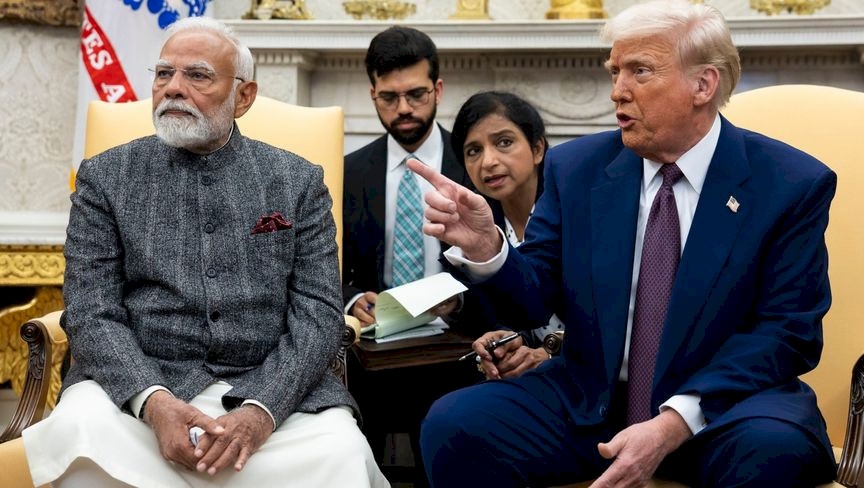
Telegraph: This is how Trump thwarted Modi's dream of making India a superpower
SadaNews - The geopolitical and economic ambitions of India have crumbled under the weight of the unpredictable policies of U.S. President Donald Trump, according to an analysis in the British newspaper Telegraph.
The newspaper's international economics editor, Hans van Leeuwen, wrote that Trump dealt a severe blow to Indian Prime Minister Narendra Modi's ambitions by transforming India from a contender to benefit from this president's return to the White House into one of the countries most affected by his erratic policies and military maneuvers, especially after the widening war in Iran and turmoil in global energy markets.
Leeuwen states that just a few weeks ago, Modi was at the peak of his political power, after his Bharatiya Janata Party secured a sweeping electoral victory, solidifying its control over most Indian states, which seemed to pave the way for his grand project known as "Viksit Bharat" (Developed India), aiming to transform India into a developed nation and superpower by 2047.
However, according to the writer, Trump's military adventure in the region – specifically, the war in Iran and the blockade of the Strait of Hormuz which has surpassed its eightieth day – dealt a strong blow to the Indian economy, which relies 87% on oil and gas imports, leading to a flight of foreign investors, a decline in the currency, and rising inflation.
This situation prompted Moody's to lower its growth forecast for India to 6%, a rate that experts see as insufficient to achieve the "Developed India" goal within less than two decades.
Although this rate appears high compared to major economies, it remains far below the rate New Delhi needs to fulfill its dream of becoming a global power competitive with China.
The writer quotes Chaitig Bhardwaj, a researcher at Chatham House, saying: "To reach its goal called Viksit Bharat, the country must achieve sustainable annual growth of 8%, which India has been unable to accomplish even before the outbreak of the war in Iran."
The writer points out that Modi relied on Trump's second term to bolster India's position against China, but instead found himself in direct confrontation with him over trade tariffs.
Worse yet, according to the article, is Trump's sudden rapprochement with India's strategic rival, Pakistan, which is now playing the role of mediator with Tehran, and China, which has managed to shift Trump's stance from hostility to "reluctant appreciation."
In this context, Dr. Walter Ludwig, a political scientist at King's College London, believes these developments have damaged the 20-year trust between Washington and New Delhi, emphasizing that Indians are discovering today that they "are still at a stage where international system events affect them more than they shape it."
He also asserts that the "Make in India" campaign launched by Modi to turn the country into a global manufacturing hub has not yielded the desired results, as India's manufacturing contribution remains less than one-tenth of China's industrial output.
Leeuwen clarifies that Modi was forced to take severe austerity measures, including asking 1.5 billion Indians to stop buying gold – the country's second-largest import – and enforcing import licenses. The government has also begun to cut capital spending and infrastructure to control the deficit, which represents the fuel for India's growth.
The government did not stop at symbolic calls; it raised tariffs on gold to 15% and imposed restrictions on its importation in an attempt to contain the balance of payments crisis and preserve foreign exchange reserves.
The article also reviews the structural weaknesses in the Indian economy, such as weak investment in advanced technology and education, as well as the nature of the decentralized democratic system that limits the government's ability to make swift economic decisions like China's.
The report notes that the Indian government initially tried to absorb the shock of rising energy prices by using strategic stockpiles, reducing taxes, and providing support. However, the continuation of the war has made this policy exceedingly costly for public finances.
With the rising cost of subsidies and budget deficits, the government has gradually begun to allow fuel prices to increase, while concerns grow that it may have to reduce infrastructure spending—where Modi relies on achieving high growth rates to support the "Great India" project.
The writer concludes that while Modi still maintains political control domestically, his ambition to transform his country into a global superpower is now facing increasing external constraints imposed by Trump's wars and fluctuating alliances, in a highly turbulent international moment, indicating that India's path toward "superpower" status remains long and fraught with challenges amid the turmoil of its American ally.
 Follow the latest Sada News via Google News
Washington Strikes Sites in Iran in Response to Attack on Ship in Hormuz

Occupation Closes Ramallah Entrances and Uses Tear Gas on Citizens, Causing Severe Traffic...

Currency Exchange Rates Against the Shekel on Sunday (July 12)

Weather: Intense Heat in Most Areas

CNN: Omani Proposal for Navigation in Hormuz Through Two Separate Corridors

Lebanon to Participate in Talks with Israel in Rome Next Week

"They held us at gunpoint with American rifles".. Settlers besiege American congressman in...
