

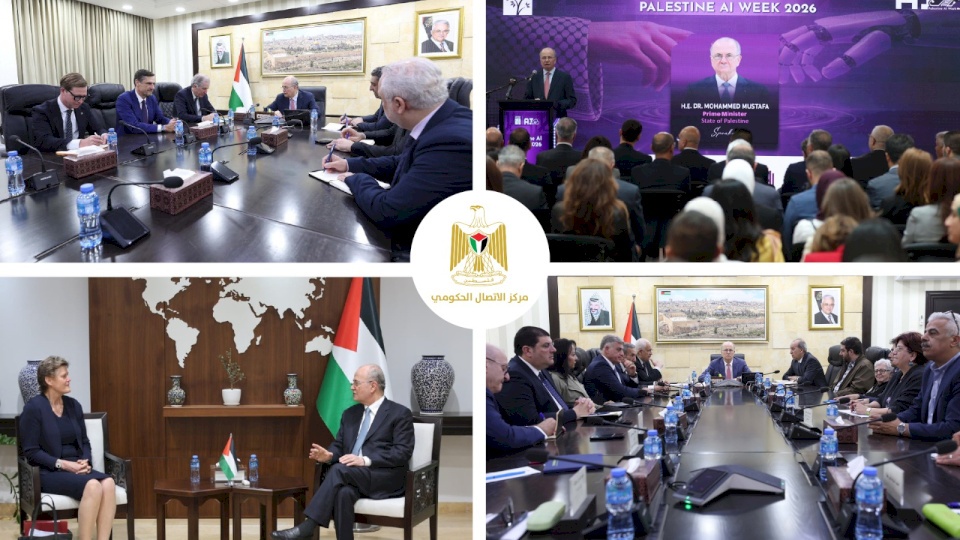
The Government Contact Center Monitors the Main Interventions Carried Out by the Government Last Week
SadaNews - The Government Contact Center issued a report highlighting the most important developmental and reform interventions implemented by the government during the past week (April 26, 2026 – May 2, 2026), as follows:
Prime Minister Mohammad Mustafa announced during the launch of the Palestinian Technology Park the intention to establish a National Council for Digital Economy, with a government commitment to train 10,000 young men and women on artificial intelligence skills, and to qualify and employ 1,000 graduates annually.
He discussed with the British Deputy National Security Adviser the field developments, particularly the escalation of settler attacks and settlement expansion, the continued violation of the ceasefire in Gaza, and the restrictions on the entry of aid.
He also called, during his meeting with the European envoy, for accelerating international efforts to implement Security Council Resolution No. (2803) and relevant international resolutions, and to enhance political and financial support for our people's steadfastness and to halt Israeli measures, in addition to meeting with the network of civil society organizations to enhance coordination.
The Ministry of Foreign Affairs and Expatriates, along with the Ministry of Education and Higher Education, organized a field tour for the diplomatic corps to the villages of al-Mughayer and Abu Falah to observe the occupation's violations and the crimes of settlers.
The Minister of Foreign Affairs participated in a session of the United Nations Security Council discussing the situation in the Middle East, and held a series of diplomatic meetings and communications to garner more political support for our people. The ministry also condemned the establishment of a Jewish school in the Sheikh Jarrah neighborhood of occupied Jerusalem.
For its part, the Ministry of Social Development and its partners implemented a comprehensive package of field interventions; 595 families in the West Bank benefited from food and non-food parcels and vouchers worth a total of 150,000 shekels. Over 139,000 people in Gaza benefited from various food interventions including baby formula, diapers, vegetables, fruits, hot and ready meals, bread, food parcels, beets, and dates, along with 775 cups of potable water. Additionally, 1,386 people benefited from clothing, health parcels, stationery, and blankets, as well as the preparation of educational points, maintenance of a water well, and the implementation of a sports activity.
In the realm of women's protection, 130 interventions were implemented in the West Bank, while 3,361 beneficiaries in Gaza gained access to individual and group psychological support services, phone consultations, case conferences, institutional referrals, and follow-ups for victims of psychological and physical violence.
The interventions also included 235 interventions in the childhood file and 112 interventions related to juveniles in the West Bank. In the orphans’ file, 1,068 orphans in the West Bank benefited from various interventions, while 721 beneficiaries in Gaza received support through sponsorships, vegetable parcels, urgent responses for families, as well as the provision of diapers and milk. Additionally, 53 interventions for persons with disabilities were executed in the West Bank.
The interventions also targeted the elderly by implementing 109 interventions in the West Bank, in addition to providing 234 new health insurance services and renewals, 58 interventions concerning nurseries, and 55 interventions in economic empowerment, alongside qualitative interventions in volunteering, training, and supporting charitable associations through the ministry's directorates.
For its part, the Ministry of Education and Higher Education announced the availability of scholarships in Vietnam for a bachelor's degree in the fields of engineering and agriculture for the academic year 2026-2027.
The minister also signed a memorandum of understanding with the president of Birzeit University to enhance cooperation in the fields of artificial intelligence and emerging technologies. The ministry completed the establishment of Jinsefout Mixed Secondary School in Qalqilya at a cost of 880,000 dollars, along with offering tenders for the maintenance and rehabilitation of Kfirat School in Jenin at a cost of 100,000 dollars and four schools in Bethlehem at a cost of 380,000 dollars, expanding Jalud Secondary School south of Nablus at a cost of 300,000 dollars, and supervising the expansion of Duma School at a cost of 44,400 dollars.
Regarding student achievements, Abu Ali Iyad Girls School in Qalqilya won first place "Champion" in the Future Science Challenge for the project "Smart Tour Guide (Masar)," while Talai al-Amal School in Nablus achieved first place regionally in the "Nation of Innovation" competition. In practice, the ministry organized support and advocacy visits for the students of Um al-Khair School in Masafer Yatta and diplomatic tours to observe the conditions in Mughayer village.
The Ministry of Health launched emergency and ambulance protocols in partnership with the Medical Relief Society to enhance rapid response, and held a meeting with health sector unions to agree on a mechanism that ensures the continuity of services according to the law. They also warned against using the "Wegovy" product outside official channels, emphasizing the necessity of medical consultation.
An achievement was made by bringing the waiting list for internship doctors down to zero, and a draft national strategy for sexual and reproductive health (2026-2030) was completed with an update on the breast cancer protocol and the development of reproductive health indicators. An evaluative visit was carried out to Caritas Hospital in cooperation with the World Health Organization within the patient safety initiative, which revealed a notable commitment to standards, treating complex dental cases for children with disabilities at Palestine Medical Complex, while the internal audit unit executed 42 audit tasks and participated in 143 committees during the first quarter, enhancing institutional performance efficiency.
The Ministry of Industry implemented a series of interventions to enhance the competitiveness of the industrial sector, most notably launching an industrial city incentives program with European funding of nearly 9 million euros to encourage the relocation and expansion of companies, increase productivity and create jobs, in parallel with organizing introductory workshops in Hebron, Nablus, Jenin, and Tulkarm.
The ministry also discussed with the Energy Authority enhancing integration and developing an electrical tariff supportive of industry and encouraging renewable energy, and participated in the launch of National Occupational Safety and Health Week with an initiative to form specialized committees and reassess hazardous professions, additionally conducting field visits to facilities. In terms of partnerships, support for the industry in Jerusalem was discussed with the Arab Chamber of Commerce, enhancing economic resilience.
On the ground, the interventions included issuing a new facility license and two operational licenses for the first time, renewing 29 licenses, conducting 38 inspections, with a capital of 52,100 dinars and job opportunities for 10 workers in the new facilities, in addition to renewing a quarry license, holding 3 technical committees, and issuing two laboratory accreditation certificates.
The national team for following up on the file of missing persons and those forcibly disappeared commenced its work under the leadership of the Minister of Justice, who also continued to follow up with the
 Follow the latest Sada News via Google News
Israeli Army: 8 Palestinians Arrested for Attempting to Pursue Settlers in Mikhmas

Conviction of Pro-Palestinian Protesters Following Rally in America in 2024

Two Martyrs in Israeli Shelling in Southern Lebanon and a Soldier Seriously Injured

Foreign Ministry Denies Qaddou's Allegations Regarding South Africa’s Lawsuit

Arrests During the Raids of Occupation Forces in Various Areas of the West Bank

The Occupation Continues Its Violations of the Ceasefire in Gaza Strip

Report: Washington feared Israel's assassination of Qalibaf and Araqchi during negotiation...
