

Hamas: Meetings with Mediators to Establish Paths for Full Implementation of the Gaza Agreement
SadaNews - Hamas spokesperson Hazem Qassem revealed that there is a delegation from the movement "currently in Cairo, with meetings taking place with mediators and guaranteeing countries," to establish pathways for the full implementation of the Gaza agreement.
Qassem stated in an interview with Anadolu that "there are continuous communications and negotiations between Palestinian factions and mediators" concerning the agreement that came into effect in October 2025.
He added that "there is now a delegation from Hamas led by Dr. Khalil al-Hayya (head of the movement in Gaza) in Cairo, with meetings held with mediators and guaranteeing countries to establish pathways for the complete implementation of (U.S. President Donald Trump’s) plan for peace in the Gaza Strip," without providing details about the visit or its duration.
He continued that the meetings also address "ensuring the implementation of what was presented in the first phase, particularly its humanitarian aspect, and engaging in parallel negotiations regarding the second phase with its various pathways."
Trump announced a plan to end the genocide conducted by Israel against Gaza on September 29, 2025, which includes a ceasefire in its first phase, a partial Israeli withdrawal from the sector, the release of remaining Israeli prisoners within it, and the entry of 600 trucks of aid daily.
While Hamas adhered to the commitments of the first phase by releasing Israeli prisoners, Israel reneged on its relief commitments and continued its aggressions.
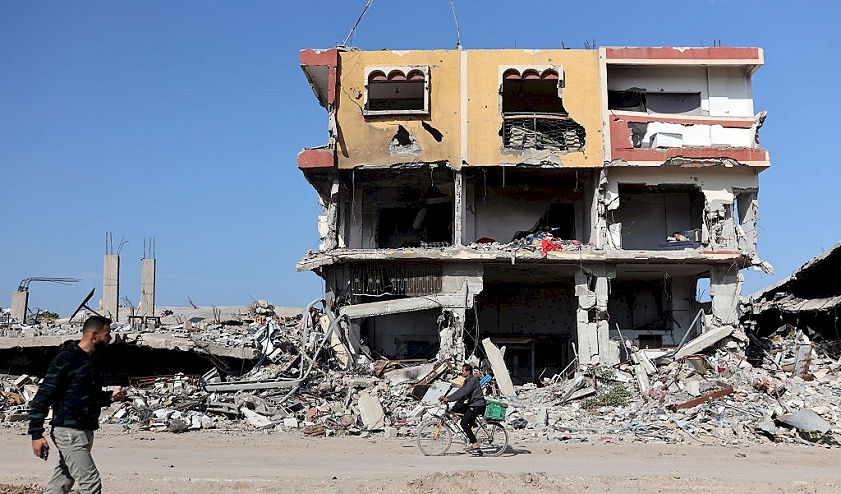
Moreover, the Israeli army continues its violations of the ceasefire agreement since October 10, 2025, through shelling and gunfire, resulting in the martyrdom of 828 Palestinians and the injury of 2,342 since that date alone, according to the latest Palestinian health statistics.
The second phase of the agreement includes a broader withdrawal of the Israeli army from the Gaza Strip, which still occupies more than 50% of its area, and reconstruction, in exchange for the commencement of the disarmament of factions, which Israel has also failed to implement, insisting instead on disarming first.
"Hamas is Dealing Positively with the Proposals of Mediators"
According to Qassem, "Hamas has dealt positively and with interest with what the mediators have proposed in terms of approaches to ensure the implementation of various aspects of this agreement, amid clear Israeli intransigence and violations represented in killings and tightening the siege on the people of Gaza."
He revealed that "there are different proposals," indicating that "what was proposed at the beginning of this path was unacceptable and adopted the Israeli position, with movement thereafter from the mediators to find multiple approaches, and there is interest from Hamas in engaging with the special effort, particularly from the Egyptian, Qatari, and Turkish mediators."
He added, "We are engaging with these various proposals with interest, positivity, and seriousness, to ensure the implementation of various aspects of the agreement and what was stated in the first phase, particularly regarding the humanitarian aspect, and engaging with the pathway related to the second phase regarding its branches including the entry of the National Committee to manage the Gaza Strip, the issue of international forces, and the matter of dealing with Palestinian weapons."
Ali Shath, head of the Gaza Administration Committee, announced via Facebook that the committee has received preliminary approval to enter the sector, affirming that its members are keen to begin their work immediately.
Palestinian Weapons
Regarding Palestinian weapons, Qassem said: "Our position has been clear in this regard; the Palestinian weapon has its broad political context related to the fundamental rights of our Palestinian people associated with the right to self-determination and the establishment of a Palestinian state, and we will approach this issue through national consensus and national dialogues and internal approaches, not just by dealing with the Israeli perspective."
He continued: "Therefore, negotiations are still ongoing and serious concerning (the weapons), and Hamas is certainly striving to ensure the interests of our Palestinian people and remove justifications from the occupation to return to war, focusing on ensuring the implementation of what was stated in the first phase of commitments on the occupation, including halting violations, delivering the agreed-upon adequate and complete aid, and also introducing the National Committee to manage the Gaza Strip."
He pointed out that "the violations of the occupation are a systematic policy; it has not respected what it committed to, nor has it respected the efforts of mediators over the course of six months, and there have been thousands of violations, with over 800 martyrs during the ceasefire period."
Moving the "Yellow Line" Westward
Qassem stated that "the occupation has repeatedly shifted the 'yellow line' westward, along with the displacement, killing, and destruction that accompanied that, and the occupation still restricts aid significantly and prevents necessary entry for our Palestinian people and violates the agreement in this regard."
Under the "yellow line," Palestinians were confined to 47% of Gaza's area, and with the new "orange line," an additional 11% of the sector's land is under Israeli occupation, confining them to only 36% of the Gaza Strip.
The spokesperson for the UN Secretary-General, Stefan Dujarric, revealed in a statement to Anadolu’s reporter on Friday that Israel has expanded its occupation in the Gaza Strip by creating what is termed the "orange line" within the "yellow line."
Meanwhile, the Hamas spokesperson confirmed that "there is a wide array of violations and non-compliance with what was stated in the ceasefire agreement; hence, a clear, specific, and practical position from mediators is always required to compel the occupation to implement what was stipulated in the agreement to halt these violations."
He added, "I believe that mediators act every time in this path, but the occupation treats these efforts with disregard."
 Follow the latest Sada News via Google News
Israeli Army: 8 Palestinians Arrested for Attempting to Pursue Settlers in Mikhmas

Conviction of Pro-Palestinian Protesters Following Rally in America in 2024

Two Martyrs in Israeli Shelling in Southern Lebanon and a Soldier Seriously Injured

Foreign Ministry Denies Qaddou's Allegations Regarding South Africa’s Lawsuit

Arrests During the Raids of Occupation Forces in Various Areas of the West Bank

The Occupation Continues Its Violations of the Ceasefire in Gaza Strip

Report: Washington feared Israel's assassination of Qalibaf and Araqchi during negotiation...
