

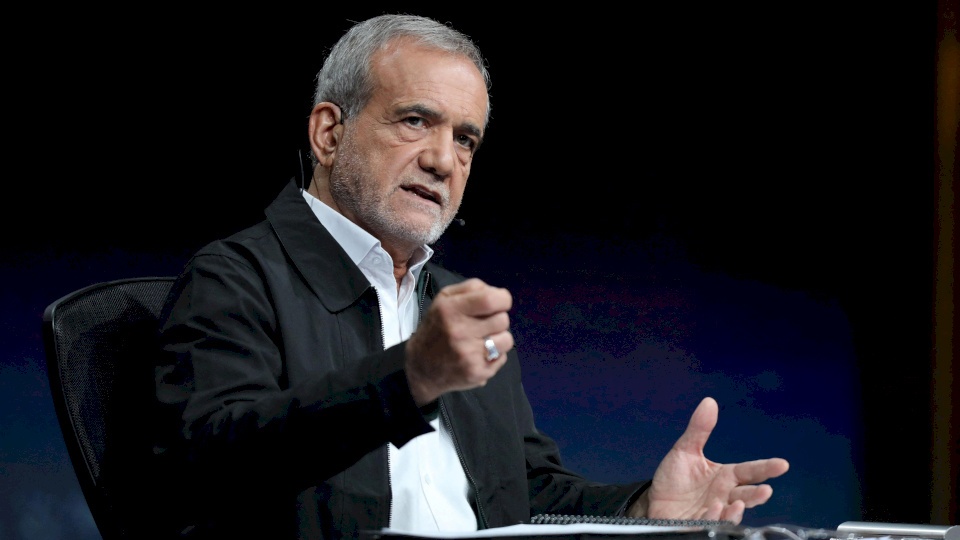
Bezeshkian: The Maritime Siege on Iran is Destined to Fail
SadaNews - Iranian President Masoud Bezeshkian held the United States and Israel responsible for any security deterioration in the Gulf region, asserting that the region's security must be managed by its countries without external interventions.
Bezeshkian stated that the Gulf is not a place for imposing unilateral foreign wills, emphasizing that the security of this strategic region can only be guaranteed through the cooperation and joint coordination of coastal states.
He added that "any attempt to impose a maritime siege contradicts international law and harms the interests of the countries in the region is doomed to failure," considering that the maritime siege strategy and imposing restrictions on trade routes have become a new tool for pressuring the Iranian government and people.
The Secretary-General of the Gulf Cooperation Council, Jasem Mohammed Al-Budaiwi, confirmed that the leaders of the Council's member states emphasized their firm rejection of imposing any fees on ships crossing the Strait of Hormuz under any circumstances or designation, reiterating the necessity of ensuring freedom and security of navigation.
Al-Budaiwi explained in a statement on the occasion of the 19th consultative meeting of the Council's leaders that they discussed developments in regional conditions, particularly the escalation in the region, the attacks against the Council's countries and the Hashemite Kingdom of Jordan, as well as ways to promote a diplomatic path that resolves the crisis and enhances long-term security and stability.
He noted that the leaders expressed their strong condemnation of attacks targeting civilian facilities and infrastructure, and the resulting human and material losses, considering these actions as a blatant violation of international law, the United Nations Charter, and principles of good neighborliness, negatively affecting the level of trust.
He affirmed that the Council's states reserve the right to defend themselves, individually and collectively, in accordance with Article (51) of the United Nations Charter, while emphasizing the unity of the Gulf stance, and that any attack on a member state is considered an attack on all member states, according to the collective defense agreement.
He pointed out that the leaders praised the efficiency and readiness of the Council's armed forces to confront missile attacks and drones, and their high capability to protect the security of member states and their resources.
He also highlighted the ability of the Council's countries to deal with the repercussions of the crisis, including the swift rehabilitation of affected energy facilities, maintaining supply stability, as well as enhancing cooperation in logistics, supply chains, and the aviation sector.
The leaders reiterated their rejection of any measures that could disrupt navigation in the Strait of Hormuz or threaten its security, demanding a return to normal conditions there and the complete restoration of freedom of navigation.
At the end of the statement, the Secretary-General referred to the leaders' directives to expedite the implementation of joint Gulf projects, particularly in transportation and logistics services, the Gulf railway project, and electrical interconnection, in addition to studying the establishment of joint projects for oil and gas transportation and water interconnection, enhancing strategic stockpiles, as well as intensifying military integration and accelerating the completion of the early warning system for ballistic missiles.
The U.S. Navy began imposing a blockade on maritime traffic in and out of Iranian ports on both sides of the Strait of Hormuz on April 13, marking a waterway that accounts for approximately 20% of the world's oil, petroleum derivatives, and liquefied natural gas supplies.
Washington asserts that non-Iranian ships have the freedom to transit the strait as long as they do not pay fees to Tehran.
 Follow the latest Sada News via Google News
Funeral Ceremonies for Ali Khamenei Begin

US Air Force intends to investigate officer who called for Trump's removal

Venezuela: Death Toll from the Earthquakes Rises to 2,595

Algeria: The initial voter turnout in the legislative elections reached 20.79%

Russian Attacks Claim Two Lives and Injure Eight Overnight in Ukraine

Trump: Iran Agreed to Everything We Want on the Nuclear File and It’s Ridiculous to Contin...

Casualties in Explosion in Damascus
