

Why Did Oil Prices Not Reach 200 Dollars Despite the Iran War?
SadaNews - Despite the closure of the Strait of Hormuz and the continuation of the US-Israeli war against Iran, oil prices have not reached 200 dollars as many expected; instead, they remained within a less acute range, reflecting the global market's ability to absorb the shock rather than explode.
Since February 28, the date the war broke out, prices have fluctuated within a variable range, recording Brent crude at its highest levels of about 119 dollars per barrel at the end of March, while prices dropped during periods of calm to below 90 dollars, averaging near 100 dollars, while the price of Arab light crude oil exceeded 140 dollars.
Since the beginning of the Iran war, reports and experts have anticipated that oil prices could reach 200 dollars. For instance, Rory Johnston, the founder of the "Commodity Context" newsletter specializing in commodity market analysis, noted that the continued closure of the strait could push oil prices above 200 dollars per barrel, in a scenario that energy experts describe as one of the worst possibilities being studied by the sector.
The Wall Street Journal reported that analysts from the "Wood Mackenzie" financial consulting firm stated that reaching an oil price of 200 dollars "is not unlikely in 2026".
JP Morgan also warned in previous reports of the possibility of oil prices reaching 150–200 dollars per barrel in the event of a severe shock to global supplies.
Reasons for Resisting Large Price Increases
1- Drawing from Stockpiles
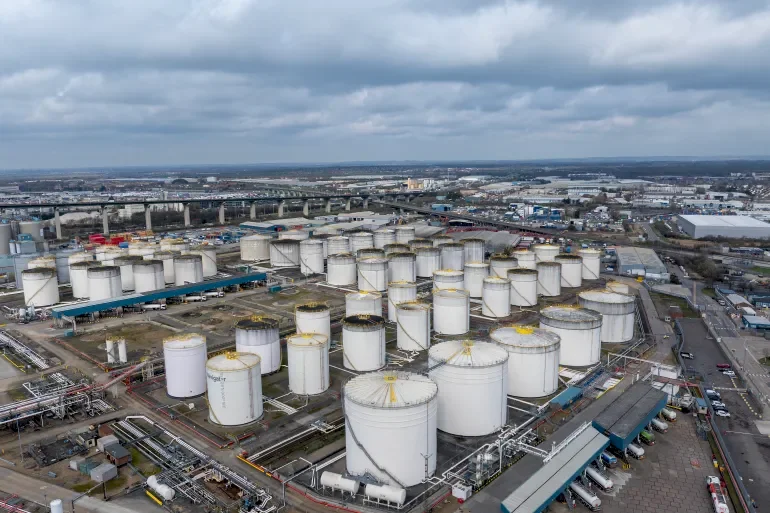
One of the most prominent reasons for curbing prices was the coordinated intervention to draw from global stockpiles, where the International Energy Agency announced the release of about 400 million barrels from reserves, in a move aimed at calming the markets and compensating for some of the lost supplies.
Moreover, the reserves of major countries played a crucial role, especially China, whose stock is estimated between 1.2 and 1.4 billion barrels.
Japan announced the withdrawal of 80 million barrels from its oil reserves to support economic stability, providing a temporary safety net that alleviated the shock in the first weeks.
2- Russian Supplies
The return of Russian supplies to the markets following the US's decision to partially ease sanctions allowing for the purchase of pre-loaded Russian oil on tankers contributed to this situation.
3- Iranian Flexibility
In addition, Iranian exports maintained their flow to markets through what is known as the "shadow fleet", reducing the supply gap, as recent data showed that Iranian oil exports still found their way to markets despite the maritime blockade imposed by the US this month.
According to Reuters, Fortessa reported that about 10.7 million barrels of Iranian crude oil passed through the Strait of Hormuz and exited the blockade's area between April 13 and 21.
4- Alternative Routes
Moreover, the use of alternative routes to bypass the Hormuz blockade, such as the East-West pipeline in Saudi Arabia with a capacity of nearly 7 million barrels per day, and the Kirkuk-Ceyhan pipeline from Iraq to Turkey, limited the impact of the complete closure of the strait.
Some countries also resorted to using alternatives; according to Bloomberg, China launched a major project to convert coal into gas after being stalled for over a decade, as part of a wave of investments that will allow Beijing to mitigate fuel supply threats as geopolitical tensions rise.
Mohammed Ramadan, a former advisor to the Kuwaiti Minister of Finance, told Al Jazeera Net that "the release of strategic reserves and lifting restrictions on Russia and Iran, along with export alternatives, have played various roles in preventing prices from reaching higher levels," asserting that these are "temporary solutions, not permanent".
5- Demand Destruction Balances the Market
Alongside supply, the decline in demand emerged as one of the most significant price dampers, as the global economy began to adjust to the crisis.
Analyst Amr Al-Shobky points out that "demand destruction has already begun, with the cancellation of flights and a slowdown in some economic activities"; however, he considered that exceeding 130 dollars represents a turning point, while reaching 150 dollars will lead to "serious demand destruction".
He adds to Al Jazeera Net that the world has lost about 650 million barrels from stockpiles, reflecting the depth of the crisis, but he explains that what is happening "is no longer merely a military war, but has turned into an economic war controlled by the parties through influencing prices".
6- Politics at the Heart of Markets
Political statements, especially from US President Donald Trump, played a pivotal role in regulating the market's rhythm.
According to experts, markets reacted to every sign of calm or talk of negotiations, causing prices to drop, while they rose with any field escalation.
Nouar Al-Sadi, a specialist in international economics, says, "The market was caught between caution and reassurance; every time oil exceeded 110 dollars, soothing messages were issued to bring it back down to the nineties," adding that the existence of potential negotiations limited sharp spikes.
He adds that the closure was not surprising, as it was preceded by a long mobilization, allowing consumer countries to bolster their reserves, alongside continued shipments arriving that were already en route during the first weeks of the war.
How Did the Market Absorb the Shock?
In general, the previous data reveal that the market absorbed the shock through a combination of:
Drawing from strategic stockpiles
Pumping alternative supplies from Russia and Iran
Using alternative pipelines and export routes
Resorting to temporary energy alternatives
Gradual decline in global demand
Political interventions to calm the markets
This created a temporary balance in oil markets that prevented price explosions, according to experts.
Open Scenarios
Despite this balance, experts warn that the market is still in a "gradual depletion" phase.
If the war continues without resolution, stockpiles may begin to deplete, gradually pushing prices toward higher levels that may approach 150 dollars.
Conversely, in the case of de-escalation or successful negotiations, prices may return to a more stable range, especially with the continued flow of alternative supplies.
Mohammed Ramadan, the former advisor to the Kuwaiti Minister of Finance, confirms that "reaching very high levels is not in the interest of even exporting countries, as it drives the emergence of alternatives and harms balance," noting that the fair price revolves between 80 and 90 dollars.
The current oil crisis reveals that global markets are no longer just hostages to shocks, but have tools to absorb them, from reserves to managing expectations.
However, this balance remains fragile, meaning that any sudden escalation could bring the scenario of sharp spikes back to the forefront at any moment.
In this context, Al-Shobky says that the world needs production surpluses for a long time to compensate for these stockpiles; "we are talking about high prices that will accompany the world for no less than two to three years."
 Follow the latest Sada News via Google News
Gold Heads for First Weekly Increase in 5 Weeks

Wall Street Banks Intensify Hiring in the Gulf to Keep Up with "War Deals"

Oil Continues to Decline with Increased Flows through Hormuz and Progress in Iran Talks

Gold Recovers After Waller's Speech and Easing Tension Over U.S. Rate Hike

Aluminum Prices Drop to Lowest Level Since February Amid Dollar Strength

Bitcoin Drops Below $60,000
World Gold Council: The second half of 2026 is a critical turning point for gold prices
