

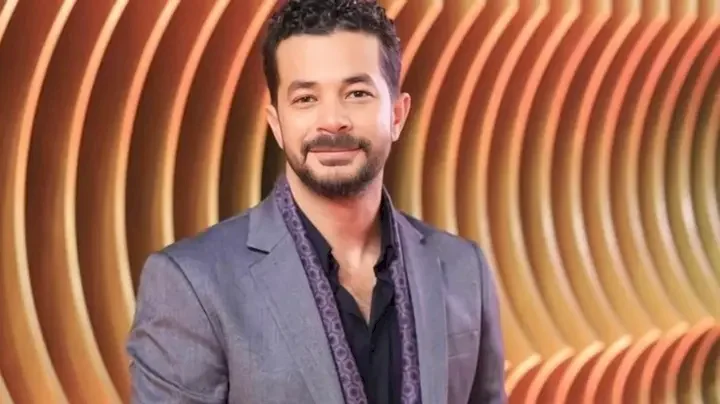
Sherif Salama: Credibility is the Most Important Thing in Artistic Work
SadaNews - The artist Sherif Salama comes among the list of actors who have succeeded in building an artistic career based on diversity and a constant search for difference, staying away from repetition or ease. Since his beginnings, Salama has been keen on presenting roles that carry clear human features, transcending ready-made classifications, smoothly transitioning between social drama, comedy, and independent cinema, relying on a calm performance and precise details that lend his characters a unique authenticity.
Sherif Salama does not bet on absolute stardom as much as he bets on the value of the role and its impact within the work, which has made him present in multiple artistic experiences that left a mark on both the audience and critics.
In the film "Gawazah Wala Janazah" (Marriage or Funeral), Sherif Salama embarks on a different experience through the character "Hassan Al-Dabbah", who belongs to an intertwined social world and raises questions about class, emotions, and human contradictions. The film, in which director Amira Diab mixes romance with social comedy, places its heroes in direct confrontation with sharp differences in backgrounds and expectations, within a narrative that appears simple on the surface but carries a deeper reading of human relationships.
Sherif Salama's presence in this work comes as an extension of his conscious artistic choices, as he prefers to engage in stories that focus on the human element before the event, betting on authenticity before display. In his interview with "Al-Arabiya.net", Sherif discussed his role during the film's events, the behind-the-scenes work with director Amira Diab, artist Nelly Karim, and also the filming behind the scenes in the desert.
What made you excited to participate in the film "Gawazah Wala Janazah"?
**The truth is that what attracted me the most was the character "Hassan Al-Dabbah", as it is completely different from all the roles I have played before, in addition to the idea of the film itself. My initial conversation with director Amira Diab about her vision for the work was a key factor in my decision, as I felt from the beginning that there was a project that carried a special spirit and a different experience.
How did you approach the character of Hassan Al-Dabbah in terms of preparation and construction?
**From the very beginning, I focused on the character's intricate details, whether in her vocabulary, behavior, or past, and I tried to live within her own world. I don’t like to rely on a ready-made reference because I prefer to see the dimensions of the character for myself, absorb it, and then finally present it in a way that reflects my vision of her and makes her closer to reality.
How do you see the role of cinema at the moment?
**I believe that cinema has an important role in highlighting daily life, its problems, and the differences among people within society. We, as filmmakers, have a responsibility to present diverse human models that reflect this difference and raise genuine questions about reality without artificiality or exaggeration.
It’s said that light comedy is close to you, yet you always present different styles.. how do you view that?
**Indeed, light comedy is close to me, and I feel very comfortable in it, but at the same time, I don’t like to be confined to one mold. A true artist, in my opinion, should be able to present multiple schools and genres, and remain open to new experiences, as diversity is what keeps the passion and continuity alive.
What was your experience like with director Amira Diab, as this is her first directorial experience?
**Collaborating with Amira Diab was a wonderful experience on all levels. She is a very conscious director who prepares her work with great care and pays attention to every detail, whether artistic or human. The atmosphere on set was simple and based on true cooperation among everyone, which directly reflects on the quality of the work, so I really enjoyed working with Amira.
And what about your repeated collaboration with Nelly Karim?
**Working with Nelly Karim is always enjoyable and comfortable. She is a sensitive actress with strong tools, and this is our second collaboration after the series "Faten Amal Harbi", and there’s a third collaboration in a series during Ramadan, and with each experience, the understanding and comfort in performance increases. I believe that the differences in the characters we present is what creates this artistic closeness and adds depth to the scenes.
Shooting in the desert may seem exhausting for some.. how was the experience for you?
**Contrary to expectations, the experience was not exhausting to that extent, thanks to the great cooperation among the crew, and the absence of high temperatures during filming. The production also took care to provide all possible comforts, which helped us focus on our performance.
In the end, what do you consider the most important aspect for you as an actor during work?
**For me, credibility remains the most important element in any role I present, even more than the idea of the most challenging scene or physical challenges. When a character is honest and convincing, the work reaches the audience in a natural and real way.
 Follow the latest Sada News via Google News
FIFA Referees Committee, Led by Colina, Clarifies Cases from Egypt vs. Argentina Match

The Egyptian Federation Files Official Complaint Against Referee Letexier

Do You Know How to Comfort Someone Who is Crying? Here's What to Say and Do in Tough Momen...

"Backrooms": From Digital Legend to Cinematic Phenomenon

Prediabetes.. The Silent Bomb Carried by Millions Without Their Knowledge

From Sweden 1958 to the Epic of Egypt 2026.. Argentina's History with World Cup Comebacks

After the South Africa Precedent.. Nigeria Investigates the Encroachment of Technology Com...
