

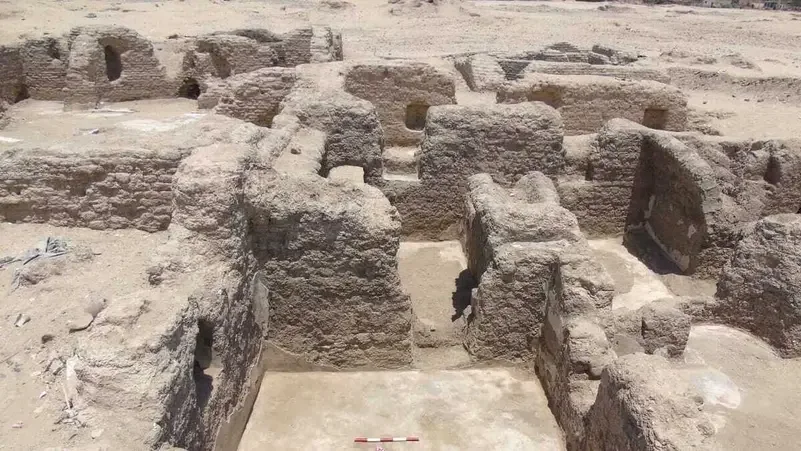
Byzantine Monastic City Unearthed in Egypt
SadaNews - The Egyptian archaeological mission affiliated with the Supreme Council of Antiquities announced a new archaeological discovery in Sohag Governorate, southern Egypt.
Remains of a complete residential complex for monks dating back to the Byzantine era have been found.
The Ministry of Tourism and Antiquities stated in an official statement today, Tuesday, that the discovery took place at the site "Al-Qarya Balduir" in the Tama Center of Sohag Governorate.
In this context, Egyptian Minister of Tourism and Antiquities Sherif Fathy confirmed that this discovery embodies the richness and diversity of Egyptian cultural heritage across different eras, indicating that such discoveries support the ministry's efforts in developing the cultural tourism product and highlighting unconventional archaeological destinations, which contributes to attracting more visitors and researchers interested in the history of civilizations and religions.
Complete Monastic Community
For his part, Dr. Mohamed Ismail Khaled, Secretary-General of the Supreme Council of Antiquities, explained that the significance of this discovery lies in the new information it provides about the nature of monastic life in Upper Egypt during the Byzantine era, noting that the excavation results indicate the existence of a complete monastic community with an organized lifestyle within the site.
In the same context, Mr. Mohamed Abdel Badi, Head of the Egyptian Antiquities Sector, stated that the excavations revealed remains of rectangular-shaped buildings made of mud bricks, extending from west to east, varying in size from approximately 8 × 7 meters to 14 × 8 meters.
These buildings include rectangular halls, some of which contain niches or alcoves designated for worship, in addition to small rooms with vaulted ceilings, likely used as cells or places for individual worship.
Small Circular Buildings
He also pointed out that the walls of the buildings preserved remnants of layers of plaster, featuring niches and wall openings, while the floors consisted of a layer of plaster. Some buildings were characterized by southern courtyards that include entrances, as well as the discovery of small circular buildings believed to have been used as dining tables for the monks.
Dr. Mohamed Nagib, Director General of Sohag Antiquities, added that the excavations also resulted in the discovery of basins made of red brick and limestone, covered with a layer of red plaster, likely used for water storage or industrial purposes. Remains of a mud brick building extending from east to west, approximately 14 × 10 meters in size, were found, likely serving as the main church of the monastic complex, consisting of a nave, a choir, and an altar, where remnants of supports indicating the presence of a central dome were found in the nave, while the altar is semi-circular, located in the eastern section and surrounded by two altar chambers.
Inscriptions in Coptic Script
Mr. Walid El-Sayed, head of the archaeological mission, clarified that the site has yielded a diverse range of archaeological finds, including storage amphorae bearing inscriptions that may be letters or numbers or names, in addition to ostraca inscribed with texts in Coptic, household utensils, stone fragments representing architectural elements, and pieces of limestone slabs engraved with inscriptions in Coptic script.
 Follow the latest Sada News via Google News
After Deschamps' Departure... Zinedine Zidane Tops the Candidates to Lead France

Mbappe Surpasses Messi and Becomes the All-Time Top Scorer in the World Cup

England Defeats France and Achieves Largest World Cup Achievement Since 1966

Messi Refused to Play for Spain and Missed 3 World Cups

Publishers Sue Google for Allegedly Using Books to Train Artificial Intelligence

Google Expands Capabilities of Google Search Console to Support Social Media Accounts

The Mediterranean Table... An Ancient Diet Revealing Its New Secrets for Health and Longev...
