

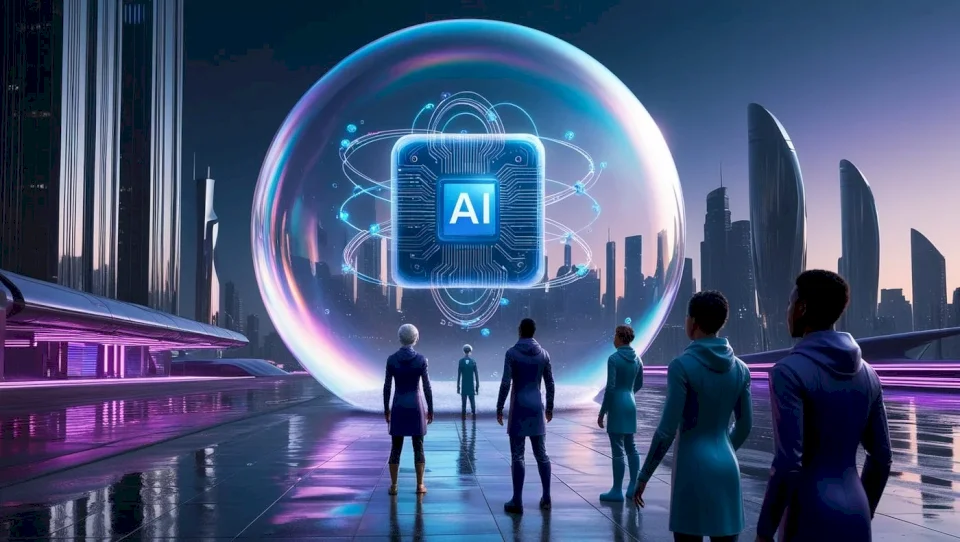
Bubbles Around Us Everywhere
SadaNews - Two months before "Black Monday," the market crash that led to the Great Depression, Roger Babson, an economist from Massachusetts, was alarmed by a wave of ordinary investors who borrowed to buy stocks: "Sooner or later, a crash will happen, and it could be catastrophic."
After that, the market dropped by 3%, a decline that was then known as "Babson's Crash." But in the weeks that followed, as Andrew Ross Sorkin writes in his new historical and fascinating book, "1929: Inside the Greatest Crash in Wall Street History - and How It Broke a Nation": "The market shed Babson's pessimism," partly due to optimism about new, widespread products like radios and cars. He noted that "imaginative investors were succeeding once again."
Today, pessimists, like Babson, are abundant, warning of the dangers of artificial intelligence, particularly the valuation of listed and private tech companies and their relentless pursuit of the elusive goal of general AI (systems capable of doing everything humans can do and more).
Will 2026 witness the burst of the AI bubble?
Data from Omdia, a data analytics company, indicates that tech companies will spend nearly $1.6 trillion annually on data centers by 2030. The magnitude of the hype surrounding artificial intelligence, which still has profit potential that merely remains a hypothesis, has confused many level-headed investors.
Nonetheless, as was the case a century ago, the idea of missing the next big opportunity has convinced many companies to ignore these dire predictions.
The Phase of Unreasonable Over-optimism
Adveit Aron, a climate finance and energy infrastructure analyst at the Public Projects Center, who questioned the financing plans behind data center projects in his recent report, "Bubble or Nothing," which resembles Babson's mindset, remarked: "They are all playing a game of random guessing, thinking that these ambitious technologies will solve any existing problem... We are definitely still in a phase of unreasonable over-optimism."
It is usually wise for journalists to avoid debating whether a resource or technology is overvalued. I don't have a definitive opinion on whether we are living in an AI bubble, but I question whether the question is narrow-minded.
If we define a speculative bubble as any phenomenon where the value of a certain asset rises unsustainably beyond a defined intrinsic value, then bubbles seem to be almost everywhere. They appear to expand and contract simultaneously.
Concerns about the AI Bubble Grip Wall Street
There may be a bubble in gold, which has risen nearly 64% in price in the 12 months up to December 12, and another in government debt, according to Borg Brende, the president of the World Economic Forum, who recently noted that countries collectively have not seen such a large deficit since World War II.
Many financiers believe there is a bubble in the private credit market, a $3 trillion market allocated for loans provided by major investment firms (many of which fund the construction of AI data centers), which lies outside the highly regulated commercial banking system.
Jeffrey Gundlach, founder and CEO of DoubleLine Capital, described this type of random, unregulated, and opaque lending as "poor lending" in the "Odd Lots" podcast on Bloomberg. JP Morgan Chase CEO Jamie Dimon referred to it as "a recipe for a financial crisis."
Cryptocurrency Bubbles
The starkest manifestations of this contradiction have made it impossible to easily evaluate the true value of assets. For example, Bitcoin's total market value increased by $636 billion from the beginning of the year until October 6, only to fall back and lose all that and more by December 12.
The trading volume of meme coins, which are digital currencies that commemorate internet fads, peaked at $170 billion in January, according to Blockworks, a news company focused on cryptocurrencies, but crashed to $19 billion by September. The coins ($TRUMP) and ($MELANIA), launched by the president's family two days before inauguration day, were at the forefront of this decline, losing 88% and 99% of their value, respectively, since January 19.
Many investors evaluated these digital currencies not based on their potential to create real value for stakeholders and the world—like traditional company stocks that announce profits, for instance—but based on the opportunity to make vast profits quickly. They approached it as if they were sitting at a dice game table on a trip to Las Vegas.
There may be demographic reasons pushing investors, especially those attracted to cryptocurrencies, sports betting, and online prediction markets, to try to manipulate financial markets as if they were casinos.
Can Half of Gen Z Become Billionaires?
A recent Harris Poll revealed that 6 out of 10 Americans aspire to amass a fortune. Seventy percent of Gen Z and millennials say they want to become billionaires, compared to 51% of Gen X and baby boomers.
A study by Empower Financial last year indicated that Gen Z believes that "financial success" requires a salary of about $600,000 and a net worth of $10 million.
Thanks to TikTok videos, group chats, Reddit forums, and the inescapable nature of the instant internet, everyone in the world is now aware of opportunities to make money simultaneously.
This sounds good in principle, but it has led to a tidal wave of imitation, mass competition, and collective behaviors that make the new Apple TV series (Pluribus) seem perfectly timed. The attention economy - meaning the things we all care about everywhere at any time - has replaced the traditional economy with its complex, boundless dimensions.
Is “LaBubu” Not a Bubble Too?
In the business world, this single-minded focus on artificial intelligence prevails. In popular culture, there was a Sydney Sweeney bubble, followed by a Pedro Pascal bubble and a "6-7" bubble. If you don't have teenage kids, look it up on Google. Over the past year, thanks to celebrities like Lisa from the K-Pop band (Blackpink), there has also been a global obsession with the useless, animal-shaped stuffed dolls sold by the Chinese toy company Pop Mart International Group, and let’s call this a "LaBubu bubble."
In the food sector, there is undoubtedly a protein bubble, where everyone from popcorn makers to breakfast cereal companies markets their protein content to attract health-conscious consumers and GLP-1 hormone users.
“Beyond Meat” Sparks a Revolution in Pea and Protein
In media, there may be a similar bubble in Substack newsletters, and podcasts hosted by celebrities like Amy Poehler’s Good Hang and Megan Markle’s Confessions of a Female Founder, and documentaries focusing on celebrities' lives, which are allowed by their owners and available for streaming almost weekly, with the latest being the Netflix film Being Eddie about Eddie Murphy and Victoria Beckham.
W. David Marks, author of Blank Space: A Cultural History of the Twenty-First Century, stated: "Everyone's reference circle is global, surpassing far beyond what one sees around and transcending their class or actual position. Globalized compatible movements can emerge within these markets, which were impossible in the past."
The stakes are higher for artificial intelligence than for a product like "LaBubu." No company wants to fall behind, so every major player rushes forward, building computing infrastructure using intricate financing arrangements. In some cases, this involves creating special purpose entities (remember those that emerged during the 2008 financial crisis?) burdened by debt to purchase graphics processors from Nvidia, the AI chips that some observers believe could decline in value faster than expected.
The Quantitative Impact of the AI Bubble
Tech giants can weather any fallout from this frenzy fueled by fear of missing out. They are heavily funding their data centers from their robust balance sheets and can handle the consequences if all employees, for example, decide that the current release of ChatGPT is good enough to set their annual self-evaluation.
Microsoft is pursuing advanced AI "aligned with human interests"
However, other companies are engaging in riskier behaviors. Oracle, a traditional database provider and an unexpected competitor in the AI race, is raising $38 billion in debt to build data centers in Texas and Wisconsin.
Other companies known as "new cloud computing" companies, such as CoreWeave and Fluidstack, which create specialized data centers for AI and Bitcoin mining, are borrowing vast amounts. Suddenly, the cumulative effect of the AI bubble starts to manifest more sharply.
Gill Luria, managing director at D.A. Davidson & Co, invoked Roger Babson's quote from a century ago: "When I see entities creating data centers costing tens of billions of dollars based on borrowed money and having no real customers, that's when I start to worry. Lending money to invest in speculation is never a good idea."
Carlota Perez, a British-Venezuelan researcher who has been writing for decades about cycles of economic booms and busts, is also concerned. She asserts that innovation in technology is turning into high-risk speculation in a debt-laden, gambling-like economy that is fragile and susceptible to bubbles that burst once doubt spreads.
In an email, Burns wrote: "If AI and cryptocurrencies collapse, it’s likely to cause a global downturn of unimaginable proportions. Historically, truly productive golden ages happen only when the financial sector faces the consequences of its behavior, rather than being continuously rescued, and when society curbs its excesses through proper regulation." Until then, hold tightly to your "LaBubu" dolls.
 Follow the latest Sada News via Google News
After Deschamps' Departure... Zinedine Zidane Tops the Candidates to Lead France

Mbappe Surpasses Messi and Becomes the All-Time Top Scorer in the World Cup

England Defeats France and Achieves Largest World Cup Achievement Since 1966

Messi Refused to Play for Spain and Missed 3 World Cups

Publishers Sue Google for Allegedly Using Books to Train Artificial Intelligence

Google Expands Capabilities of Google Search Console to Support Social Media Accounts

The Mediterranean Table... An Ancient Diet Revealing Its New Secrets for Health and Longev...
