

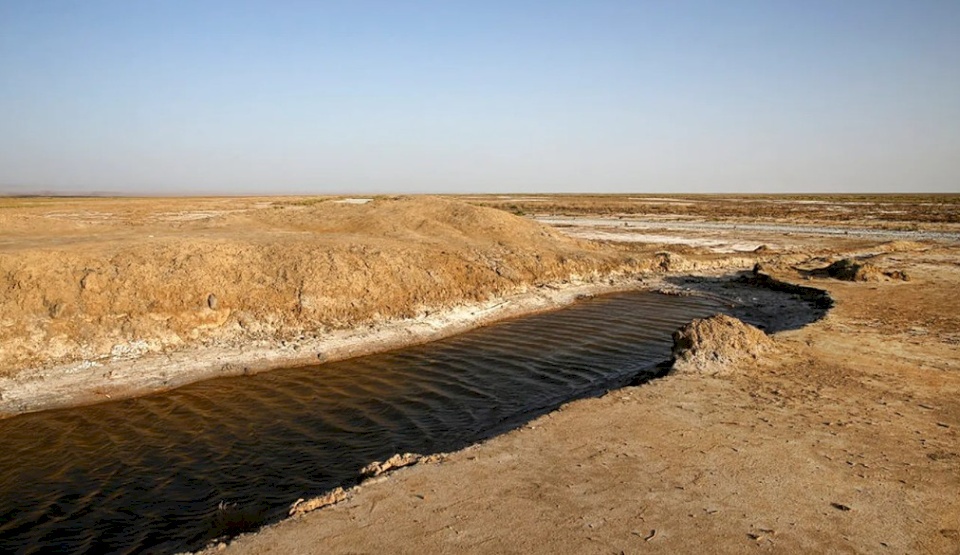
Why is Tehran Threatened by Thirst?
SadaNews - The history of our cities has been written with water, from Mesopotamia to Egypt and the Indus Valley. The first urban communities were established next to irrigated agricultural lands. Rice, corn, and quinoa fields accompanied the spread of civilization in East Asia and the Americas. If water is absent, the major cities that will shape this century will wither and then vanish.
This appears to be a risk factor in an increasing number of locations. Cape Town in South Africa and Chennai in India have both suffered from severe droughts in recent years that brought them to the brink of collapse. Similarly, the rapidly growing Indian cities of Bengaluru and Hyderabad faced similar conditions last year. Now, Tehran, the largest of these cities, with a population of around 15 million, is experiencing the same state of emergency.
Residents of the Iranian capital are forced to cut off water to their homes for continuous hours to conserve it, amid a drought that has lasted for five years and a dramatic 96% drop in the rainfall rate compared to the normal average.
Last month, President Masoud Pezeshkian announced that the city may have to undergo complete evacuation if the current drought does not end soon. This emphasizes a bitter truth of contemporary life: even relatively prosperous cities may be just a few years away from "Day Zero", the point where vital water sources are depleted.
The dire situation in Tehran is attributed to the same obsession with food and energy security that has led many countries to raise trade and regulatory barriers against clean energy at present. The commitment to food self-sufficiency following the 1979 Iranian Revolution—which rejected food energy imports in favor of growing wheat and rice locally—has led to the depletion of groundwater layers and reservoirs for irrigating thirsty crops. Over 90% of water is consumed in agriculture, leaving very little for the needs of urban populations.
How Have Wrong Policies Consumed Water Resources?
This might be justified in light of the extensive sanctions that have crippled the Iranian economy for decades but has come with a waste of resources. The per capita water resources in Iran are greater than those in Germany, India, or South Korea, so it should be sufficient to meet most of its needs if well-managed. However, this has not occurred. Flood irrigation, an old method that wastes huge amounts of water through evaporation compared to drip irrigation that uses pipes, remains the prevailing method for field irrigation.
Tariffs and subsidies make trade with more productive countries fragile. China and India are the largest grain producers and are also key participants in the barter-based oil trade that circumvents international sanctions imposed on Tehran. However, China barely exports food to Iran, while Basmati rice farmers in India face an import ban imposed from time to time whenever the Iranian government seeks to support its local farmers.
Statements by Energy Minister Abbas Ali Abadi earlier this month, where he supported the import of "virtual water"—that is, crops that consume large amounts of water and should be grown in countries with higher rainfall rates—are a rare official acknowledgment of the failures of self-sufficiency efforts and the necessity of importing more food from abroad.
This crisis points to an increasing imbalance in the cycles of our planet. While Iran suffers from acute water shortages, heavy seasonal floods on the other side of the Indian Ocean have caused damages worth $20 billion, stretching from Sri Lanka to Vietnam. Neither of these situations would likely have occurred without the effects of climate change.
Global Warming and the Carbon Footprint
While Iran can now expect a drought similar to that of 2025 every 10 years, this drought in a pre-global warming world would have occurred once per century at least. As the sixth largest emitter of greenhouse gases in the world and one of the largest oil exporters, it bears a significant portion of the responsibility for global warming that now makes Tehran uninhabitable.
It is not alone in this situation. Many countries affected by the recent Asian floods may find themselves facing a drought similar to what Tehran has experienced in the future. A study conducted in 2020 on 12 major cities in developing countries at risk of water shortages ranked Tehran relatively low. To meet the minimum standards of health and hygiene, cities like Lagos, Jakarta, Mumbai, and Kolkata need at least 50% more water per capita than their systems can provide. Tehran's shortfall is a relatively modest 29%.
Evacuation is not the solution. Like polluted Delhi and flooded Jakarta, Tehran has reached a stage where relocating its population is impossible, regardless of the desires of businesses or government officials.
Better options are available. These include easing restrictions on food imports to relieve pressure on local fields. Utilizing Iran's vast oil and gas reserves to produce hoses and pipes to ensure that available water does not evaporate. Most importantly, leveraging barter trade with China to transition to renewable energy. Iran's future will only be truly secure when it begins to cut its carbon emissions.
 Follow the latest Sada News via Google News
After Deschamps' Departure... Zinedine Zidane Tops the Candidates to Lead France

Mbappe Surpasses Messi and Becomes the All-Time Top Scorer in the World Cup

England Defeats France and Achieves Largest World Cup Achievement Since 1966

Messi Refused to Play for Spain and Missed 3 World Cups

Publishers Sue Google for Allegedly Using Books to Train Artificial Intelligence

Google Expands Capabilities of Google Search Console to Support Social Media Accounts

The Mediterranean Table... An Ancient Diet Revealing Its New Secrets for Health and Longev...
