

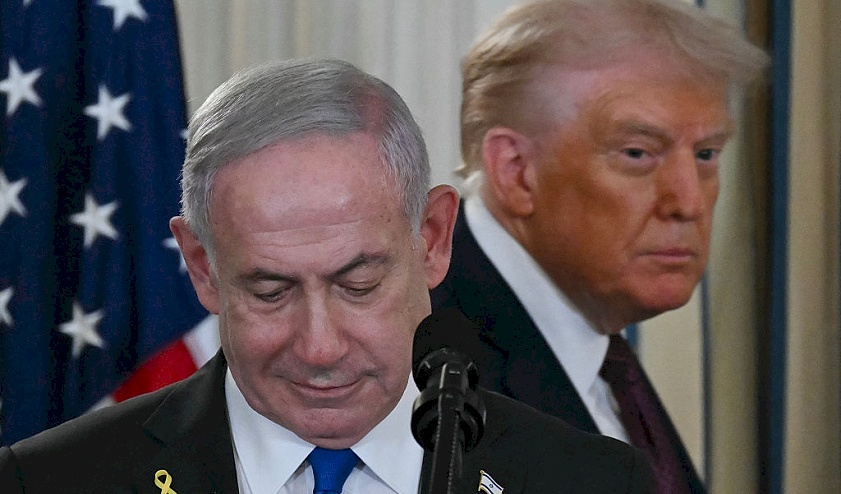
Report: Trump Refuses to Respond to Netanyahu's Calls to Speak with Him
SadaNews - Informed Israeli sources reported that U.S. President Donald Trump has repeatedly refused in recent weeks to respond to phone calls from Israeli Prime Minister Benjamin Netanyahu, who requested to speak with him directly. Instead, Trump tasked close associates to talk with Netanyahu and update him on developments.
The sources considered this an unusual American approach towards Israel during a sensitive period for the latter, characterized by political communications regarding Iran, its nuclear program, the Strait of Hormuz, and prospects for a comprehensive ceasefire in the region, as quoted by the website of the newspaper "Ma'ariv" today, Sunday.
The newspaper pointed out that in recent weeks, Trump has been following an approach that emphasizes the Gulf states as key partners for the United States in the region, downplaying Israel's role, and repeatedly thanking Saudi Arabia, the UAE, Qatar, Kuwait, and other countries in his speeches and press conferences for their support of the U.S. regarding the crisis with Iran. In one of his recent speeches, Trump mentioned the countries that assisted the U.S. but did not mention Israel.
Moreover, the newspaper added that in the office of the Israeli Prime Minister, they view this as an American attempt to shape alliances in the region in a way that is more comfortable for the White House at this phase. For Trump, the action regarding Iran should appear as a broad U.S.-regional step, based on "moderate" Arab and Gulf states, rather than as a move aligned with or involving Israel.
According to the newspaper, this American policy is part of recent developments around the draft agreement that is taking shape between the United States and Iran. In this context, there are understandings that include extending the ceasefire for sixty days, reopening the Strait of Hormuz, providing economic incentives for Iran, and a potential ceasefire in Lebanon, while Israel publicly opposes all these steps.
The newspaper reported that in Israel, these developments are being followed with concern, especially since the nuclear issue has currently been deferred to the next phase of talks. There are fears in Israel that Iran could achieve significant economic, political, and regional gains in the first phase before demanding significant steps in the nuclear domain. There is also growing concern in the Israeli political establishment regarding Israel's standing in these political developments.
It is noteworthy that in recent years, Netanyahu has made a concerted effort to portray his relations with Trump as a channel for direct and open communication that allows for significant Israeli influence on U.S. policy in the region.
However, sources speaking to the newspaper indicated that the American dealings suggest a different reality. One source stated, "The Americans want to portray this step as a broad regional initiative, rather than an Israeli step. For Trump, the Gulf states are now his central political suppliers in the Middle East."
The newspaper continued that this also has implications for the domestic American arena, as Trump seeks to showcase a political achievement leading to stability in energy markets and reducing the risks of a broad regional war without being perceived as acting on Israeli motives or being drawn into Netanyahu's interests.
In Netanyahu's office, they acknowledge the American considerations, according to the newspaper, but they fear the broader implications, which include the possibility of reaching an agreement with Iran that Israel does not want, alongside growing questions regarding Israel's status and its influence on the White House during a politically sensitive period in the Middle East.
 Follow the latest Sada News via Google News
CNN: Omani Proposal for Navigation in Hormuz Through Two Separate Corridors

Lebanon to Participate in Talks with Israel in Rome Next Week

"They held us at gunpoint with American rifles".. Settlers besiege American congressman in...

Axios: Possible Iranian-Omani Statement to Open the Middle Corridor in Hormuz to Ships

US Military Delegation in Lebanon to Discuss Mechanisms for Israel's Withdrawal from "Tria...

After Renewed Clashes.. Mediators Seek to Revive Diplomatic Path Between Washington and Te...

Mojtaba Khamenei Vows to Avenge His Father
