

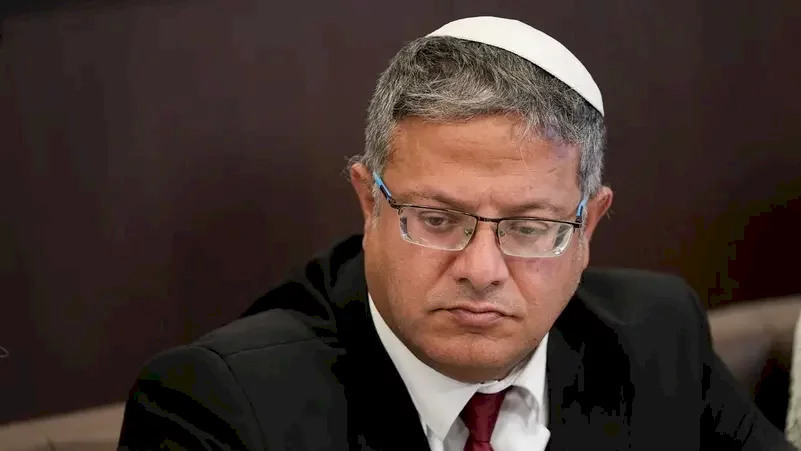
From Terror Convict to Minister of Security... How is Ben Gvir Reshaping Israel?
SadaNews - Former British Ambassador to Israel Matthew Gold believes that the rise of Israeli National Security Minister Itamar Ben Gvir from the depths of extremism to the heart of the Israeli government reflects a deep and dangerous shift in Israel, warning that the man "is no longer just an extremist on the margins but is reshaping state institutions with a fascist mentality based on violence, provocation, and hatred".
In an article in The Times, the author reviews the trajectory that led Ben Gvir from a convicted activist supporting terrorism and inciting racism to one of the most influential politicians in Benjamin Netanyahu's government, asserting that the latter "has legitimized the far-right for his political survival, and today he has become a prisoner of it".
The article begins by mentioning the wave of international outrage sparked by Ben Gvir after he published a video mocking activists of the Global Freedom Flotilla heading to Gaza, where they were cuffed and blindfolded.
The scene triggered widespread condemnations, prompting France to ban him from entering its territory, while the Chief Rabbi of the UK described the scene as a "desecration of the name of the Lord", and even within the Israeli government, Foreign Minister Gidon Saar criticized him.
Too Dangerous and Extreme
However, according to the author, Ben Gvir politically feeds off this kind of condemnation, presenting himself as the man who "does not apologize and does not submit to Western pressures" and uses a rhetoric of strength and humiliation as part of his political image before his far-right audience.
The article notes that Ben Gvir draws inspiration from the racist Kach movement founded by extremist Rabbi Meir Kahane, which was classified as a terrorist organization by both Israel and the United States after its followers were involved in acts of violence against Palestinians. Ben Gvir joined the movement in his youth during the First Palestinian Intifada and quickly became one of its most prominent activists.
The author asserts that the Israeli army itself considered Ben Gvir "too dangerous and extreme", which is why he was exempted from mandatory military service, a highly rare step in Israel. His criminal record includes "at least eight convictions", including incitement to racism, supporting a terrorist organization, and obstructing police work.
The article recalls that Ben Gvir gained fame in the 1990s after appearing on television waving the license plate of former Israeli Prime Minister Yitzhak Rabin after stealing it, saying, "We reached his car, and we will reach him too," just weeks before Rabin was assassinated by the Jewish extremist Yigal Amir.
Changing Language, Not Ideas
Ben Gvir also kept a picture of Baruch Goldstein, the perpetrator of the 1994 Ibrahimi Mosque massacre in the city of Hebron, in his home for years, in which 29 Palestinian worshippers were martyred. He only removed the picture in 2020 when he tried to enter formal political life.
The author states that Ben Gvir and his allies later realized that gaining power required "changing the language, not the ideas", so their slogans transformed from "Death to Arabs" to "Death to Terrorists", while maintaining the same ideological essence. In 2021, he assisted Netanyahu in integrating his faction "Jewish Power" (Otzma Yehudit) into the religious right alliance, allowing him to enter the Knesset and then the government.
After the "Al-Aqsa Flood" operation, Ben Gvir began presenting himself as the "Protector of the Jews", benefiting from the rising fear and anger within Israeli society. His popularity particularly relies on poor Sephardic Jews and young Israelis who "grew up amidst wars and constant conflict".
Infiltrating State Institutions
The author warns that the greatest danger lies not only in Ben Gvir's statements or provocative behavior, but in his "success in infiltrating state institutions", especially the police and the army. He accuses him of politicizing the police force by appointing loyalists who are lenient towards settler violence against Palestinians, while violently suppressing Israeli dissenters.
The article spends considerable time discussing the growing influence of the extreme religious right within the Israeli army, especially in the Netzach Yehuda battalion, which, according to the author, has turned into a sanctuary for extremist settlers opposed to Arabs. This unit has been involved in violations against Palestinians and defiance of military orders, raising concern within the Israeli security establishment itself.
The author concludes that Ben Gvir is no longer just a marginal phenomenon but has become "reshaping Israel in his image", relying on cruelty and national and religious incitement. He adds that what was once viewed as isolated extremism has now become part of the governing structure in Israel, noting that "the fire-starters are no longer at the gates but are now managing important parts of the state".
Source: Times
 Follow the latest Sada News via Google News
CNN: Omani Proposal for Navigation in Hormuz Through Two Separate Corridors

Lebanon to Participate in Talks with Israel in Rome Next Week

"They held us at gunpoint with American rifles".. Settlers besiege American congressman in...

Axios: Possible Iranian-Omani Statement to Open the Middle Corridor in Hormuz to Ships

US Military Delegation in Lebanon to Discuss Mechanisms for Israel's Withdrawal from "Tria...

After Renewed Clashes.. Mediators Seek to Revive Diplomatic Path Between Washington and Te...

Mojtaba Khamenei Vows to Avenge His Father
