

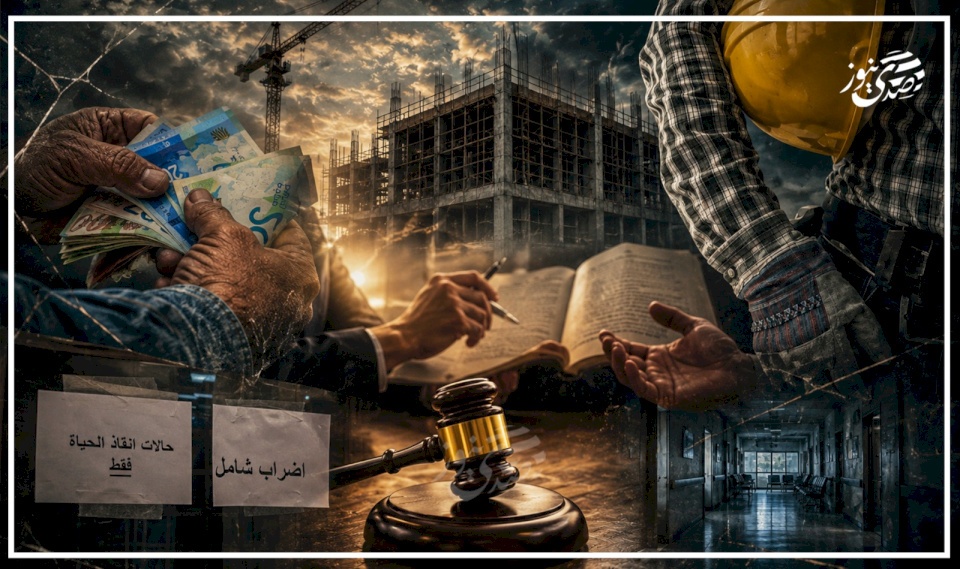
Low Salaries Ignite Fatal Comprehensive Strikes in Palestine.. Is the Service System on the Verge of Collapse?
SadaNews Report: The Palestinian government is facing one of the most complex labor crises in its history, as the scope of protests has expanded to include vital sectors of the state, driven by financial and living pressures that public employees can no longer bear. Amid the rising prices of goods and services, thousands of employees have found themselves facing a bitter economic reality, especially after salaries were cut and payments were made at only 2000 shekels, amounts that employees describe as insufficient to cover the minimum needs of their families. The scene has become even gloomier due to the stagnation affecting the markets, with anxious forecasts that the next salary payment will be delayed to shortly before the upcoming Eid al-Adha holiday.
Doctors' Union: The Government Will See What It Doesn't Expect
In light of these developments, the Doctors' Union recently announced extensive protest measures that led to a halt in operations at healthcare centers, limiting services in government hospitals to only critical emergencies and life-saving operations.
These steps came as an expression of reaching a deadlock in dialogue with the government, where the head of the Doctors' Union, Salah Al-Hishlamoun, called for the necessity of finding effective management of the crisis that fairly addresses the medical staff, stating in radio remarks: "The government will see what it does not expect from the doctors."
The union warned in its statement that the ongoing state of "stubbornness" places the healthcare system in a serious decline that threatens the safety of services, at a time when hospitals are already suffering from a severe shortage of medicines and staff, as well as basic patient needs, alongside warnings from private hospitals about the collapse of the sector due to the accumulation of financial dues owed by the government for years.
Before the doctors, the Health Professions Union, representing nurses, laboratory specialists, radiologists, and physical therapists, announced a partial strike.
Other Strategic Sectors Join the Strikes
The state of protest did not limit itself to the health sector but expanded to include other strategic sectors. The Engineers' Union announced a comprehensive and open strike in all government and military institutions, stressing that the dignity of engineers and their financial rights cannot be postponed. In the same context, the founding committee of the Public Sector Employees Union joined the protest activities through a comprehensive strike as a warning step, coinciding with a partial strike at Palestine Technical University "Khadouri", which included halting the approval of grades and registration, in protest against financial policies affecting the rights of both academics and employees alike.
On the other side of the crisis, the judicial system has come to a standstill following the suspension of work in the regular courts, with employees confirming that living conditions have become "more complicated" than their ability to continue. The disbursement of 5000 shekels to members of the judiciary, including judges and public prosecution (about 350 members), sparked widespread debate in the labor community, despite the clarification from the Supreme Judicial Council that these amounts were disbursed as a one-time payment from the judicial development fund that has been active for years.
This disparity in disbursement has prompted the teachers' movement to call for a new escalation and the closure of schools, at a time when the education sector has been experiencing a silent crisis since the beginning of the academic year, with teachers working only three days a week and a significant reduction in the curriculum, raising serious concerns about the quality of education and the future of students.
For its part, the official side sees that the roots of the crisis are primarily political, resulting from Israel's continued withholding of Palestinian clearance funds and taxes estimated at about 14 billion shekels. With the absence of these financial flows and their complete halt for nearly a year, previous warnings from Prime Minister Mohamed Mustafa about the "difficult months ahead" emerge as a reality imposed on the public scene, leaving the government, unions, and citizens in an open confrontation with a crisis whose solutions do not seem near on the horizon.
 Follow the latest Sada News via Google News
Report: Washington Monitors Israeli Espionage on American and Iranian Officials

Houthis Threaten to Target Saudi Airports, Accuse it of Violating Yemen's Airspace

Netanyahu and Trump Agree to a Upcoming Meeting in the United States After Their Conversat...

Injuries and Arrests in Settler Attack Near Khan al-Ahmar East of Jerusalem

Trump's Right Wing is Crumbling.. Will the Iran War Create a Third American Party?

Aoun: The Agreement Framework Does Not Legalize the Occupation's Continuation, and the Leb...

Israeli Spyware Program Hacked European Parliamentarian's Phone and Investigated Surveilla...
