

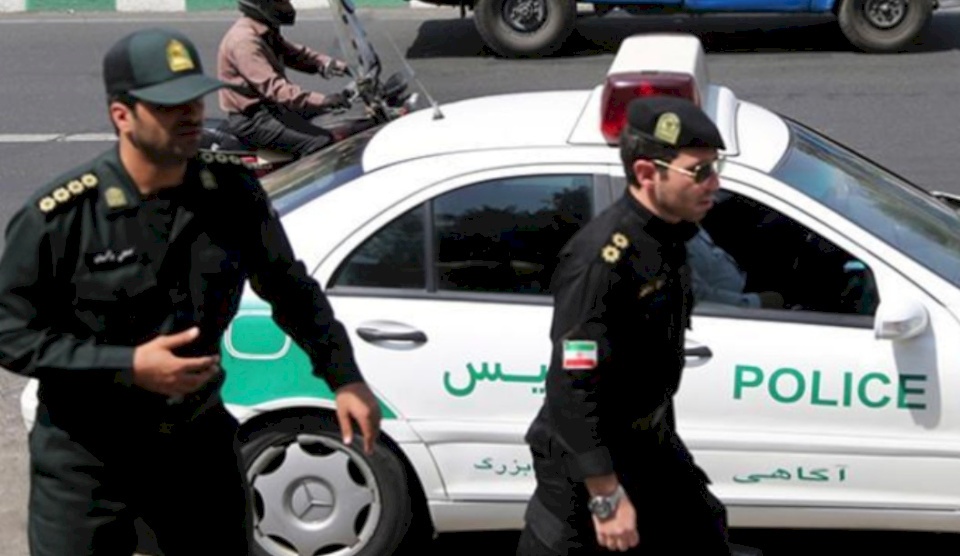
109 Iranian security forces killed in protests as internet blackout continues for 60 hours
SadaNews - The Tasnim news agency (semi-official) reported that 109 members of the security and police forces were killed during the protests, while the non-governmental organization "NetBlocks" stated that "the internet blackout has been ongoing in Iran since it was imposed by the authorities on Thursday due to the demonstrations."
The agency added that these security personnel were killed "in the riots that took place in several areas of Iran over the past few days."
The official Iranian television stated that 30 members of the security and police forces in Isfahan province were killed, while the commander of the Iranian police's special forces revealed that 8 members were killed during "the riots last Thursday and Friday."
Additionally, the television - quoting police from Lorestan - stated that the police "arrested about 100 rioters in the province."
The Iranian Red Crescent also stated that "one of our members was killed during an attack on relief buildings in the city of Gorgan in the north of the country."
For his part, the Iranian Minister of Interior confirmed that "the riots are gradually decreasing."
Iran is witnessing protests over the living conditions in the country for the 15th consecutive day amid a complete internet blackout, and anti-authority slogans have been raised at various demonstrations.
Activists have published clips showing gatherings in neighborhoods of the capital, as well as in the cities of Isfahan, Mashhad, Kermanshah, Arak, and Babylon.
A judicial official in Iran stated - yesterday (Saturday) - that 6 members of the security and police forces were killed and 120 others were injured in riots in Fars province in southern Iran.
The judicial official added that "individuals connected with the enemies exploited legitimate demands from citizens to target security and stability in the country."
Ongoing internet blackout
In a statement broadcast by state television, the Revolutionary Guards accused what they referred to as terrorists of targeting military and security bases over the past two nights, resulting in the deaths of several civilians and security personnel, and reported that fire was set to property.
In contrast, the "Human Rights Activists News Agency" - based in the United States - stated that the death toll from the protests rose to more than 116 and that more than 2600 had been detained.
Also, the non-governmental organization "NetBlocks" monitoring the internet reported today (Sunday) that "the internet blackout is still ongoing in Iran since the authorities imposed it on Thursday due to the protests."
The organization stated via the "X" platform that the internet blackout has continued for more than sixty hours, considering that "this censorship measure poses a direct threat to the security of Iranians and their quality of life at a pivotal moment for the future of the country."
Qalibaf issues a direct threat to Israel and the U.S. military, indicating the possibility of a preemptive strike (Reuters)
"Legitimate targets"
For his part, the Iranian Parliament speaker, Mohammad Baqer Qalibaf - today (Sunday) - warned that the U.S. military and Israel would become "legitimate targets" if the United States carried out attacks on Iran as threatened by U.S. President Donald Trump.
Qalibaf's statements are the first of their kind to include Israel on the list of potential targets for any Iranian strike.
Qalibaf issued this threat as deputies rushed to the parliamentary platform chanting "Death to America."
The Iranian Parliament speaker said: "The Iranian people must know that we will deal with them in the harshest ways, and we will punish everyone who is arrested."
Qalibaf then directed a direct threat to Israel, or the "occupied territories" as he described them, as well as to the U.S. military, indicating the possibility of a preemptive strike.
In this context, the Iranian President, Masoud Bezhakiyan, accused Washington - yesterday (Saturday) - of "inciting chaos within Iran and stirring up unrest," emphasizing that "the people support their country, and their system is stronger than before."
President Bezhakiyan acknowledged the public discontent in Iran, stating that the government is responsible for the current economic problems and urged officials not to blame external entities like the United States.
In contrast, Trump expressed his support for the protesters. He stated - in a post published yesterday (Saturday) on his "Truth Social" platform - that "Iran is seeking freedom perhaps like never before, and the United States stands ready to help."
"No indications of an attack"
Meanwhile, the "Wall Street Journal" reported from U.S. officials that officials in the Trump administration discussed how to carry out an attack on Iran to meet their president's threats. According to the newspaper's sources, the discussion among administration officials included identifying potential targets in Iran.
The newspaper quoted a U.S. official saying that among the options is to launch extensive airstrikes targeting Iranian military sites. He added that there is no consensus yet on the appropriate course, and no equipment or forces have been moved.
The U.S. official noted that discussions regarding Iran fall within routine planning, and there are no indicators of an imminent attack.
Additionally, the "New York Times" reported that U.S. officials indicated that Trump has been briefed in recent days on new options for launching attacks on Iran.
The officials stated that Trump has not yet made a final decision, but he is seriously considering issuing an order to strike Iran in response to the crackdown on protests.
They added that some options presented to Trump are linked to Iranian security elements using violence against protesters.
The newspaper also reported a military official stating that U.S. military leaders need more time to prepare for any retaliatory Iranian strikes.
Protests began on December 28 due to price hikes and deteriorating living conditions, after the exchange rate of the local currency, the rial, reached low levels and inflation rose to 43% according to official figures.
Two interrelated factors and paths
Hassan Ahmadian, a political science professor at the University of Tehran, stated that the protests stem from two interrelated factors, one arising from internal discontent, and the other manifesting in external roles, both present in the current scene.
He explained in an interview with Al Jazeera that there are legitimate popular demands stemming from widespread dissatisfaction among Iranians regarding deteriorating economic conditions, which is a sentiment shared by a large segment, perhaps a majority of the Iranian society at this stage.
Conversely, Ahmadian pointed to a clear external role, reflected in statements from officials in the United States and the Israeli Prime Minister, in addition to parties from the opposition outside the country, considering that these stances amplify the negative image of the economic situation and give it broader political and security dimensions.
The political science professor indicated that this external dimension - according to the official narrative - is perceived as an "artificial" factor aimed at fueling confrontations in the Iranian street and increasing their intensity.
Regarding the Iranian government's approach to the protests, the Iranian academic clarified that this issue is a point of contention within Iranian society itself, as there are critical views of the government's approach, while other views see this method as somewhat effective and are even relatively positively received by part of society.
He indicated that the Iranian government faces significant economic constraints that limit its ability to improve living conditions, at a time when it is under external pressure pushing for the expansion of confrontations in the street.
Therefore, authorities are trying to address the crisis through two parallel paths: an economic path and another security path, with a clear attempt to separate the majority of protesters from those the government describes as "rioters" to avoid widening the scope of clashes, according to Ahmadian.
Ahmadian added that the government has, so far, worked on these two paths, and he believes that this approach has achieved a degree of success, as evidenced by the decline in popular participation in the protests, especially with the rise of accompanying violence.
Regarding the increase in the number of casualties, he explained that this rise is due to the change in the nature of the protests, as the first ten days did not witness large numbers or widespread clashes in Iranian cities, before the demonstrations, since last Thursday, shifted towards violent confrontations leading to a steady increase in the number of casualties.
Source: Al Jazeera
 Follow the latest Sada News via Google News
Trump: We will make great progress with Beirut.. Aoun: It is time for Lebanon to be stable

The Lebanese Army Deploys in the South and Comes Under Gunfire; Israel Clarifies

Bezhkian: Directives from the Leader to End the State of No War, No Peace

Saudi Arabia condemns the Houthi threats to navigation and pledges to protect its ships

Global Warning to Americans Due to Rising Tensions in the Middle East

Houthi Movement Announces Ban on Maritime Navigation Against Saudi Arabia

Earthquake of 5.5 Magnitude Hits Western Iran
