

"A Museum That Is Not Looted".. The Story of Rebuilding Sudanese Memory in the Virtual World
SadaNews - After a complete closure of more than two years, the Sudan National Museum in Khartoum has reopened its doors to visitors, but in a virtual format, following a precise reconstruction of its valuable collections, the majority of which were lost as they were destroyed and looted in the early months of the war that has been ravaging Sudan since April 2023.
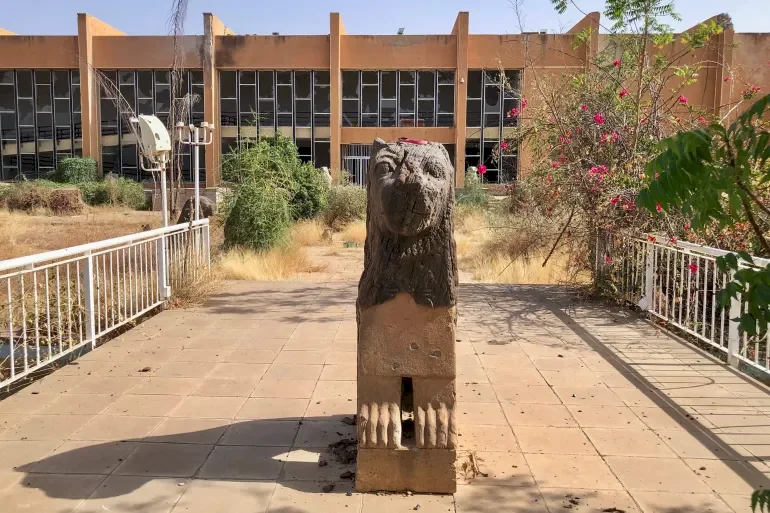
At the same site, of the approximately 100,000 artifacts that had been stored in the museum since its establishment in the 1950s, only a few remained, as thieves left behind only what is difficult to transport, such as the murals of temples that were relocated during the construction of the Aswan Dam or the massive statue of the black pharaoh "Taharka", which stands alone in the courtyard of the National Museum of Sudan in Khartoum, no longer surrounded by admiring visitors or contemplative researchers, but rather debris of other statues and shattered display case glass.
Iklas Abdel Latif, the head of the committee for recovering looted artifacts and the museums officer at the Sudanese National Antiquities and Museums Authority, told Agence France-Presse during the announcement of the project supported by the Louvre Museum in France and Durham University in the UK: "The virtual option was the only possible choice."
Documenting the Looting
Satellite images taken during the looting phase showed trucks loaded with treasures heading towards the vast Darfur region in the west, under the control of the Rapid Support Forces, but research with the help of Interpol has only yielded limited results during this time.
In March 2025, employees from the antiquities sector set foot in the museum for the first time in two years, after the army regained control of the city center. The shock exceeded all expectations, as they were stunned by the scale of destruction that included priceless exhibits. The greatest tragedy was the "gold room", which housed "invaluable artifacts... pure gold pieces of 24-carat gold, some of which date back around 8,000 years".
Faiza Derisi, a member of the French permanent unit for antiquities in Sudan, reminded that "the Khartoum Museum was the cornerstone of preserving Sudanese heritage", noting that "the damage is enormous", but she affirmed that "the virtual format allows for the reconstitution of the lost collections and the preservation of a clear memory".
The researcher and archaeologist has worked for over a year to restore the lost content within a database, based on fragmented official lists, published studies by researchers, or photographs taken during excavation missions. Meanwhile, graphic designer Marcel Berry attempted to recreate the atmosphere of the museum through computer design, including its architectural layout, lighting effects, and exhibit arrangements.
Virtual Visits
Since January 1st, the "Virtual Museum of Sudan" has allowed online exploration of artifacts gathered from archaeological sites along the Nile Valley in a graphical space. In the long term, the museum's three-dimensional halls, designed based on original plans and images, will include over a thousand artifacts from the heritage of the ancient Kushite kingdoms.
By late 2026, visits to the museum's famous "golden room" will be available online, featuring jewels and pure gold pieces looted by thieves.
The war erupted between the Sudanese army led by the head of the Transitional Sovereignty Council, Abdel Fattah al-Burhan, and the Rapid Support Forces led by his former deputy, Mohamed Hamdan Dagalo (Hemedti) in April 2023, dividing the country and leaving tens of thousands dead and millions displaced.
In the midst of this tragedy, the Sudanese government directly accused the Rapid Support Forces of "destroying artifacts and possessions that chronicle the Sudanese civilization that has lasted for over 7,000 years", considering it a "war crime", a charge denied by the Rapid Support Forces.
This systematic looting led the United Nations cultural organization (UNESCO) to launch a global appeal at the end of last year urging the public to refrain from trafficking in antiquities, emphasizing the significance of what the museum contained in terms of "important artifacts and statues of great historical and material value".
Source: Agence France-Presse
 Follow the latest Sada News via Google News
After Deschamps' Departure... Zinedine Zidane Tops the Candidates to Lead France

Mbappe Surpasses Messi and Becomes the All-Time Top Scorer in the World Cup

England Defeats France and Achieves Largest World Cup Achievement Since 1966

Messi Refused to Play for Spain and Missed 3 World Cups

Publishers Sue Google for Allegedly Using Books to Train Artificial Intelligence

Google Expands Capabilities of Google Search Console to Support Social Media Accounts

The Mediterranean Table... An Ancient Diet Revealing Its New Secrets for Health and Longev...
