

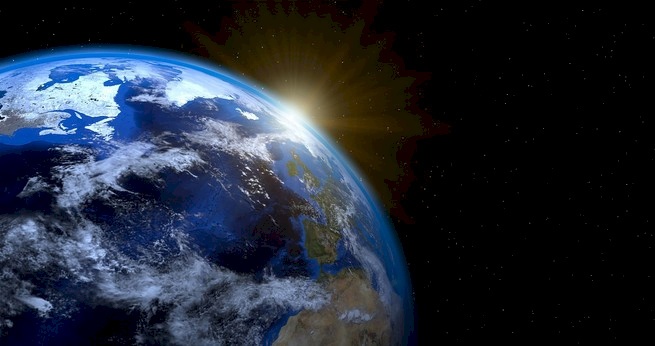
When the Sun Approaches Earth More in January
SadaNews - On Saturday, January 3, 2026, the Earth reached its "perihelion" point around the Sun (the closest it gets to the Sun) in its elliptical orbit, which elongates, sometimes moving away and sometimes getting closer.
Member of the Arab Union for Astronomy and Space Sciences, Walid Sobhi Shaqir, stated that during its orbit around the Sun, the Earth nears in winter (around January 3 and 4) each year to a distance of 147.1 million kilometers, thus reaching the perihelion point. In contrast, in summer, it is at its aphelion (the farthest point in its orbit) at a distance of 152.5 million kilometers, occurring on July 6, 2026.
Shaqir pointed out that the difference between the two distances is about 5 million kilometers, which is an enormous distance equivalent to 392 times the diameter of the Earth, measuring 12,742 kilometers.
He added that if the difference between Earth's "aphelion" and "perihelion" in relation to the Sun were about 10 million kilometers, it would raise our planet's temperature by 3 to 5 degrees Celsius. The climate would change steadily and significantly, making summers hotter, winters warmer, and reducing snowfall in many areas while raising sea levels. Consequently, this would cause disruptions in rainfall patterns, leading to more floods in some regions and increased drought in others.
Optical and Photographic Observations
In terms of observation, the apparent diameter of the Sun seems larger during these days (perihelion and around it) than at any other time during the year, measuring 32.7 arc minutes (an arc minute is one-sixtieth of a degree), compared to a summer appearance of about 31.6 arc minutes. This makes the difference in the Sun's diameter between winter and summer more evident only in photographs.
It is noteworthy that the Sun is currently undergoing a peak in its solar activity cycle, characterized by the appearance of a large number of sunspots, which leads to many solar flares that can affect global wireless communication networks.
Therefore, specialists warn against looking at the Sun at any time from sunrise until just before sunset, as its strong rays can significantly harm the eyes. However, viewing it at sunset is relatively safe due to the thick atmosphere filtering out more than 95% of its rays, allowing it to be seen as a clear orange disk at many times.
At sunrise, the sky is clearer and less polluted, as the Sun rises brightly with strong rays that astronomers prohibit looking at.
Source: Al Jazeera
 Follow the latest Sada News via Google News
After Deschamps' Departure... Zinedine Zidane Tops the Candidates to Lead France

Mbappe Surpasses Messi and Becomes the All-Time Top Scorer in the World Cup

England Defeats France and Achieves Largest World Cup Achievement Since 1966

Messi Refused to Play for Spain and Missed 3 World Cups

Publishers Sue Google for Allegedly Using Books to Train Artificial Intelligence

Google Expands Capabilities of Google Search Console to Support Social Media Accounts

The Mediterranean Table... An Ancient Diet Revealing Its New Secrets for Health and Longev...
