

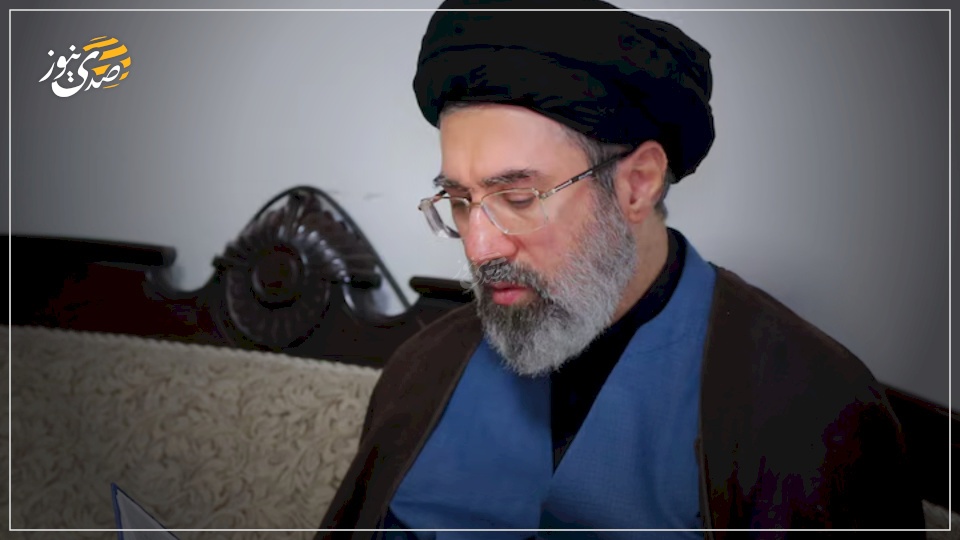
Tehran Downplays Khamenei's Injury as US Intelligence Monitors His Isolation
SadaNews - An Iranian health ministry official stated that the injuries sustained by Iranian leader Mojtaba Khamenei due to the US-Israeli strikes at the end of February were "superficial" only, providing rare details about the day of his injury, amid American reports indicating that he has been in an undisclosed location since the outbreak of the war.
The reformist news agency "Ilna" quoted Health Ministry spokesman Hossein Kermanpour as saying that Mojtaba Khamenei arrived at a hospital not specified around 1 PM on February 28 and went into surgery with several other wounded individuals.
Kermanpour stated that the injuries were limited to "superficial wounds to the face, head, and legs," and did not require amputation or any complicated medical procedures. He added, "From my perspective as a doctor, these injuries were not severe and required only one or two stitches."
He explained that Khamenei, who was fasting during the month of Ramadan, refused to break his fast and continued until iftar time, emphasizing that this "indicates that his health status was good." He noted that the leader left the hospital around 2 AM on March 1, without mentioning where he was transferred to.
Khamenei, aged 56, has not appeared publicly since assuming his position following the death of his father, former leader Ali Khamenei, on the first day of the US-Israeli attack on Iran on February 28, which sparked a wide-ranging war in the Middle East. His statements since then have been limited to written messages, raising speculation about his health status and whereabouts.
In March, US Defense Secretary Pete Hegseth stated that Mojtaba Khamenei is "injured" and "likely disfigured." However, the new Iranian narrative attempted to downplay the severity of his injury after weeks of ambiguity surrounding his absence from the public scene.
This narrative coincides with a report from CBS News that cited US officials acquainted with intelligence information suggesting that the Iranian leader is actually holed up in an undisclosed location with limited ability to communicate with the outside world and can only be reached through a complex network of couriers.
Officials stated that the difficulty in accessing Khamenei has caused problems for the Iranian officials authorized to communicate with the administration of US President Donald Trump, partially explaining the slow emergence of details regarding the potential agreement with Iran and previous negotiations.
According to the report, any proposals sent by Washington may require a long time before receiving a response due to the complications of delivering messages to the leader. A White House spokesperson declined to comment on the intelligence regarding his whereabouts or the Iranian communication mechanisms.
A senior US administration official stated on Sunday that the leader has approved the outlines of the current draft agreement, while Trump wrote on the "Truth Social" platform that he expects the final word to be issued in the coming days.
According to CBS, Mojtaba Khamenei has taken strict security measures to avoid strikes similar to those that led to the killing of his father. Officials stated that American and Israeli intelligence information gathered from within the Iranian government has made it possible to locate and eliminate a large number of senior Iranian leaders during the war.
Sources added that most Iranian leaders spend weeks inside heavily fortified bunkers and avoid direct communication except in extreme necessity. One official remarked that "watching them trying to figure out how to communicate with each other is almost like watching a comedy show. They are in complete distress."
The greatest caution is exercised around the leader himself; even officials at the highest levels of the Iranian government do not know his whereabouts and have no direct means of contacting him. Instead, messages pass through a network of couriers created to obscure his location.
One official said this explains the issuance of statements like "the leader agreed to the outline" or "we are waiting for a response on the final points," adding that all information reaching him is relatively old and that there are significant delays in his responses.
According to the report, Khamenei communicated with close officials generally, providing guidance on issues that could be negotiated and matters that should not be raised.
On May 7, Iranian President Masoud Behzadian stated that he met with the leader and that their meeting lasted two and a half hours.
Three days later, Iranian state television reported that the commander of the "Joint Chiefs of Staff Operations Headquarters," Ali Abdollahi, met with Mojtaba Khamenei, who offered "new directives and guidance to continue operations against the enemy."
 Follow the latest Sada News via Google News
CNN: Omani Proposal for Navigation in Hormuz Through Two Separate Corridors

Lebanon to Participate in Talks with Israel in Rome Next Week

"They held us at gunpoint with American rifles".. Settlers besiege American congressman in...

Axios: Possible Iranian-Omani Statement to Open the Middle Corridor in Hormuz to Ships

US Military Delegation in Lebanon to Discuss Mechanisms for Israel's Withdrawal from "Tria...

After Renewed Clashes.. Mediators Seek to Revive Diplomatic Path Between Washington and Te...

Mojtaba Khamenei Vows to Avenge His Father
