

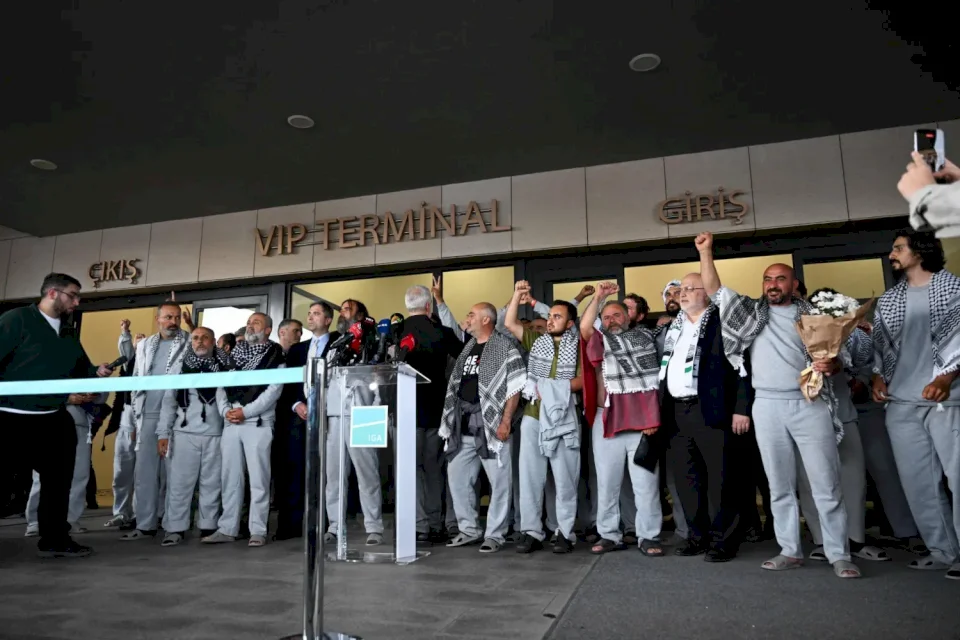
Activists from 'The Global Resistance Fleet' recount arrest and abuse by Israel
SadaNews - A purplish bruise surrounded one of Julian Cabral's eyes, and he had a wound on his left temple and an injury to his shoulder bone when he arrived at Istanbul Airport yesterday evening, as part of the first group of activists from 'The Global Resistance Fleet' that Israel expelled after intercepting their ships at sea.
The 57-year-old Belgian, originally from Antwerp, sailed on a small boat from Turkey as part of the convoy, accompanied by six others including a fellow Belgian, an Italian, a Malaysian, a Finn, a Canadian of Palestinian descent, and a South African.
Cabral recounts to the French Press Agency how they were intercepted by the Israeli Navy on Monday in international waters more than 500 kilometers from its shores.
Turkey evacuated more than 400 people on special flights organized by the Foreign Ministry, preparing to receive them at Istanbul Airport, along with doctors and ambulances.
Cabral says that the Israelis "first disrupted communications, then boarded in broad daylight carrying their weapons and fired rubber bullets just for fun."
He continues, "We discovered that we were the twelfth ship to be intercepted. We were surprised. The cruisers surrounded us from all sides. They moved toward us very violently even though we were raising our hands in the air."
- A punch -
He adds, "I was the second in command of the boat. Our captain, an Italian, was still standing, and they targeted him immediately. I received a punch to my left temple."
He continues, "After that, they transferred us violently with our hands tied with plastic straps to a ship that resembled a prison, (they put us) inside containers. I heard them say in English: 'Let's mess with him a little.'"
Cabral states that the activists requested to see a doctor for three days, but the response was always "later, later."
While pointing to his ribs and arms, he narrates that the Israelis "confiscated medication from a person with epilepsy... On board the Sirius boat, seven persons among them suffered a total of 35 fractures."
While being taken to Israel by sea, Cabral states that the soldiers threw boxes of bread and water to the detained activists "but not in sufficient quantities."
He adds, "We were about 200 people... We asked for more water, toilet paper, and sanitary pads for women. We had to ask for everything."
- 'They treat their animals better' -
The detainees were taken off the ship on Wednesday and transported in vehicles to a protest center near the city of Ashdod in southern Israel. Cabral says that the handcuffs were "much too tight," and that the detainees were forced to bend for long hours.
He continues, "We couldn't see anything. They were pressing on our necks... They kept slapping us and humiliating us... Some were laughing with them and playing the Israeli national anthem. They were particularly harsh with the Jordanians and Tunisians."
The detainees were transferred on Thursday to Ramon Airport in southern Israel "where we were also subjected to humiliation," according to the Belgian activist, before being deported.
The deportation of the activists came a day after far-right National Security Minister Itamar Ben Gvir released a video showing them while detained, handcuffed and kneeling, which sparked widespread condemnation and diplomatic responses.
Cabral expects to return to Belgium on Friday after seeing a doctor, and intends to participate again in any fleet aiming to break the Israeli blockade of the region.
At the airport as well, Bilal Kitei, a Turk from the predominantly Kurdish city of Bingol, embraced his wife after returning from his second trip with 'The Global Resistance Fleet.'
He was on a boat carrying about ten activists and stated that the Israeli forces employed a method of interception that was "much harsher than the previous time" which occurred in April.
He explains, "They attacked us. We were all beaten... this is what the Palestinians suffer all the time," adding, "Unfortunately, they (the Israelis) treat their animals better."
 Follow the latest Sada News via Google News
CNN: Omani Proposal for Navigation in Hormuz Through Two Separate Corridors

Lebanon to Participate in Talks with Israel in Rome Next Week

"They held us at gunpoint with American rifles".. Settlers besiege American congressman in...

Axios: Possible Iranian-Omani Statement to Open the Middle Corridor in Hormuz to Ships

US Military Delegation in Lebanon to Discuss Mechanisms for Israel's Withdrawal from "Tria...

After Renewed Clashes.. Mediators Seek to Revive Diplomatic Path Between Washington and Te...

Mojtaba Khamenei Vows to Avenge His Father
