

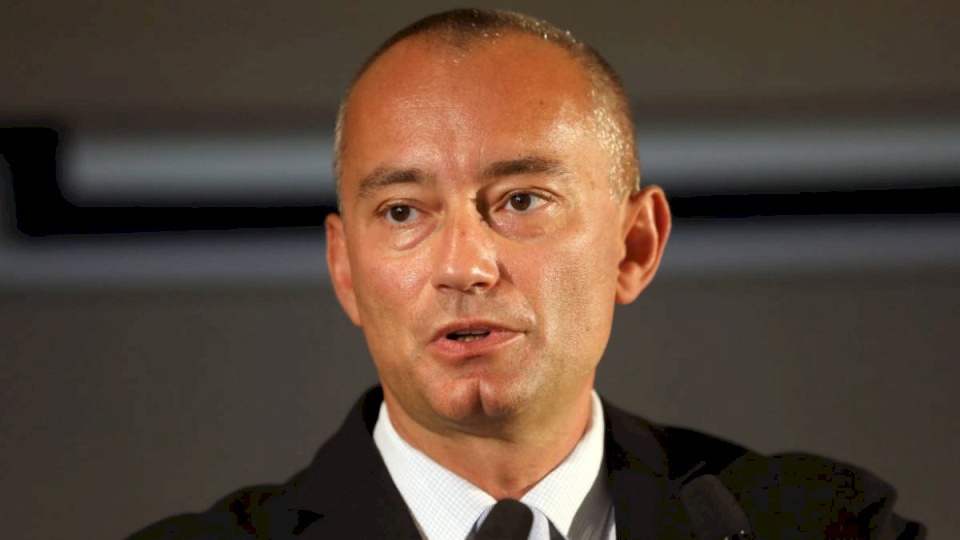
Mladenov Reports to the Security Council and Warns of the Risk of Turning the Situation in Gaza into a Permanent State
SadaNews - The High Representative of the so-called "Peace Council" in Gaza, Nikolai Mladenov, warned on Thursday about the risk of the "current situation" of the fragile ceasefire in the Strip becoming a "permanent state".
Mladenov presented to the United Nations Security Council the first report of the "Peace Council", which claims that Hamas's refusal to disarm and relinquish its control over Gaza is the "main obstacle" to the peace plan.
In his video speech, he said, "While I continue to call on Hamas and other Palestinian factions to return to the negotiation table" and respect their commitments, "I must also clarify that the implementation of (the plan) cannot move forward solely through Palestinian commitments".
Mladenov emphasized that the continued loss of lives in the Strip despite the "far-from-perfect" ceasefire and the Israeli restrictions on the entry of humanitarian aid "are not abstract issues".
He continued, "I want to clarify the dangers of the parties' inaction. The danger is that the current deteriorating situation becomes a permanent state, with Gaza divided (with Israel controlling about 60% of the area of the Strip), and Hamas maintaining military and administrative control over more than two million people in less than half the area of the Strip".
He pointed out that "these people are likely to remain trapped among the rubble, dependent on aid, without significant reconstruction because reconstruction funds will not reach until the weapons are dismantled".
He stressed that "no investment, no movement, no prospects. As a result, another generation of Palestinian children is growing up in tents, in fear" and overwhelmed by despair, adding, "There is no security for Israel nor a viable path for Palestinian self-determination".
Mladenov proposed a "roadmap" consisting of 15 points to implement the peace plan proposed by Trump, which he said outlines mechanisms for implementing issues related to the future of the Strip, including reconstruction, disarmament, Israeli withdrawal, the operation of the international stabilization force, and rebuilding the police apparatus.
He noted that it is still too early to talk about a genuine recovery in Gaza, as the reality there remains painful. He claimed that there are "security guarantees from Israel that when Hamas commits to this roadmap, Israel will immediately move to fulfill its other obligations under the Sharm El-Sheikh agreement"; according to his statement.
Mladenov considered "no Palestinian group will be asked to hand over its weapons to Israel, as weapons are not handed over to the enemy but to the Palestinian state represented by the National Committee for the Administration of Gaza", and pointed out that disarmament "cannot happen overnight but should be done in phases according to a timeline and international oversight, and applies to everyone".
The ceasefire officially came into effect on October 11, 2025, after three days since the beginning of the third year of the Israeli extermination war. The first phase of the truce saw the release of the last Israeli prisoners, in exchange for the release of Palestinian prisoners. However, the transition to the second phase, which includes disarming Hamas and the gradual withdrawal of the Israeli army, remains pending.
Meanwhile,
the United Nations warned that the situation in the occupied Palestinian territories is heading towards further serious deterioration, urging not to delay the "Peace Council" pathway in Gaza and the necessity to urgently advance the political process.
This was stated in a speech by UN Deputy Coordinator for the Middle East Peace Process, Ramiz Akbarov, during a session held by the Security Council on Thursday to discuss developments in the "Peace Council" process in Gaza.
Akbarov clarified that the conditions in the occupied Palestinian territories "are becoming more dangerous day by day". He pointed out that the settlers' attacks in the occupied West Bank, including the occupied city of Jerusalem, and their attempts to seize Palestinian lands are leading to a significant escalation of tension.
He stressed that the pace of violence and attacks against Palestinian villages has increased significantly, with about 220 populated areas being attacked, leading in some cases to mass displacement. He emphasized that the continuation of these "dangerous" trends cannot be ignored, calling for urgent steps to reverse this course.
Akbarov confirmed that the solution must be within the framework of the "two-state solution", indicating the need to work towards ending the occupation and the conflict, while continuing to support the United Nations for both Palestinians and Israelis to reach a fair and lasting settlement.
Regarding the Gaza Strip, he clarified that the delay in implementing the ceasefire provisions has led to a regression of any positive progress made after the de-escalation, adding that the residents of the Strip are experiencing a state of "deep uncertainty".
The UN official added, "Israeli attacks continue almost daily, resulting in dozens of casualties. Israel controls about 60% of the Gaza Strip through what is known as the yellow line established after the ceasefire".
He also pointed to the ongoing restrictions on humanitarian aid entry, and that the humanitarian situation in Gaza is "extremely catastrophic". He mentioned that the estimated humanitarian needs for Palestinians amount to about 4.6 billion dollars, while only 540 million dollars are currently available to meet these needs.
Cities and towns in the West Bank are witnessing a rise in incursions, raids, and closures carried out by the Israeli army since the start of the extermination war on the Gaza Strip in October 2023, according to official Palestinian data.
Since then, Israeli army assaults and attacks by settlers in the occupied West Bank have resulted in the martyrdom of 1,162 Palestinians, and the injury of about 12,245 others, in addition to the arrest of nearly 23,000; according to official Palestinian statistics.
 Follow the latest Sada News via Google News
CNN: Omani Proposal for Navigation in Hormuz Through Two Separate Corridors

Lebanon to Participate in Talks with Israel in Rome Next Week

"They held us at gunpoint with American rifles".. Settlers besiege American congressman in...

Axios: Possible Iranian-Omani Statement to Open the Middle Corridor in Hormuz to Ships

US Military Delegation in Lebanon to Discuss Mechanisms for Israel's Withdrawal from "Tria...

After Renewed Clashes.. Mediators Seek to Revive Diplomatic Path Between Washington and Te...

Mojtaba Khamenei Vows to Avenge His Father
