

The European Union Approves Resumption of Trade Relations with Syria
SadaNews - The European Council announced on Monday the approval of a decision to end the partial suspension of the cooperation agreement between the European economic bloc and Syria, allowing for the resumption of full trade relations between the two sides.
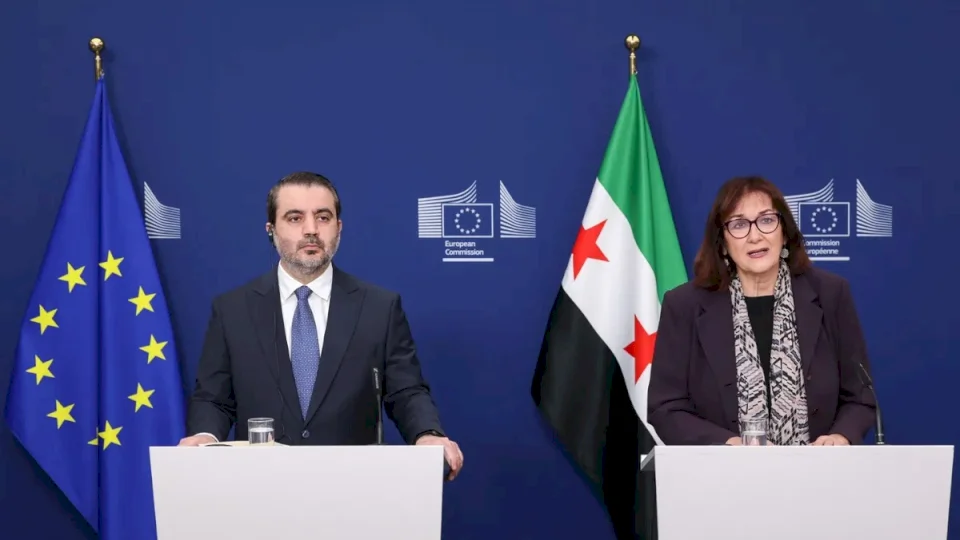
The announcement coincided with the visit of Syrian Foreign Minister Asaad Al-Shaybani at the head of a Syrian delegation to the European Union headquarters in Brussels, to attend the "EU-Syria Partnership Coordination Forum," and to meet with several senior European officials.
The Council stated that this step represents an important move towards enhancing bilateral relations between the European Union and Syria.
The European Council added in a statement that the decision "sends a clear political signal of the European Union's commitment to re-engage with Syria and support its economic recovery."
Al-Shaybani: We Seek to Build a Path for Bilateral Cooperation
The Syrian Foreign Minister stated during a joint press conference with the European Union Commissioner for Mediterranean Affairs, Dubravka Suica, on the sidelines of the forum, that Syria "is entering a phase of establishing an institutional and sustainable pathway that goes beyond providing aid and relief to build a path for bilateral cooperation and a partnership based on mutual benefit."
Al-Shaybani confirmed that Syria "is entering these discussions with the highest degree of seriousness, and we expect our partners to emerge from this meeting with a solid basis for understanding," according to the Syrian news agency "SANA."
He added: "In Syria, we have no minorities or majorities; everyone is Syrian under the law and the Syrian constitution, and we are working to rebuild Syria in all fields and facilitate the voluntary return of refugees."
Syrian Foreign Minister Asaad Al-Shaybani held a meeting in Washington on Thursday with members of the Senate Foreign Relations Committee to discuss enhancing cooperation between the two countries.
He continued: "We all realize that the current exceptional geopolitical moment carries rare opportunities for the region and for Europe as a whole, and investing in this moment requires initiative; historical windows close if not exploited in time, and what we can achieve today together may surpass what can be achieved tomorrow."
He went on to say: "Syria is one of the cornerstones of stability in the region, and we have strengthened this stability over the past year and a half, and this phase is not over; it requires completing the rebuilding process and repairing the infrastructure, and this is what we came to achieve today," pointing out that "today, Syria is one of the alternative routes as a strategic and stable path, and due to its strategic location, it can be one of the secure routes for supply chains."
Al-Shaybani added: "We consider the European Union, the United States, and the Gulf countries as partners of Syria."
Supporting Reconstruction Efforts
On her part, the European Commissioner for Mediterranean Affairs stated during the conference: "We stand today with Syria to transition from crisis to recovery, as Syria is one of the most important countries in the Eastern Mediterranean, and its reconstruction requires working together due to the vast and significant needs."
The European Commissioner added: "We provide support for health institutions and infrastructure in addition to enhancing the pace of achieving economic and social recovery and building institutions, which is the foundation for a prosperous Syria for all."
She clarified that "achieving recovery in Syria is about building the future and achieving the capacity to adapt to instill hope in the hearts of Syrians," pointing out that "Syria is on the right track, and achieving recovery requires some time."
The German Foreign Minister announced that her country will provide aid to Syrians worth 300 million euros through the United Nations and selected organizations, ahead of the donors' conference in Brussels.
The European Commissioner announced during the forum that "the European Union is working to implement a financial package estimated at 175 million euros, in addition to providing a second financial package of 180 million euros this year as part of supporting the Syrian government in rebuilding and achieving recovery."
She explained that this funding "will help unlock investments in the public and private sectors and encourage European banks, which is important for Syria that aspires to rebuild and provide services to facilitate the return of refugees who have capabilities and creativities to contribute to the reconstruction of their country, Syria."
She added that the bloc is working to facilitate the voluntary and safe return of Syrian refugees, and we will organize an investment conference at the end of this year to support Syria and the return of refugees."
European Partnership with Syria
The European Union announced that it will hold, on Monday, in Brussels, two high-level meetings with the Syrian government aimed at strengthening bilateral relations and discussing ways to support social and economic recovery, reconstruction, and achieving long-term stability in Syria.
The Directorate-General for the Middle East and North Africa and Gulf DG MENA in the European Union mentioned in a statement on Friday that "these meetings come as part of a new page in relations with Syria and cooperation with it, which was manifested in the visit of European Commission President Ursula von der Leyen and European Council President Antonio Costa to Damascus last January."
According to the statement, on Monday, the "Syria Partnership Coordination Forum" meeting will be held to unify international efforts in the fields of aid, reconstruction, and development, co-chaired by the Mediterranean Affairs Commissioner Dubravka Suica and Syrian Foreign Minister Asaad Al-Shaybani, with the participation of high-level representatives from member states, the G7, Arab states, the United Nations, and major financial organizations.
The directorate added that this will be followed by holding the first "High-Level Political Dialogue" between Syria and the European Union, chaired by the European Union's High Representative for Foreign Affairs, Kaia Kalas, and Minister Al-Shaybani, with the participation of the Mediterranean Affairs Commissioner and the Commissioner for Crisis Management, Janez Lenarcic.
The Syrian President Ahmad Al-Shara discussed with European Commission President Ursula von der Leyen and European Council President Antonio Costa the importance of maintaining the unity of Syrian territories.
The directorate pointed out that this dialogue "represents a strategic shift from a phase of crisis response to a long-term partnership based on a shared vision for stability and prosperity, and an opportunity to affirm the commitment to a peaceful and inclusive transition that meets the aspirations of all Syrians and ensures long-term stability and prosperity for the country and the region as a whole."
The dialogue between Syria and the European Union comes in the context of the ongoing and positive development between the two sides, including President Ahmad Al-Shara's visits to several European countries and his participation in the informal EU meeting with regional partners in Cyprus last month, as well as his meetings with several European officials, and the visits of the President of the European Council and the President of the European Commission to Syria last January.
Strengthening Economic and Security Relations
In mid-April, a document reviewed by "Reuters" revealed that the European Union intends to strengthen ties with Syria by re-establishing official political contacts and paving the way for stronger economic and security relations, in the latest step in a broader shift in policy towards Damascus after years of stagnated relations.
The reference document, prepared by the diplomatic service of the bloc, indicated that the bloc will fully resume work under the cooperation agreement signed in 1978 with Syria, and will begin high-level political dialogue, a term used by the Union to refer to formal and organized discussions with transitional authorities in Syria on May 11.
A diplomatic document showed that the European Union intends to strengthen ties with Syria by re-establishing official political communications and paving the way for stronger economic and security relations.
In a notable amendment to the policies in place, the document also stated that the European Union said it "will reshape and adjust" the sanctions system to maintain leverage while continuing to engage with the Syrian leadership, targeting those who negatively influence the transitional process.
Syria, having most Western sanctions lifted by the end of last year, seeks greater integration into the international community during the transitional phase.
The document outlines plans to enhance European economic partnership with Syria, including a framework for trade and investment, stimulating private sector financing, and supporting reforms to improve the business environment in Syria through a new technical assistance center.
The document also mentioned, according to "Reuters", that the European Union will work with Syrian authorities to facilitate the "safe, voluntary, and dignified return" of refugees and displaced persons.
 Follow the latest Sada News via Google News
Report: Washington Monitors Israeli Espionage on American and Iranian Officials

Houthis Threaten to Target Saudi Airports, Accuse it of Violating Yemen's Airspace

Netanyahu and Trump Agree to a Upcoming Meeting in the United States After Their Conversat...

Injuries and Arrests in Settler Attack Near Khan al-Ahmar East of Jerusalem

Trump's Right Wing is Crumbling.. Will the Iran War Create a Third American Party?

Aoun: The Agreement Framework Does Not Legalize the Occupation's Continuation, and the Leb...

Israeli Spyware Program Hacked European Parliamentarian's Phone and Investigated Surveilla...
