

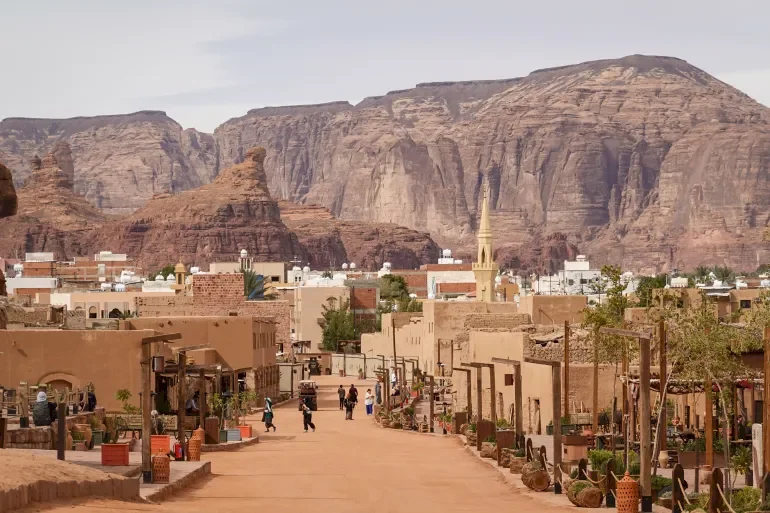
Al-Ula: The Story of a Saudi City That Shaped Stone to Carve the Memory of Heritage
SadaNews - In the northwest of the Kingdom of Saudi Arabia, where the silence of the desert meets the majesty of the mountains, the city of Al-Ula emerges not only as a tourist destination but as a living witness to the genius of humanity that has shaped stone into an unbreakable identity. Here, the rock formations encapsulate a history that spans thousands of years, telling the story of the empires that have made this land a prominent center of economic and political gravity throughout the ages.
The Compass of Civilizations
The location of Al-Ula is considered a strategically important point on the ancient trade routes connecting southern Arabia with the Levant. This location contributed to the establishment of successive civilizations within it, most notably the kingdoms of Lihyan and the Nabataeans, who left significant traces at the site of "Al-Hijr" (Madain Salih).
The site of "Al-Hijr" is distinguished by the presence of tombs and architectural features carved into the mountains, making it a UNESCO World Heritage site, as it was listed in 2008 as the first Saudi site on the World Heritage list.
An Open Museum
The significance of Al-Ula is not limited to its rock facades but extends to intricate details; at "Mount Ikmah", visitors find themselves in front of a "library open to the sky" containing hundreds of inscriptions documenting the laws and religious rituals of ancient civilizations. At "Dadan", the "Tombs of the Lions" stand as a testament to an exquisite artistic level reflecting strength and sovereignty. Even Islamic history has its share in the "old town", with houses built from mud bricks that narrate the story of uninterrupted human settlement.
In contrast to being a silent archaeological site, Al-Ula has today become a global destination for the arts, manifested in the "Miriam Hall", an architectural miracle that entered the Guinness World Records as the largest building covered in mirrors in the world, reflecting the beauty of the surrounding nature and openly declaring that the past is the cornerstone of the future.
Development Beyond Stone
The Al-Ula development project relies on an integrated development methodology aimed at incorporating local populations into the ongoing economic and cultural activities. Currently, activities in the region are distributed across several main sectors:
Environmental Protection: The "Sharaan" reserve oversees programs for the resettlement of native species, including the Arabian leopard.
Agricultural Sector: Investing in the palm oasis (which includes about two million trees) through agricultural tourism programs to support local production.
Events and Tourism: Organizing international conferences and events aimed at attracting visitors and those interested in the culture and creativity sector.
Through these steps, Al-Ula is transitioning from merely being a site of historical artifacts to an active developmental center, where the cultural heritage is employed as a tool to achieve sustainable economic and social growth, linking the region's history with the demands of modern development.
Source: Online Websites
 Follow the latest Sada News via Google News
After Deschamps' Departure... Zinedine Zidane Tops the Candidates to Lead France

Mbappe Surpasses Messi and Becomes the All-Time Top Scorer in the World Cup

England Defeats France and Achieves Largest World Cup Achievement Since 1966

Messi Refused to Play for Spain and Missed 3 World Cups

Publishers Sue Google for Allegedly Using Books to Train Artificial Intelligence

Google Expands Capabilities of Google Search Console to Support Social Media Accounts

The Mediterranean Table... An Ancient Diet Revealing Its New Secrets for Health and Longev...
