

"Resident" Robots in the Depths to Monitor Marine Pipelines and Cables
SadaNews - Researchers in Norway have tested an autonomous underwater robot that managed to perform inspection tasks for marine infrastructure, and then automatically returned to a fixed station on the sea floor to recharge its battery and transmit the data it collected.
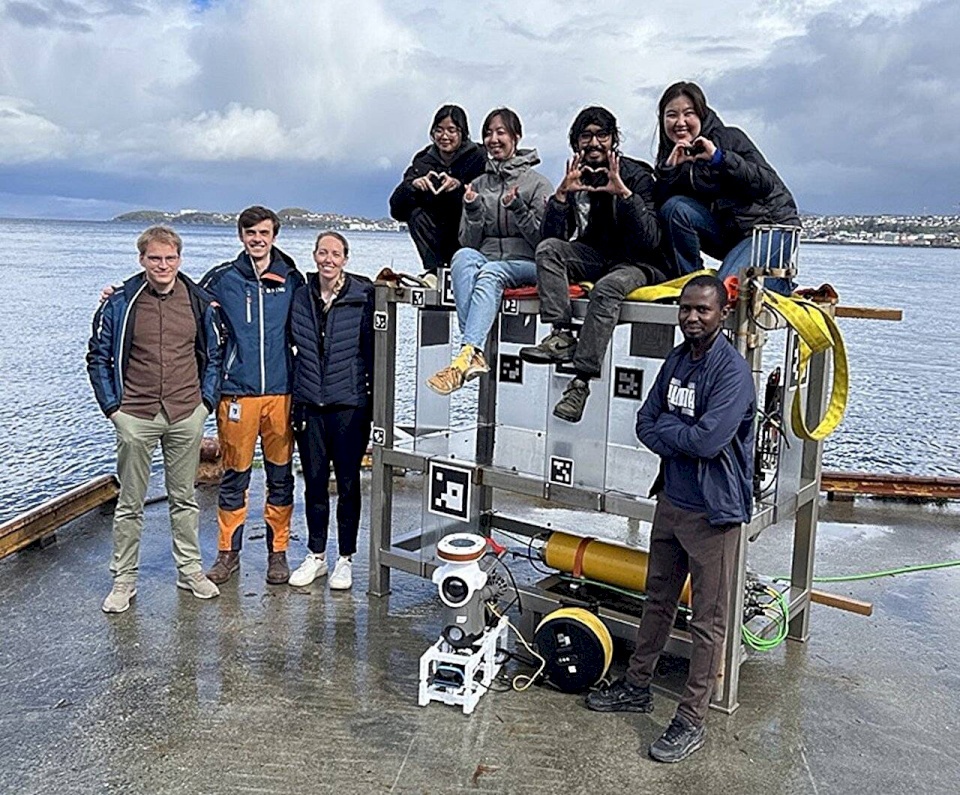
The experiments were conducted at a depth of 90 meters in the Trondheimsfjord, in a move aimed at developing robots that can stay underwater for months or years, instead of returning to ships or land for maintenance and charging after each task.
The need for monitoring pipelines, communication cables, power lines, and marine facilities is growing, alongside the expansion of economic activity in the seas and increasing concerns about the security of underwater infrastructure.
Current inspection operations often rely on large ships equipped with sonar devices or underwater vehicles accompanied by support ships and operating teams. These operations require a large number of workers, in addition to high costs and carbon emissions resulting from operating ships for extended periods.
The new project aims to replace "resident" robots in the sea as part of this model, departing from fixed bases on the seabed, performing inspection tasks when needed, and then returning to their stations without direct human intervention.
Martin Ludvigsen, a professor in the Department of Marine Technology at the Norwegian University of Science and Technology, stated that these robots could play a significant role in monitoring and protecting infrastructure without depending continuously on costly surface ships.
A 10-Kilogram Robot
During the tests, researchers used a "Blueye X3" robot weighing about 10 kilograms, equipped with a camera, sonar, sensors, communication equipment, an inductive charger, and a magnetic stabilization system.
After completing a task, the robot uses a set of navigation techniques to locate the charging station and communicate with it. Initially, it relies on acoustic systems for low-speed location determination and communication, then shifts to visual guidance as it approaches the station, where the camera reads specific markers and uses computer vision techniques to direct it to the docking point.
Upon docking with the station, data transmission begins at a higher speed while the battery is wirelessly charged via induction. The seabed station is linked to onshore facilities through a cable that provides power and communication.
90% Success Rate
The system has been deployed twice, achieving a total of four weeks of operational service. During this period, the robot completed inspection tasks and recorded a 90 percent success rate in returning to and docking at the charging station.
Although the result indicates the possibility of repeating the operation, the team believes that the percentage should reach 100 percent before relying on the system independently.
Ludvigsen noted that successful docking is crucial because the robot's inability to return to the station could mean its loss and inability to recover, especially when operated without a nearby operator or support vessel.
For this reason, the current tests were conducted using a safety line that allows for the robot's recovery when necessary. Backup recovery methods will continue to be used in future experiments until the system proves its capability to operate autonomously and reliably.
Challenges of Underwater Navigation
Navigation in the depths of the sea differs from movement on land or on the water surface, as signals from global positioning systems do not reach the depths. The robot needs to combine several means of estimating its location and direction, including gyroscopes, accelerometers, and inertial navigation systems, in addition to acoustic techniques that measure movement relative to the seabed. These systems consume computational power and energy, making navigation and efficiency enhancement among the foremost challenges for long-term operations. Tests also revealed unexpected issues in computer vision. When fish swam in front of the camera, they confused the program responsible for interpreting the images, leading researchers to improve the system's ability to distinguish between objects and the surrounding environment.
From Experiments to Commercial Operation
The project is still in the development phase, and researchers face challenges concerning the durability of docking stations, complete autonomy, communication, maintaining trajectory and direction, as well as cost reduction.
The team believes that incidents targeting pipelines and communication and power cables have raised the need for simpler and more widespread solutions to monitor the seabed. Currently, there is no commercially ready system for permanent operations without supervision, but researchers see that the experiments have demonstrated the feasibility of the idea for application and repetition. In the future, these systems could allow for repeated inspections at a lower cost, reducing reliance on vessels and minimizing risks to workers at sea, while also speeding up the detection of faults or damage to pipelines, cables, and underwater facilities.
 Follow the latest Sada News via Google News
World Cup: Egypt Achieves Historic Milestone by Advancing to the Second Round, while Saudi...

"Resident" Robots in the Depths to Monitor Marine Pipelines and Cables

Apple Raises Prices on Mac and iPad... iPhone Not Included in the Hike So Far

Study: Steroid Drugs Can Alleviate Nausea and Vomiting in Cancer Patients

New Discovery on Pneumonia May Improve Treatment for Severe Cases

Capsule Remains in Stomach for Two Days to Improve Ulcer Treatment

8 Daily Habits That May Help You Live to 100 Years
