

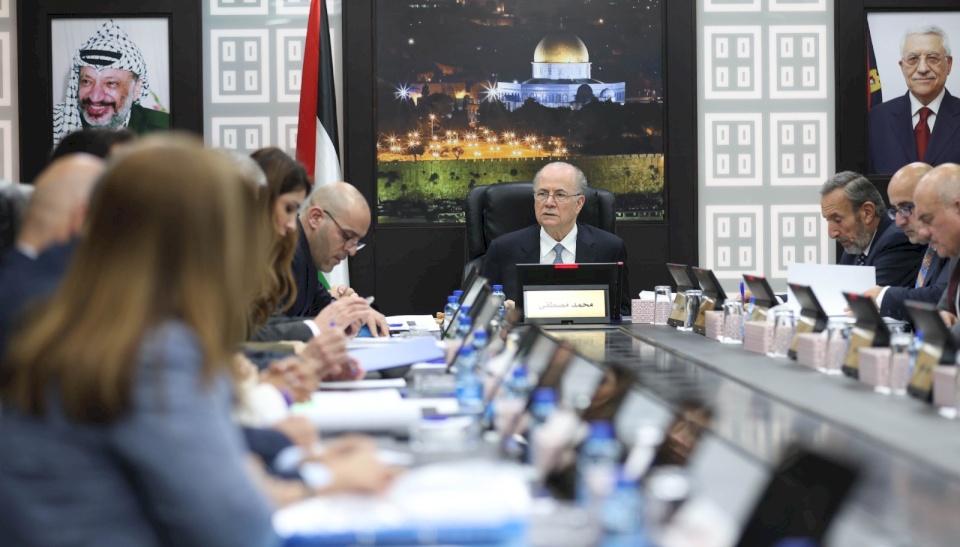
Despite the Ongoing Financial Crisis.. The Government Increases Working Days for Public Employees by One Day
SadaNews: The Palestinian Cabinet stated during the weekly government session today, Tuesday, that in light of the continuing financial crisis resulting from the complete seizure of clearance funds by the occupation, and to alleviate the burden on employees from the repercussions of the current financial crisis, the Cabinet has approved work arrangements for civil servants such that the working schedule will be three in-person days for those within the governorate, and two days for those from outside the governorate, while remote work will be implemented for the remaining days of the week, taking into account the special circumstances of the Ministry of Health.
He added: The head of the governmental department will rotate his employees to ensure the continued provision of services to citizens from 8 AM until 3 PM, throughout the week.
Additionally, regarding the working hours of public schools, the current methodology will continue to be applied until the end of the current semester.
He stated that due to the particular nature of the Ministry of Health, the ministry has been granted the authority to assess shifts and coordinate between the medical, technical, and administrative staff to ensure that health services do not discontinue for citizens.
The Cabinet warned in its session of the grave dangers posed by the daily crimes committed by terrorist settler militias and the escalation of their organized assaults in the West Bank and Jerusalem, which manifested in repeated incursions, stone-throwing, physical assaults, and the burning of Palestinian homes and properties, particularly in the village of Jaloud south of Nablus. They condemned the uprooting operations in Burqa and al-Mughayer, as well as in Ya'bad west of Jenin, alongside the cutting down of hundreds of olive trees in the Tarmsayya Plain north of Ramallah, in a systematic targeting of land and people.
The Cabinet affirmed that all these practices collectively represent a dangerous escalation and war crimes aimed at imposing coercive realities on the ground, amid the continued enforcement of strict restrictions imposed by the occupation army on the landowners and the provision of protection and support to settler militias and their assaults.
In a related context, the Cabinet called on the international community and mediators to assume their full responsibilities in obligating the occupation to agree to ceasefire with our people in the Gaza Strip, ensuring the protection of civilians, stopping all forms of assaults, opening crossings, lifting restrictions on the entry of aid, and putting an end to ongoing violations.
Moreover, the Cabinet considered the successful holding of local elections, despite the difficult circumstances faced by our people and national institutions, to reflect a message of resilience and will from our people, especially with the partial inclusion of the Gaza Strip and towards the completion of conducting them in all areas of the West Bank, Gaza Strip, and Jerusalem.
The Cabinet expressed gratitude to all our people who exercised their right to nominate and vote, appreciating the efforts of the teams from the Central Elections Commission, police, and various supportive security agencies, as well as teachers, local and international observers, the official and private media, civil society, and various partner institutions in ensuring the success of the elections.
The Cabinet also adopted the recommendations of the ministerial committee overseeing the implementation of the national spatial plan in its second meeting, which included the expansion of 12 structural plans which contribute to enhancing citizens' use of their lands, protecting their properties, and organizing urban expansion.
In a related context, the Cabinet listened to a summary of a study prepared by the Environmental Quality Authority regarding the re-evaluation of biodiversity areas, including 50 sites, taking into account the established criteria for classifying biodiversity sites on one hand and the specific circumstances of the Palestinian situation under occupation and its procedures on the other hand, and its inclusion of protecting biodiversity areas by adopting them as a main layer in the comprehensive national spatial plan 2050 to facilitate optimal land use by citizens, especially in light of the escalating risks from the occupation's plans and procedures for annexation and confiscation.
The Cabinet also directed the Ministries of Finance and Local Governance to complete the process of land assessment in municipalities that have not been covered previously, so that the next phase includes twenty municipalities, in order to enhance development in these areas.
The Cabinet also approved a regional memorandum of understanding between the Palestinian Telecommunications Regulatory Authority and its counterparts in several neighboring countries to enhance regional cooperation in the field of telecommunications and exchange experiences.
On the occasion of the upcoming International Labor Day which falls next Friday, the Cabinet extended its congratulations to workers and all our people, wishing that the upcoming holiday arrives with the realization of our people's aspirations for freedom, justice, and independence.
 Follow the latest Sada News via Google News
Israeli Spyware Program Hacked European Parliamentarian's Phone and Investigated Surveilla...

Israeli Army: 8 Palestinians Arrested for Attempting to Pursue Settlers in Mikhmas

Conviction of Pro-Palestinian Protesters Following Rally in America in 2024

Two Martyrs in Israeli Shelling in Southern Lebanon and a Soldier Seriously Injured

Foreign Ministry Denies Qaddou's Allegations Regarding South Africa’s Lawsuit

Arrests During the Raids of Occupation Forces in Various Areas of the West Bank

The Occupation Continues Its Violations of the Ceasefire in Gaza Strip
