

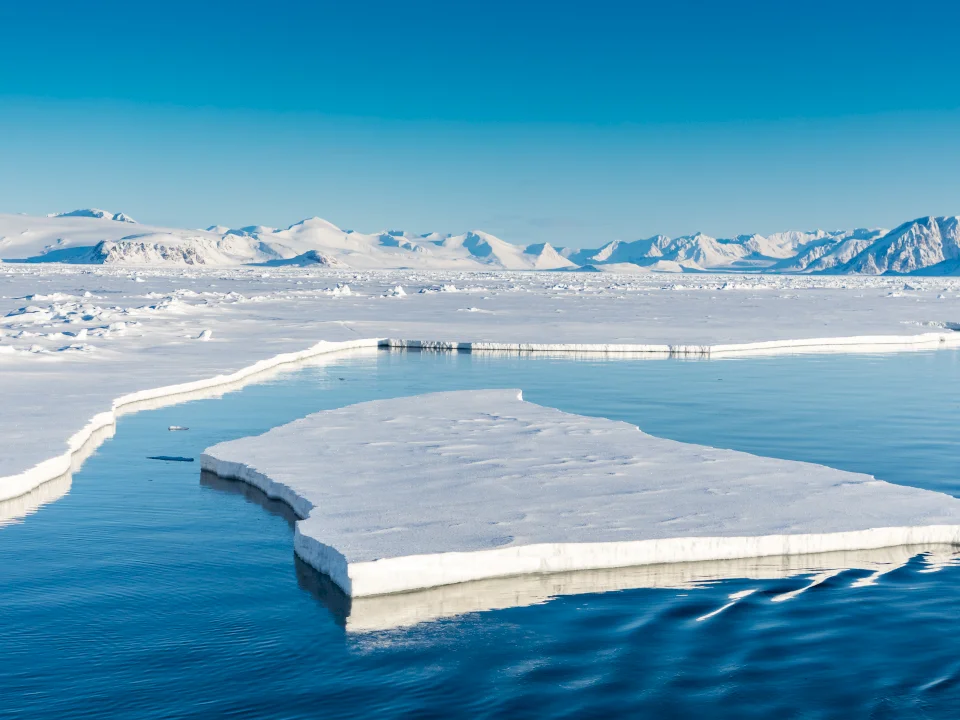
A Recent Study Explains... Why Did the Antarctic Freeze Before the Arctic?
SadaNews - Although Antarctica used to have a moderate climate and was rich in vegetation, it froze over about 34 million years ago, covered by an ice sheet that today is around five kilometers thick, according to a report from the Reuters news agency.
In contrast, the Arctic did not freeze until about 25 million years later, a disparity that has long puzzled scientists.
However, researchers now believe they have found an explanation for this mystery, after studying the terrain of Antarctica and using computational models to reconstruct its surface evolution over millions of years.
The study found that a powerful geological process led to the continuous uplift of a mountain range in East Antarctica, eventually surpassing a critical level that allowed for the formation and expansion of glaciers, thus establishing the permanent ice cover.
This resulted in the emergence of the massive ice sheet in East Antarctica at a time when global temperatures were about five degrees Celsius higher than current levels.
Consequently, the Antarctic gained its ice cover long before the long global winter that later allowed for an ice cover to form around the Arctic.
The ice sheet over East Antarctica was already settled by the beginning of the geological epoch known as the Oligocene, which followed the Eocene in Earth's history.
In the past, Antarctica was part of the ancient supercontinent Gondwana, which also included landmasses that now form Africa, South America, Australia, the Arabian Peninsula, and the Indian subcontinent.
With the movement of tectonic plates over millions of years, these continents gradually separated and drifted to their current positions.
"Mantle Waves"
Thomas Gernon, a geologist at the University of Southampton in the UK and a leader of the study published in the journal Science, stated: "Our study shows that an ancient geological process that began over 160 million years ago during the separation of Africa from Antarctica, and continued for tens of millions of years, is what determined when and where major ice sheets on Earth could form during the transition between the Eocene and Oligocene epochs about 34 million years ago."
He added that this period witnessed the transition from a warm greenhouse-like climate to the cooler phase that the planet currently experiences. Antarctica remained connected to Australia and South America for tens of millions of years after its separation from Africa, before later splitting from them as well.
The geological process referred to by Gernon is known as "mantle waves," which are slow-moving disturbances that arise from deep within the Earth during the breakup and separation of continents.
As these waves moved through the mantle beneath Antarctica, they caused the formation of a vast plateau topped by the Gamburtsev Mountains, a mountain range located in the central part of East Antarctica.
Although these mountains rise to about 3,390 meters, they are now buried beneath the largest ice sheet on Earth.
The researchers noted that erosion factors and the uplift caused by these mantle waves gradually raised the terrain to levels sufficient for ice stability, even under a globally warmer climate than present.
Climate and Terrain Interaction
The geologist from the University of Southampton who co-led the study, Theia Hinks, said the findings highlight the interaction between climatic changes and changes in terrain.
Thomas Gernon explained that by the end of the Eocene epoch, the necessary elevation for the formation of a permanent ice cover in Antarctica ranged between 1.5 and 2 kilometers above sea level.
The study's models indicated that vast areas of East Antarctica surpassed this level about 45 million years ago.
He added: "Just as temperatures decrease as we ascend to the peak of a tall mountain, higher elevation areas are more capable of retaining snow year-round. We found that before Antarctica was covered with ice, the area of the Gamburtsev Mountains significantly expanded above the critical level needed for ice sustainability. About 34 million years ago, nearly 90 percent of the area had surpassed this level, compared to only about a third 60 million years ago."
The situation was different in the Arctic; glaciers experienced expansion and retreat over the past 50 million years, but the large ice sheets did not settle there until less than 10 million years ago.
This is because the Arctic does not have any actual land mass; it is located in the middle of the Arctic Ocean, meaning there are no elevated terrains that could reach the necessary threshold earlier for permanent ice formation.
Gernon stated: "It was essential for the climate to become cooler due to decreased atmospheric carbon dioxide concentrations before permanent ice could form at lower elevations."
 Follow the latest Sada News via Google News
Usernames on WhatsApp Spark Debate Between Privacy and Fraud Risks

10 Films That Marked the First Half of This Year

A New Apple System Monitors Fraud Indicators Before Sensitive Transactions

New Drug Gives Hope to Pancreatic Cancer Patients

How to benefit from taking vitamins and dietary supplements?

Study: Experimental Drug Promises Treatment for Patients with Life-Threatening Respiratory...

A Recent Study Explains... Why Did the Antarctic Freeze Before the Arctic?
